
Many projects selected for the ICT Startup League aim for overseas expansion. However, Toyeight Holdings Inc. stands in a slightly different position. The very catalyst for its founding lies in the educational challenges on the ground in Southeast Asia, and the region is already the company's base of operations.
Their selected project is "Comprehensive Preschool Support Utilizing AI Developmental Evaluation." It aims to build a comprehensive preschool support model for children before they enter elementary school, using AI-driven digital developmental screening and early intervention programs optimized for individuals. Simply put, it scientifically "visualizes" the developmental status of preschool children to provide personalized learning and support for each child.
Developmental screening is an objective evaluation of a child's physical and mental development—including language, motor skills, and social interaction—through play with blocks and toys and interviews compared to age-appropriate milestones. In Japan, it is frequently conducted during routine check-ups like the 3-year-old health exam. While it aids in detecting developmental disabilities, its broader purpose is to deeply understand the child by grasping their current developmental stage and identifying their strengths and weaknesses. This results in better guidance and support for parenting and education. Toyeight is dedicated to the evolution and popularization of this developmental screening in Southeast Asia.
The focus on Southeast Asia is heavily influenced by the career of co-founder Masaki Ishibashi. After graduating from university, he worked for a quasi-governmental organization under the Ministry of Foreign Affairs that manages Japanese schools abroad. He says that being shocked by the state of primary education in Southeast Asia during that time became the formative experience that led to his entrepreneurship. What was this life-changing shock? We asked him about the details of the business.
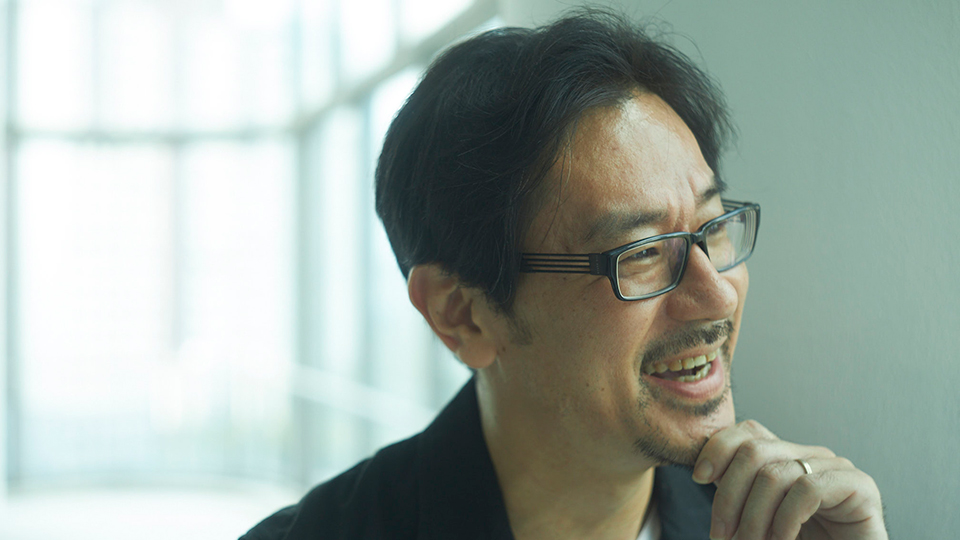 Masaki Ishibashi, Co-founder of Toyeight Holdings Inc.
What kind of organization was the quasi-governmental body under the Ministry of Foreign Affairs where you worked after graduation?
Ishibashi: It's called the Japan Overseas Educational Services (JOES). It's an organization that provides all kinds of support related to the education of children of overseas employees, including Japanese schools worldwide.
And it was there that you were shocked by primary education in Southeast Asia?
Ishibashi: Yes. There was an experimental introduction of immersion education (immersion programs), where various subjects are taught in English, at a Japanese school in Singapore. I applied for the project manager position and was hired. Part of the job involved researching the educational situation in Singapore, and the reality I saw back then was shocking...
Specifically?
Ishibashi: In Singaporean elementary schools at the time, teachers held canes during class. There was a strong mindset that "children must obey the teacher," and disobedience resulted in corporal punishment. This was about 25 years ago, and such sights have disappeared in modern Singapore, nor did it happen at the higher education level even then. But if that was the case in Singapore, which was advanced within Southeast Asia, you can imagine what it was like in other countries. Teachers were treated more like babysitters, and some were of questionable quality as educators. There was no sense of student autonomy in the classroom; the priority was simply for them to be quiet. This shocked me. Conversely, I also gained a conviction that "if primary education changes, Southeast Asia will grow exponentially."
That sounds very different from Japanese primary education.
Ishibashi: I feel that one of the assets Japan has left is its primary education. I have rarely seen basic education in other countries that so thoroughly includes discipline, such as cleaning up after oneself. While Singapore has been focusing on primary education recently, Japan still has an advantage in terms of accumulated experience, data, and the quality of its teachers.
So, how did that "shock" lead to starting a business?
Ishibashi: Through my work at the foundation, I discovered the joy of working abroad. After finishing my duties at the Japanese school, I moved to a news agency that reported on Asian economic news while stationed overseas. This experience proved useful when I later moved to a consulting group. I started as a researcher, but eventually, as the person in charge of Southeast Asian business strategy, I became involved in projects across various industries.
So you didn't start the business immediately.
Ishibashi: No. The catalyst for the startup came during my time in consulting. For one, I had just had a child of my own, but I couldn't quite visualize what they should learn or what kind of job they should pursue. When we were children, there was a single track: "Go to a good university and then a big company." Personally, I hated that track (laughs). But today, that single track isn't necessarily the only correct answer. I found myself lost on what my child should be learning.
A change in your own life stage was one of the reasons.
Ishibashi: The other reason was a project I handled in consulting around the same time for a Japanese company expanding into Southeast Asia. It involved developing playgrounds designed to develop children's talents as an educational business. It was rewarding for me as I was thinking deeply about primary education and parenting. Unfortunately, the project was withdrawn due to the impact of the COVID-19 pandemic. I felt it was a waste, so I decided to co-found a business with my current partner, who shared similar feelings about parenting and education, effectively taking over the project. We were motivated by the idea that by doing it ourselves, we could install sensors in the playgrounds to visualize a child's developmental progress, talents, characteristics, and what they are truly passionate about—offering it as a more evolved system.
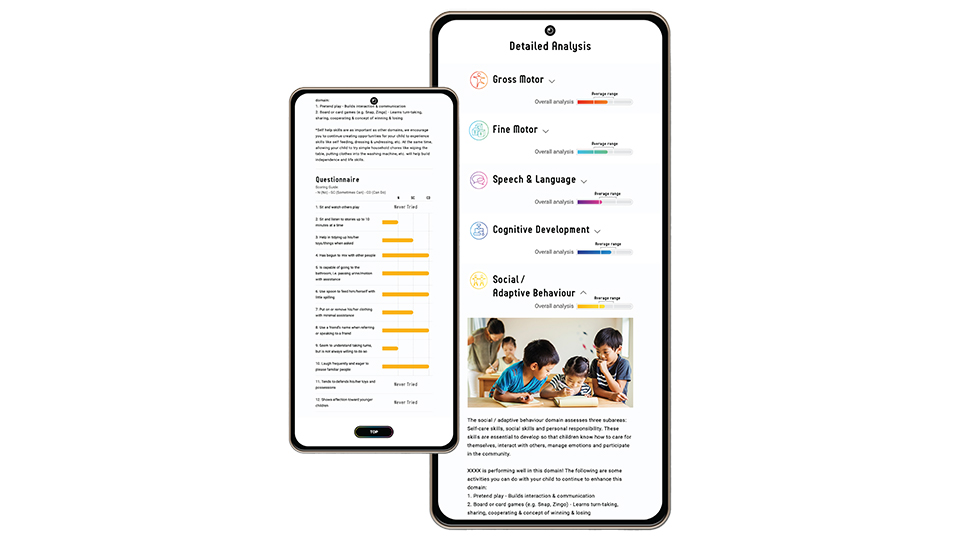 Processing score results in the cloud to issue screening reports
By starting this business, you are now personally proving the conviction you once felt: "If primary education changes, Southeast Asia will grow exponentially."
Ishibashi: Yes. Our initial motivation was to use sensors and cameras to measure how children play and use AI analysis to help parents find what their child is truly passionate about. If parents can identify what their child loves and is absorbed in at the earliest stage possible, it becomes easier to set a direction for parenting and education and provide advice for their future career paths.
Why did the business specifically pivot to focusing on developmental screening?
Ishibashi: To realize this idea, we needed a lot of data. However, if a newly founded startup says, "Please send us videos of your child playing, and we'll diagnose them," people would be suspicious and wouldn't send anything. So, we decided to first specialize in solving a social issue. Southeast Asian countries were still lagging in the field of developmental screening.
Which country did you start in?
Ishibashi: Malaysia. The lack of a formal developmental screening system was a significant social issue there. There were only about five specialists in the capital, Kuala Lumpur, resulting in a 1-to-3-year waiting list and high diagnostic costs. Meanwhile, the Malaysian government at the time was focused on solving social issues with advanced technology and offered preferential policies in terms of business attraction and subsidies. So, we decided to participate by applying our technology to developmental screening. As a result, Malaysia addresses its social issues, and we gain access to various types of data.
So it was a win-win situation.
Ishibashi: Yes. However, once we got there, we realized that in countries without developmental screening, even if a child has developmental delays, people around them often don't acknowledge it, creating a reality where it appears as though there is no developmental gap...
It must have been a problem left untouched until then.
Ishibashi: I think there was also a lack of understanding among parents and teachers, who didn't know what to do even if they wanted to solve it. Therefore, our business became not just about conducting screenings but also providing solutions to the problems identified.
Specifically, what methods do you use for screening and solutions?
Ishibashi: First, we use a smartphone to give the child a task that takes about 20 minutes. We capture that with the camera and output a screening report on the smartphone based on the task's success or failure. We have built an algorithm that analyzes images and audio—such as hand and finger movements and eye-brain coordination—and combined it with Japanese developmental screening data. The key feature is that it can provide high-precision screening results even without a specialist present.
That makes developmental screening much more accessible.
Ishibashi: Furthermore, if a delay is found in the screening results, we provide early intervention programs based on the content or, in some cases, immediately refer them to a doctor. We want to further evolve this developmental screening through the ICT Startup League.
 Screening proceeds funly in a game format. High completion rate even without experts.
What is the future outlook for the business?
Ishibashi: Having successfully commercialized in Malaysia, we are now expanding into other Southeast Asian countries. In many respects, Singapore is the standard for Southeast Asia, so we want to produce results at the same level as the official developmental screening tools used in Singapore through comparative verification experiments.
What are the key points for achieving that?
Ishibashi: False negatives and false positives. Children with developmental delays being overlooked, or conversely, children with no issues being labeled as having a delay. We must raise the sensitivity and specificity to the same level as a doctor's diagnosis.
That sounds like a high hurdle.
Ishibashi: Our tool is not a medical device, but if it doesn't produce the same results as a doctor, it won't gain trust. Regarding sensitivity and specificity, we don't want to just diagnose uniformly based on results; we want to incorporate the flexible and adaptive judgment criteria and data interpretation of doctors into the algorithm to adjust the cut-off values (the numerical threshold that separates "positive" from "negative" or "normal" from "abnormal"). By analyzing and adjusting this according to the characteristics of each country and region in Southeast Asia, we want to establish a standard model applicable to the entire region.
What about expansion in Japan?
Ishibashi: I do want to do it in Japan, but compared to the rest of Asia, Japan already has a solid system for developmental screening. Given our current company size, expanding in Southeast Asia comes first. However, if we can establish a digital developmental screening ecosystem in Southeast Asia, I believe we can offer it to Japan as well. In rural Japan, it might become difficult to conduct developmental screenings as we always have due to labor shortages caused by population decline.
What are your impressions of participating in the ICT Startup League?
Ishibashi: The scale of enthusiasm is different from other accelerators. You get the chance to actually talk to leaders in various fields on many occasions, and they generously share information or listen to your opinions and give feedback. I feel it is very interactive.
I heard you also participated in the League Academy.
Ishibashi: Yes. There are all sorts of people in the League Academy, and they answer Q&A sessions very seriously. There is much to gain from those discussions even if the answer isn't directed at me. Many accelerators, for better or worse, only involve interaction with a single person in charge, and the relationship often ends when the period is over. In that sense, the ICT Startup League has "depth." I clearly see why it was named a "League" in terms of interactivity and depth. It makes me want to be a member of the league, and not just belong to it, but eventually be in the spotlight as a speaker at the Academy.
You gave an impromptu presentation at the Value-Up Session of the 1st Startup League Academy.
Ishibashi: On that day, a slot in the Value-Up Session suddenly opened up, so I raised my hand and volunteered to present. I thought it was a chance for participants to remember my name. To be honest, due to lack of preparation, the content was a mess, but several people reached out saying, "That sounds interesting, tell me more," and I've even met with them since. Some were interested in our strength in Southeast Asia. I hope people in the ICT Startup League remember that "Toyeight is the one for Southeast Asian projects."
Thank you. Finally, please tell us about your future dreams, including your business.
Ishibashi: In one sentence, I want to create a "world where all children are accepted as they are." I believe developmental disabilities are, in a way, strongly characterized by a "mismatch" with the uniform frameworks created by modern society. It's a pity for children to be bound by those frameworks. Every child has some kind of talent. I want to create an ecosystem that realizes a world where all children can exercise their respective talents, and I want people to say, "That's Toyeight's business."
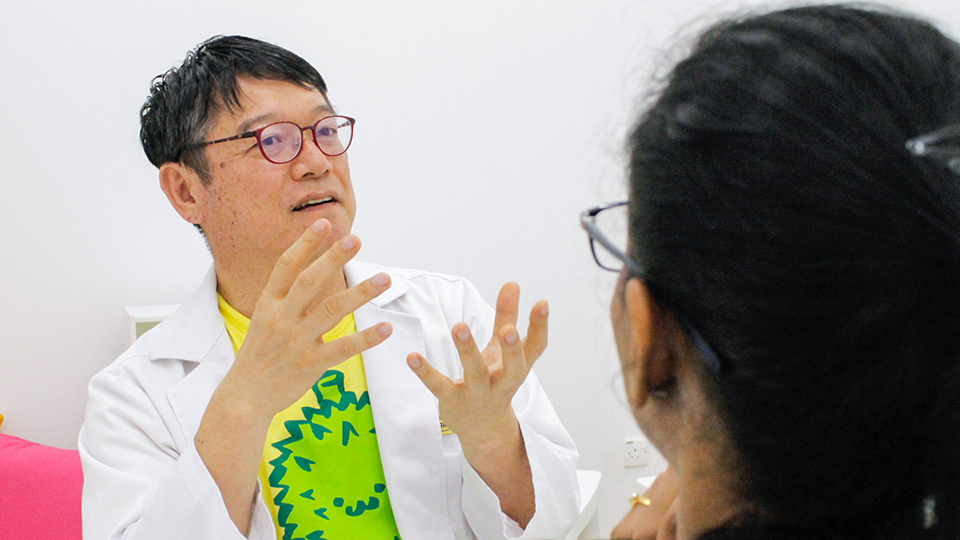 Developmental specialists are stationed in-house to support therapy at Japanese schools
Editor's Note
Mr. Ishibashi jumped overseas immediately after graduating from university. However, he says that until just one year before that, he had no intention of working abroad at all.
"In university, I was in the varsity baseball club and served as vice-captain. At the time, I was devoted to baseball, aiming to be the 'youngest manager to appear at Koshien'."
As graduation approached, he began to wonder, "If I take away baseball, what is left of me?" At that moment, he happened to find a job listing for the Japan Overseas Educational Services. He applied to test himself, thinking it "looked interesting."
As a result, he discovered the joy of working overseas and, after his coordination work ended, he chose to live abroad rather than return to the path of baseball.
This episode teaches us that life can be changed significantly by a single moment or a single decision.
■ ICT Startup League
This is a support program that started in FY2023, triggered by the Ministry of Internal Affairs and Communications' "Project for Supporting Seed-stage R&D for Startup Creation."
The ICT Startup League supports startups through four pillars:
1. R&D Expenses / Hands-on Support
Up to 20 million yen in R&D expenses are provided in the form of subsidies. In terms of hands-on support, the selection and evaluation committee members who were involved in choosing the league members continue to support and promote their growth even after the selection. For companies that the committee members evaluated as "must-select," a support system is built where the committee members themselves provide continuous support, such as advice on business plans and providing growth opportunities—much like "fan-driven" support.
2. Discovery and Cultivation
We provide opportunities for learning and networking that promote the business growth of league members.
We also work to discover those who aim to start a business in the future, aiming to expand the base of entrepreneurship.
3. Competition & Co-creation
The program is a place for positive competition, like a sports league, where startups learn together and strive to win the necessary funding (up to 20 million yen). We also provide a space for co-creation where league members collaborate to expand their businesses through various opportunities, such as sessions with selection and evaluation committee members.
4. Communication
We collaborate with the media to share the initiatives of league members! By making their businesses known to many people, we aim to expand opportunities for new matching and chances.
■ Related Websites
Toyeight Holdings Inc.
/
Toyeight Holdings Inc. (LEAGUE MEMBER)
/
ICT Startup League
💡 Read Next
After exploring the on-the-ground stories of our startups, discover the "big picture" from the top leaders driving Japan's startup ecosystem.
▶︎ Experts Discuss How Startups Should Compete in the Future
For more details on STARTUP LEAGUE's startup support, please see here.