
Between observations from space via satellites and aerial photography via aircraft, there exists a massive "void" in the current Earth observation data market.
Satellites can cover vast areas, but they often suffer from low resolution. Furthermore, because they orbit the Earth, it is difficult to capture images at the exact moment you want to "see this specific location right now." On the other hand, aircraft offer high-resolution imaging, but the charter costs are astronomical, making continuous monitoring or frequent data updates unrealistic.
As the "missing link" to resolve this dilemma, HAPS (High Altitude Platform Station)—platforms utilizing the stratosphere at an altitude of 20km—are attracting global attention.
In the midst of this HAPS development race, SkySense LLC is challenging the status quo by daring to take an "airship" approach rather than the mainstream fixed-wing aircraft route.
Inheriting technology from JAXA (Japan Aerospace Exploration Agency) and redefining it with modern robotics and AI, their next-generation airship is set to fundamentally change Japan's aerial infrastructure, ranging from administrative digital transformation (DX) to national defense and disaster response.
We spoke with CEO Addin Pavel, a uniquely talented engineer born in Kazakhstan who studied robotics in Japan and now holds Japanese citizenship, about his career and his grand vision.
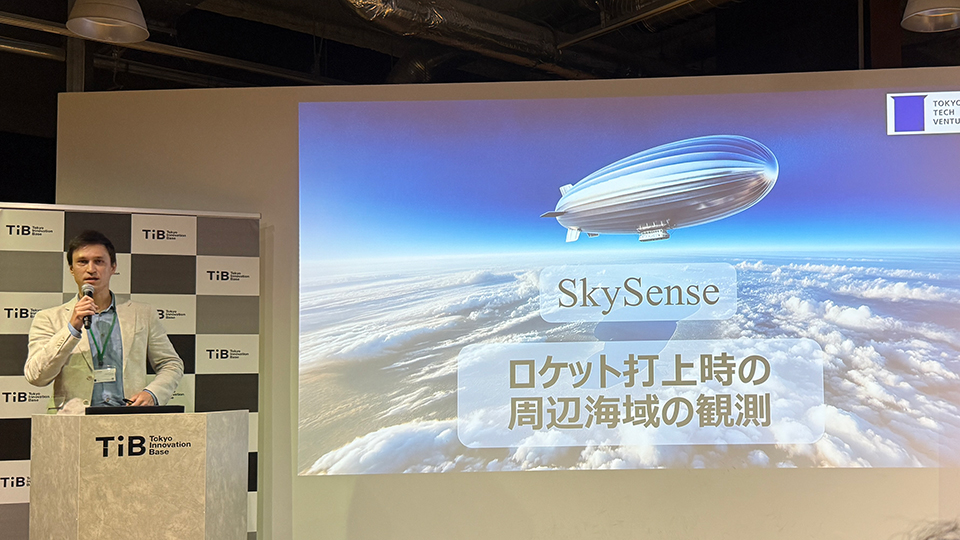 Mr. Pavel presenting on PoC at MUGENLABO UNIVERSE
I'd like to start by asking about your background. I understand you are originally from Kazakhstan and came to Japan in 2008.
Pavel: Yes. After graduating from high school, I came to Japan using the MEXT (Ministry of Education, Culture, Sports, Science and Technology) scholarship program. The catalyst was my mother, who worked as a simultaneous interpreter. She learned about the scholarship while interpreting at an event for the Japanese Embassy and suggested, "There's a program like this, why don't you try applying?"
What image did you have of Japan at that time?
Pavel: Honestly, I hadn't studied Japanese, nor was I particularly knowledgeable about Japanese culture like anime or martial arts, or deeply longing to go there (laughs). I hadn't even received specialized engineering education in high school. I applied purely out of curiosity, thinking, "It would be lucky if I got in."
That's surprisingly lighthearted for a start. Still, coming to Japan to study engineering at a university without prior Japanese study must have been a significant hurdle.
Pavel: It was incredibly difficult. When I arrived, I could only read Hiragana and couldn't hold a conversation at all.
The scholarship's undergraduate program mandates a one-year preparatory course to intensively study Japanese and basic subjects before entering university. During that year, I spent every day drilling Japanese along with international students from all over the world. Thanks to that intense study, I built a foundation and subsequently entered the Tokyo Institute of Technology to major in "Mechanism Design."
Could you explain specifically what Mechanism Design entails?
Pavel: Simply put, it's the study of "karakuri" or mechanical linkages. We design and analyze how machines move and how forces are transmitted through mechanisms. Since I was a child, I loved building things from scratch with LEGO blocks. Rather than tinkering with cars, I was the type of kid who was obsessed with thinking up new structures. So, I felt that Mechanism Design, which is directly linked to robot hardware development, was the perfect field for me.
How did you build your career after finishing graduate school?
Pavel: After completing my master's degree, I joined Yaskawa Electric, thinking "this is the place for robots." I worked in their development research laboratory on mechanism design for creating new robots, honing my foundations as an engineer. Later, in 2019, I moved to Sony to join their AI Robotics project, which was still in its startup phase. As the first employee there, I gained experience akin to working in a startup but within a large corporation, handling everything from setting up the lab to organizational building and recruiting.
After your career at Sony, why did you decide to launch a startup focused on "airships"? Did you have this concept in mind for a long time?
Pavel: To be honest, it didn't start as a business idea. It began with a personal romantic notion: "I want to ride an airship" (laughs). I loved the airships that appear in Studio Ghibli films and steampunk worlds, and my starting point was the pure question, "Why aren't airships flying in the modern era?"
But as I analyzed airships calmly from an engineering perspective, I realized that this wasn't just a romantic idea—it was an extremely rational solution to modern challenges.
Rational in what way?
Pavel: Currently, the development race for Stratospheric Platforms (HAPS) is intensifying, and the mainstream approach pursued by major telecommunications carriers is the airplane type (fixed-wing aircraft). However, airplanes must constantly catch the wind on their wings to generate lift, consuming a lot of energy just to keep flying. Also, while they can circle, they cannot stay in one fixed point in the sky.
In contrast, airships use buoyancy from helium gas, so the "energy required to float" is zero. This results in overwhelmingly better energy efficiency, and they can hover completely still in the air, allowing for "fixed-point observation" where the camera remains focused on a single point.
I see. However, keeping "still" in the windy sky seems to require very advanced control. Is that where your expertise in robotics and mechanism design comes into play?
Pavel: Yes, exactly. To prevent the airship from being swept away by the wind, we need to precisely adjust the direction and output of the propellers to match the ever-changing wind conditions, constantly maintaining balance. It’s not just a balloon; we design and control it as a precision machine. In that respect, my knowledge of mechanism design and experience in robot development at manufacturers form the core of our current technology.
I’ve heard it’s also advantageous in terms of safety (functional safety).
Pavel: Yes. With airplane types, if the engine stops or energy runs out, there is a risk of crashing. Airships, however, float due to buoyancy. Even if the propulsion system fails, they won't fall; they will simply descend slowly. This "non-crashing" characteristic is a huge advantage when obtaining certification from aviation bureaus.
If it's that rational and has so many benefits, it seems strange that it hasn't become more widespread. Why hasn't this kind of application been realized until now?
Pavel: There are two main reasons. One is the technological barrier.
In a project JAXA conducted in the 2000s, the limitations of battery technology at the time became a wall. The energy density wasn't sufficient to stay airborne at night when solar power generation wasn't possible. Adding more batteries to compensate made the airship too huge, making it technically unfeasible.
However, now, with the evolution of lithium-ion batteries, lighter materials, and more efficient solar panels, the environment is ready to clear those technical hurdles. We are receiving technology transfers from JAXA and combining that valuable past knowledge with modern technology to realize a "practical stratospheric airship" that was once impossible.
The other reason is marketability. Back then, the main focus was on communications, and private sector demand was hard to see. Now, however, the business utilization of Earth observation data is advancing, and I believe we have all the "reasons to do it now" for it to succeed as a business.
 Airship-type HAPS (Stratospheric Platform)
When SkySense's airships are practically implemented, what specific social issues will they solve?
Pavel: What we are offering is "Earth observation data" that is higher resolution than satellites and overwhelmingly cheaper than aerial photography. Currently, the entities that need this data the most are local governments and administrative agencies.
For example, in municipal "Fixed Asset Tax Evaluation" operations. Every year, it is necessary to check for home extensions or new construction. Currently, this involves taking expensive aerial photos or having staff walk around to investigate. Similarly, in "Forest Management," understanding tree species and heights requires enormous labor. Using our data, these can be identified automatically and cheaply via AI, significantly reducing administrative costs.
That truly is "DX from the sky." As Japan is a disaster-prone country, expectations for disaster prevention must also be high.
Pavel: Yes. National policy calls for "grasping the situation within 2 hours of a disaster," but immediately after an earthquake or during severe weather, airplanes and helicopters often cannot fly, and satellites can't take photos unless the timing aligns.
In our vision, we plan to deploy 45 to 50 airships nationwide. This aims to create a system where, no matter where a disaster occurs in Japan, we can reach the airspace above the site within 2 hours and deliver real-time video. From above the clouds (the stratosphere), we are less affected by bad weather and can continuously monitor wide areas, which should greatly contribute to the initial response for rescue operations and recovery planning.
I see. Overcoming technical barriers to "stay at a fixed point for a long time" directly translates to "infrastructure protecting public safety" in a disaster-prone country like Japan. The "reason to do it now" you mentioned earlier makes perfect sense. With such surveillance capability, it seems applicable to defense and national security as well.
Pavel: Exactly. Considering the recent international situation, monitoring borders and remote islands is an urgent issue. An airship that can stay aloft for six months once launched, watching borders unmanned 24 hours a day, 365 days a year, can serve as an "aerial watchtower" that raises Japan's defense capabilities.
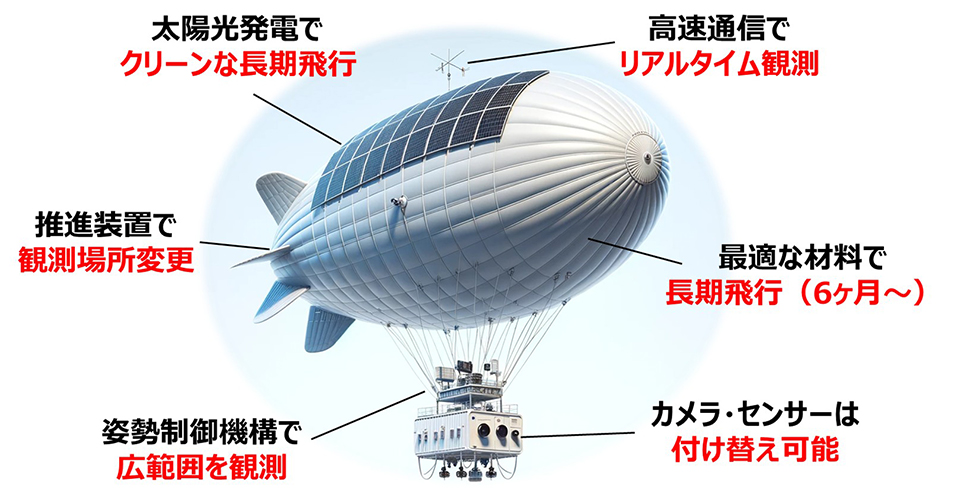 Components of the Airship-type HAPS
You were selected for the ICT Startup League this year. Please tell us about your future development roadmap.
Pavel: Currently, we are developing element technologies while proceeding with seed round fundraising. We are developing an MVP for a small airship while simultaneously conducting high-altitude photography tests using high-altitude balloons to accumulate verification data for high-resolution imaging. After that, we will gradually increase the size of the airship, adding necessary functions and conducting repeated flight tests.
Our goal is to reach mass production around 2028 to 2029. It is a very ambitious schedule for aerospace development, but we want to maintain the speed of a startup and clear hurdles like certification acquisition early on.
Selection for the League seems to be an accelerator for that.
Pavel: Yes. In deep tech areas like aerospace, especially at a stage where a prototype hasn't been completed, the reality is that fundraising and finding collaboration partners are often difficult. In this context, being selected for a program by the government (Ministry of Internal Affairs and Communications) provides a huge boost in terms of external credibility. Using this "first track record" as a foothold, I want to expand fundraising and partnerships with local governments.
With technological possibilities and business opportunities now aligned, there is significant meaning in taking on this challenge in Japan. Finally, may I ask again: you mentioned you came to Japan out of "curiosity," but are you glad you came to Japan?
Pavel: I think it was an incredibly good decision. Now, I feel like I can't live in any other country (laughs).
Actually, I acquired Japanese citizenship about five years ago. I love Japanese food and culture, and I think it's a truly livable country. When I think that this wouldn't have happened without my mother's recommendation, I feel a strange sense of destiny.
To protect and enrich the skies of this country, my second home, with our technology. That is my dream and SkySense's mission.
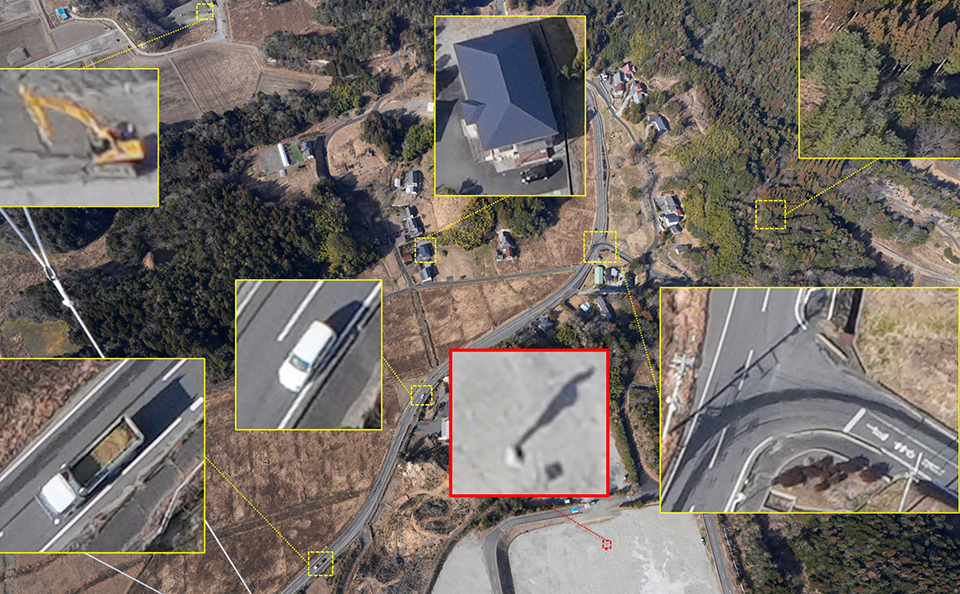 Demonstration results of high-resolution Earth observation
Editor's Note
"I want to ride a Ghibli airship"—Seeing Mr. Pavel speak with eyes shining like a young boy, contrasted with the precise physical calculations and market strategies that followed, the interview team was instantly captivated. Having come from Kazakhstan, overcome the language barrier, and honed his skills at prestigious Japanese universities and major corporations, he seemed to believe in the potential of "Japanese Monozukuri" (craftsmanship) more than anyone else. The day when this man, who laughs that he "can't live in any other country anymore," builds the next generation of infrastructure in Japan's skies may not be so far away. SkySense's challenge is a beacon of hope opening a new path for Japan's stagnating aerospace industry.
■ ICT Startup League
A support program launched in FY2023, triggered by the Ministry of Internal Affairs and Communications' "Program to Support Exploratory Research and Development for Startup Creation."
The ICT Startup League supports startups through four pillars:
1. R&D Funding / Hands-on Support
Up to 20 million yen in R&D funding is provided in the form of grants. In addition, evaluation committee members who were involved in the selection of league members continue to stay close after selection to promote growth. For companies that evaluators "absolutely want to select," a "fandom-like" support system is built where the evaluators themselves provide continuous support, such as advice on business plans and providing growth opportunities.
2. Discovery & Incubation
We provide opportunities for learning and networking to promote the business growth of league members.
We also expand our discovery efforts to those aiming to start businesses in the future, aiming to broaden the base.
3. Competition & Co-creation
It serves as a venue for positive competition like a sports league, where startups learn together and challenge each other to win the necessary funding (up to 20 million yen). We also provide a place for co-creation where league members can collaborate to expand their businesses through various opportunities such as sessions with evaluation committee members.
4. Promotion
We promote the initiatives of league members in collaboration with media! By letting more people know about their businesses, we aim to expand opportunities for new matching and chances.
■ Related Websites
SkySense LLC
/
SkySense LLC (LEAGUE MEMBER)
/
ICT Startup League
💡 Read Next
After exploring the on-the-ground stories of our startups, discover the "big picture" from the top leaders driving Japan's startup ecosystem.
▶︎ Experts Discuss How Startups Should Compete in the Future
For more details on STARTUP LEAGUE's startup support, please see here.