Towards the end of his third year in elementary school, the Great East Japan Earthquake struck. The media reported on the extensive and devastating damage. What impacted the young boy's mind the most, however, were the "rolling blackouts" carried out in the streets of Tokyo. He learned that the electricity he used as a matter of course was not something to be taken for granted. Then, due to the possibility of power shortages in the Kansai region, requests to save electricity reached the Chubu region where he lived.
"Why do things like this happen?"
This was the spark that ignited Shunsuke Mizuno's interest in energy issues—the man who would go on to found Freezo Inc. as its CEO. Now, more than ten years later, Mizuno is confronting energy problems through both research and business.
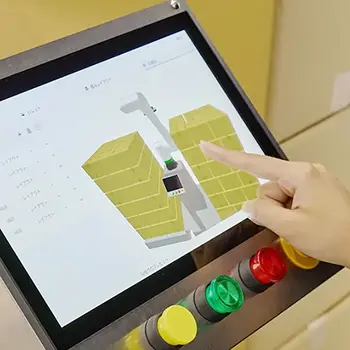
The project and research he is undertaking at the ICT Startup League is the "Development of Energy Management Systems for Refrigerated Warehouses." Simply put, he is attempting to improve energy efficiency by automatically controlling the temperature adjustment of large-scale refrigerated warehouses—installed in corporate storage and logistics facilities—using AI and mathematical optimization technology. If realized, this would revolutionize temperature adjustments that have historically relied on the experience, intuition ("gut feeling"), and standardized manuals of skilled operators, leading to significant reductions in power consumption costs for refrigerated warehouses. Furthermore, the significance of this business is immense, as utilizing cold energy storage in refrigeration units can help resolve imbalances in power supply and demand.
We spoke in detail about the contents of this business, which connects to one of Mizuno's dreams—"Energy Security"—and the path he has taken so far.
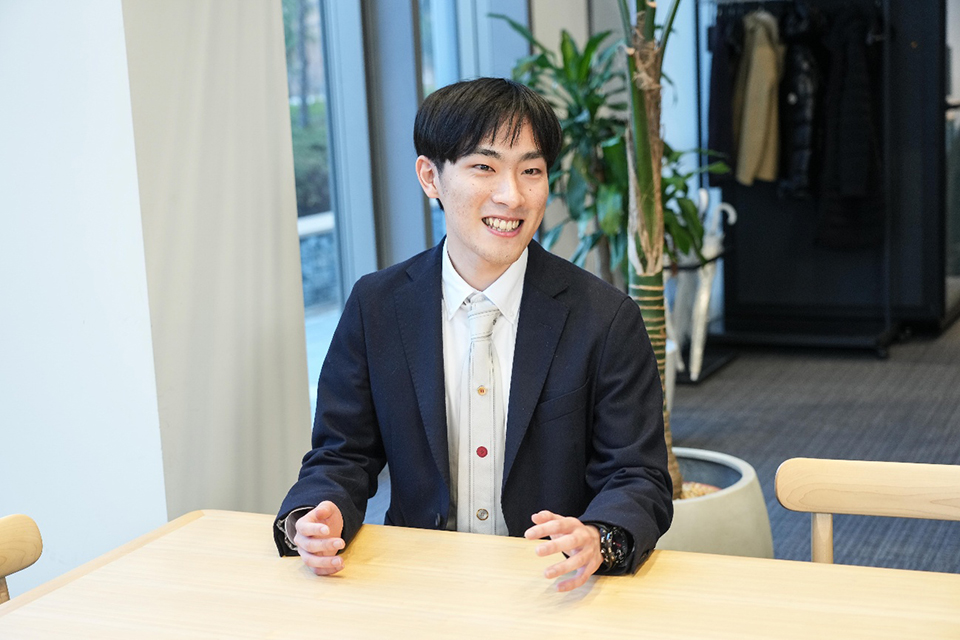 Shunsuke Mizuno, Representative Director and CEO, Freezo Inc.
I heard you became interested in energy issues during your elementary school days. How did that interest sustain itself?
Mizuno: After gaining interest following the Great East Japan Earthquake, I started visiting facilities like Chubu Electric Power's "Electricity Science Museum" in my hometown of Aichi. As I researched various things, my interest just kept growing. In the fifth grade of elementary school, I entered a "Newspaper Clipping Contest" organized by the Chunichi Shimbun with the theme "What will happen to Japan's Energy?" I received the Chunichi Grand Prize. It was a contest where you clipped and summarized newspaper articles that interested you according to a theme, and I remember it deepening my knowledge of energy.
Did you continue following energy issues after that?
Mizuno: Yes. Even when I participated in Model United Nations (an educational activity where participants act as ambassadors and diplomats to simulate actual UN meetings) in high school, I dealt with energy issues. It had a major influence on my career path decisions as well.
Specifically?
Mizuno: Since Japan has limited natural resources, in Model UN, I was thinking about how we could compete with the world in terms of energy security. However, energy issues—due to the uneven distribution of resources and the effects of global warming—are difficult to solve even when nations debate on a policy basis. I felt a great sense of powerlessness. That's when I felt this couldn't be solved without a technological breakthrough. At the time, I was hesitating between a humanities or science track for university, but this became the trigger for deciding to study engineering. Thus, I ended up researching electricity at university as well.
Even though it was Model UN, you had the experience of confronting energy issues from high school. How did you arrive at researching refrigerated warehouses from there?
Mizuno: At university, I was conducting independent research on the development of devices that generate power using snow, cold snow energy, and solar heat. While I succeeded in generating power, the output was small... so I started looking for a different approach. In that process, I focused on the fact that a system using the cold energy generated by the operation of refrigeration units for storage could become an energy resource. I feel there is potential in cold energy storage from the perspective of energy security as well. Currently, thermal power generation plays the main role in adjusting power supply and the supply-demand balance, but this technology might be able to replace it.
The advantage of thermal power is that generation can be controlled immediately by adjusting fuel input. Renewable energy sources like solar and wind are forces of nature, making them difficult to control.
Mizuno: Exactly. Since storage using refrigeration units can be utilized as "adjustment power" (flexibility) to change how electricity is used flexibly, there is a high possibility that it can take over the role of adjusting the power supply-demand balance from thermal power generation.
I now clearly see the connection between refrigeration units and energy security. It gives the impression of a business idea born precisely because you are a researcher and specialist.
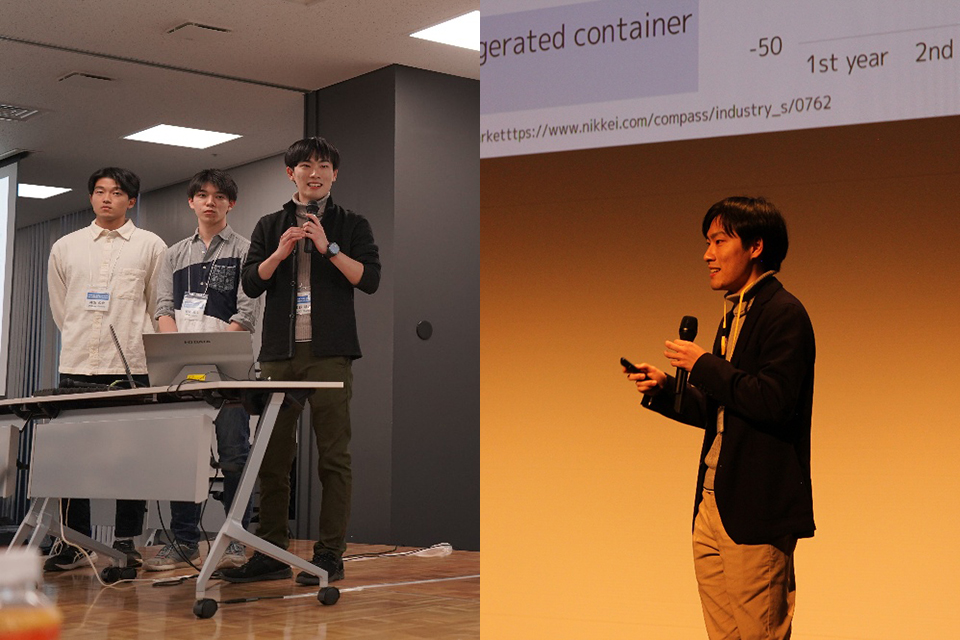 Left: Presentation at Mitou Advanced / Right: Presentation at J-StarX Program
Please tell us why you decided to pursue the "Development of Energy Management Systems for Refrigerated Warehouses," born from research, as a startup company.
Mizuno: Until high school, I had never thought about startups. However, I loved participating in various programs at university, and among them were entrepreneurship programs. I learned, albeit vaguely, that a startup was an option. As I proceeded with my research simultaneously, my desire to achieve social implementation grew stronger. I began to feel that turning it into a business as a startup would get me to "energy security" faster than research alone. Eventually, I applied to and was selected for public entrepreneurship projects, and as it became more realistic, I ended up founding the company. For me, the axis of energy security hasn't changed; it just feels like the means have shifted little by little.
How did you start moving towards commercialization?
Mizuno: First, I conducted interviews with industries that handle large-scale refrigerated warehouses, such as the logistics industry. Listening to their stories, I understood that the logistics industry also had various issues and that saving electricity in refrigerated warehouses would have a huge impact. It felt like my sense of the problem and the industry's sense of the problem were aligning.
I hear you have currently secured six companies for pilot testing.
Mizuno: Yes. We are in the middle of conducting demonstrations with the understanding of six companies, including logistics operators with bases nationwide and fisheries operators in the Tokyo metropolitan area. Even if companies are interested, there are cases where we can't get cooperation at the demonstration phase, so I want to continue looking for companies that will cooperate with us.
Please tell us the outlook for the business.
Mizuno: We aim to complete the system in another two or three years. The model is ready, but we have to build communication systems to reflect it in each company's system, so that takes time.
Are there any other technical challenges?
Mizuno: In places like warehouses, the temperature changes for various reasons, such as trucks entering and leaving. The challenge is predicting that. We know it's impossible to do perfectly, but to make a more precise system, I feel we need more information. Since this is a business, not research, major mistakes are not allowed, so attention is needed in many directions. The causes of temperature changes are things we can't know ourselves, which makes it difficult, but I want to improve accuracy while also establishing recovery methods.
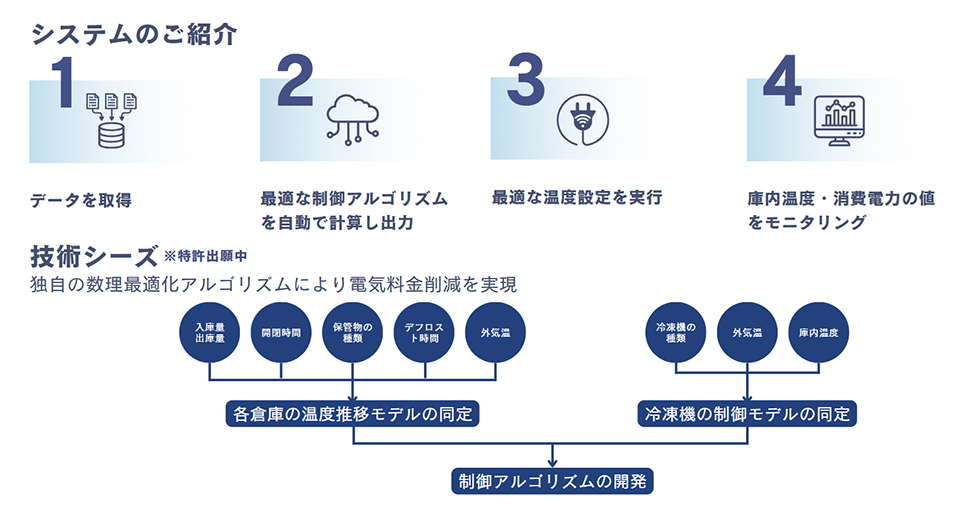 Freezo System Overview
Please tell us what you want to work on in the future as Freezo.
Mizuno: First is to properly develop and complete the energy management system for refrigerated warehouses that we are currently working on. After that, I want to spread the system to refrigerated warehouses across the country. Right now, it's automatic control of individual units, but in the future, if we can control multiple units... bundling hundreds of them together... the amount of stored energy obtained would be massive. We could realistically contribute to stabilizing the power supply-demand balance. I want to aim for the realization of a carbon-neutral society utilizing cold energy.
If that is achieved, what percentage of your dream of "Energy Security" do you image will be realized?
Mizuno: Let me see... maybe about 10% within myself. Right now, the business is within the scope of the logistics and fisheries industries, but if we can control all kinds of refrigerated warehouses in the future, I think I will have achieved the goal to some extent.
Do you have other business ideas?
Mizuno: Solving the immediate problems comes first, but in the future, I want to create new methods of power generation. It's still a vague image, and I don't have concrete ideas yet.
At that time, will you be a researcher? Or a CEO?
Mizuno: I wonder? I think that will change depending on future developments. Personally, I like the image of being an "Inventor" (laughs).
I see. Indeed, an inventor feels like it includes aspects of both a researcher and business.
Mizuno: And yet, it seems like you can move around quite freely, doesn't it? In any case, I want to explore various paths to contribute to society in the field of energy.
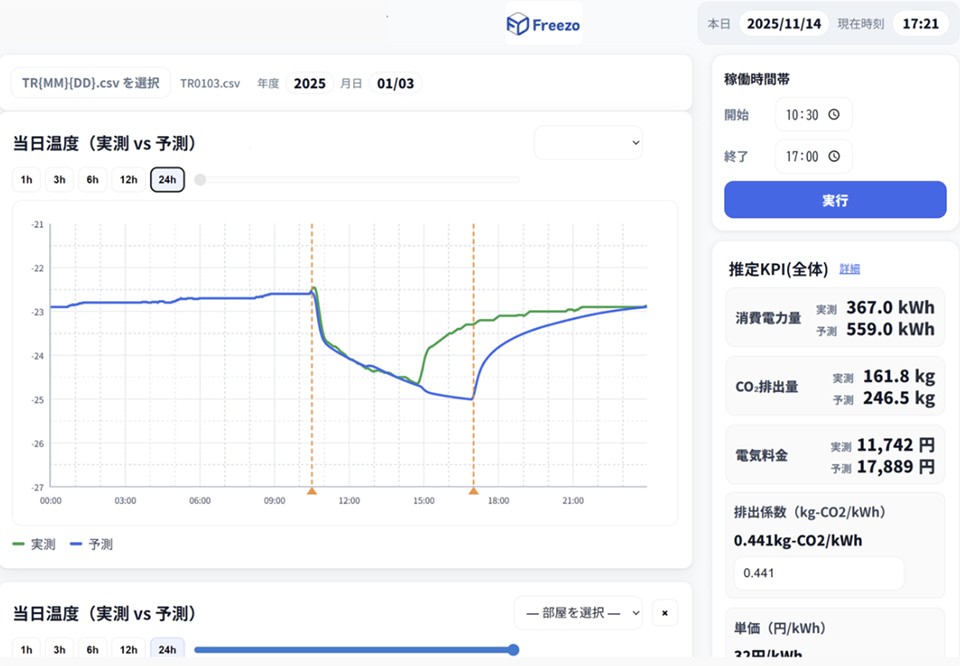 Example of Freezo simulation screen
You were selected for the ICT Startup League and participated in the academy. Do you feel there are any benefits?
Mizuno: When members gather, we talk a lot about taxes, legal affairs, internal structures, and fundraising methods involved in running a company. There are many stories that you can't gain as know-how just by living a normal life, so I'm grateful for it as a place for information exchange. I think the industry and age are factors, but many companies are in similar phases and seem to share the same sense of challenges, so I think having this kind of community is valuable.
Unlike research and business operations, that is quite a realistic discussion.
Mizuno: Since I started the business as a student, a fundamental issue is that the members, including myself, lack social experience. We don't know the "correct answer" for an organization. We know we can't just have a "student atmosphere," but many of the members are students. We are also fumbling through how to proceed with discussions with client companies, so there is a worry of "what will happen next?" Research also takes up time... There are many things I don't know what to do about regarding how a company should be.
In that respect, the exchange opportunities at the ICT Startup League seem useful. By the way, regarding "how a company should be," what specific worries do you have? Could you give us an example?
Mizuno: For example, when we have to rethink management policies, if there is a disagreement on policy among members, I don't know how to resolve it. Since everyone is discussing it without knowing the correct answer, some members start to feel anxious about that state itself. Also, I feel like basic "Ho-Ren-So" (Reporting, Communicating, and Consulting) isn't being done, and dividing tasks within the team is difficult. In such situations, figuring out the correct way to follow up with members is also a source of worry.
It's a "people" problem.
Mizuno: I think a large part of this is my own lack of management experience, so it's a challenge for the future.
Including those points, do you have any expectations for the ICT Startup League?
Mizuno: I would be happy if we could interact more casually, such as in a Slack community. Information arrives even if you are passive, and you can casually post yourself. Interactions can lead to exchanges with people you haven't met before. If something like that were possible, I feel it would lead to mutual growth.
Knowing there are people with similar worries can be reassuring, so expanding the place for exchange among business owners would be appreciated in that regard as well.
Mizuno: Yes. Because the moment I started the business, the things I had to do increased tremendously and it became very hard (laughs).
The environment and worries seem to have changed from when you were just doing research.
Mizuno: In research, I could do various things freely for my own convenience, but running a company means having to pay salaries to employees, and the worry of funds running out arises. It's a completely different kind of hardship from research, and there is some bewilderment. However, I have a nature where I can think "This is fun!" no matter what I do. It's an experience I can only have now, and I want to work hard believing it will have a positive influence on me in some way.
Editor's Note
"I have a nature where I can think 'This is fun!' no matter what I do," says Mr. Mizuno. Perhaps because of this, he has many hobbies, including mountain climbing, watching baseball (a Chunichi Dragons fan), listening to music (he likes Western music from the 1980s), visiting castles (he loves mountain castles, and his favorite is Takatori Castle in Nara), geography, history, railways, and physics—truly diverse.
However, amidst so many "likes," why has his love for "energy" remained number one since his elementary school days?
"I suppose it's because it's packed with things I like. Energy issues involve utilizing knowledge from various fields like geography, world affairs, history, and physics."
He is truly a person who embodies the saying, "What one likes, one will do well."
■ICT Startup League
This is a support program that started in FY2023, triggered by the Ministry of Internal Affairs and Communications' "Start-up Creation-type Germination Research and Development Support Project."
The ICT Startup League supports startups through four pillars:
1. R&D Funding / Hands-on Support
Up to 20 million yen in R&D funding is provided in the form of a grant. Additionally, in the hands-on support, the selection and evaluation committee members who were involved in selecting the league members will continue to stay close after selection to promote growth. For companies that the evaluation committee members rated as "must-select," a support system akin to "enthusiastic advocacy" (Oshikatsu) is built, where the committee members themselves provide continuous support such as advice on business plans and providing growth opportunities.
2. Discovery & Incubation
We provide opportunities for learning and networking that promote the business growth of league members.
We also deploy initiatives to discover people aiming to start businesses in the future, aiming to expand the base.
3. Competition & Co-creation
It is a place for positive competition like a sports league, where startups learn together and, through friendly rivalry, compete to win the necessary funding (up to 20 million yen). We also provide a place for co-creation where league members can collaborate to expand their businesses through various opportunities such as sessions by the selection and evaluation committee members.
4. Outreach
We will broadcast the initiatives of league members in cooperation with the media! By letting many people know about the businesses, we aim to expand new matching opportunities and chances.
■Related Websites
Freezo Inc.
/
Freezo Inc. (LEAGUE MEMBER)
/
ICT Startup League
💡 Read Next
After exploring the on-the-ground stories of our startups, discover the "big picture" from the top leaders driving Japan's startup ecosystem.
▶︎ Experts Discuss How Startups Should Compete in the Future
For more details on STARTUP LEAGUE's startup support, please see here.