The condition of a mother and fetus during pregnancy is often described as a "black box," difficult for even specialists to fully grasp or predict. one reason for this is that information in existing electronic medical records is merely a record of "points"—checkups that happen only once every few weeks. Dr. Keisuke Ito, Representative Director of nonat Inc., who has experienced medical settings in some of the world's poorest countries as an obstetrician, is tackling this issue with an approach combining "AI and time-series data." We followed the challenge of these doctors who attempt to transcend borders and barriers of medical resources by analyzing vast amounts of raw data—which is difficult for humans to measure or interpret—and turning these "points" into "lines."
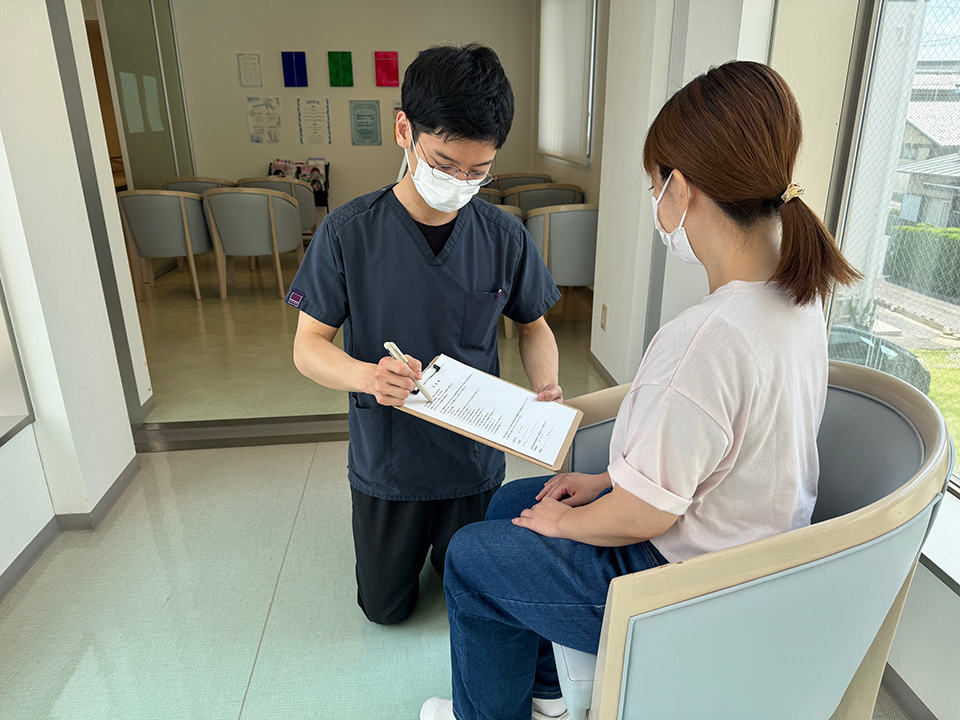 Clinical Research Site: Representative Ito explaining the clinical research consent form
I understand that after working as an obstetrician in Japan, you went to the UK in 2021 to study public health. This was while COVID-19 was spreading worldwide; what was the background behind that choice?
Ito: Since I was young, I had a desire to "use medicine to challenge myself overseas." Studying public health, which addresses global issues, is a strong option for doctors with international aspirations. Although it was under the unique circumstances of the pandemic, it wasn't that the pandemic pushed me to do it, but rather that I put a plan I had held for some time into action.
After studying public health, you worked as an obstetrician in the Republic of Sierra Leone, correct?
Ito: While I was in the UK, I was invited through a connection, which led to the opportunity. The Republic of Sierra Leone is one of the poorest countries in the world, located in West Africa, and is sometimes called "the country with the shortest life expectancy." It is an environment completely different from Japan, with food shortages, collapsed infrastructure due to civil war, and an insufficient medical system. Infectious diseases are common, and according to some statistical data, the infant mortality rate is the highest in the world, and the maternal mortality rate is about 500 times that of Japan.
500 times... That is a shocking number.
Ito: As an obstetrician, I spent about three months in Sierra Leone delivering babies and performing surgeries such as C-sections. When facing the local people as a doctor, I saw many diseases not seen in Japan and many cases where mothers and babies lost their lives. It was not uncommon for people around me to have lost several family members or relatives in childbirth or infancy.
I understand you participated in a "digital health project targeting pregnant women" in Sierra Leone and subsequently in the Republic of the Congo.
Ito: In the project, we went to rural villages several hours by car from the capital to conduct checkups and interviews with pregnant women who found it difficult to visit hospitals. It was an activity that included elements of fieldwork in addition to medical practice. Using a dedicated device developed by a company based in Congo, we used data to grasp the condition of the "perinatal period"—from 22 weeks of pregnancy to less than 7 days after birth. We checked for abnormalities affecting the lives of mothers and babies, while simultaneously verifying the usability and improvement points of the device daily. The team brainstormed together, digging deep from an on-site perspective into "what kind of medical intervention is needed to solve local issues."
How did you feel witnessing the current situations in Sierra Leone and Congo?
Ito: In the world's poorest countries, including Sierra Leone, "death" is right next to daily life. It is not a rare story for them to have their beloved children pass away at a young age. To be honest, before traveling there, I imagined that perhaps people had become somewhat "accustomed to death" in an environment where it happens so frequently. However, the reality was completely different. No matter how routine tragedy becomes, the grief and pain of a mother losing her young child is never lessened. I was painfully made to realize on the ground that the depth of that sadness is universal to humanity, unchanging regardless of the environment. I also reaffirmed the importance of doing one's best even in a harsh medical environment. Afterward, I spent my days thinking, both as a doctor and as a human being, about what could be done and how to "save lives that should be saved"—lives lost due to the medical environment. While I strongly felt that there should be no disparity in medical care based on where one is born, I also felt the limits of what a single doctor can do in the face of walls like physical distance and lack of resources.
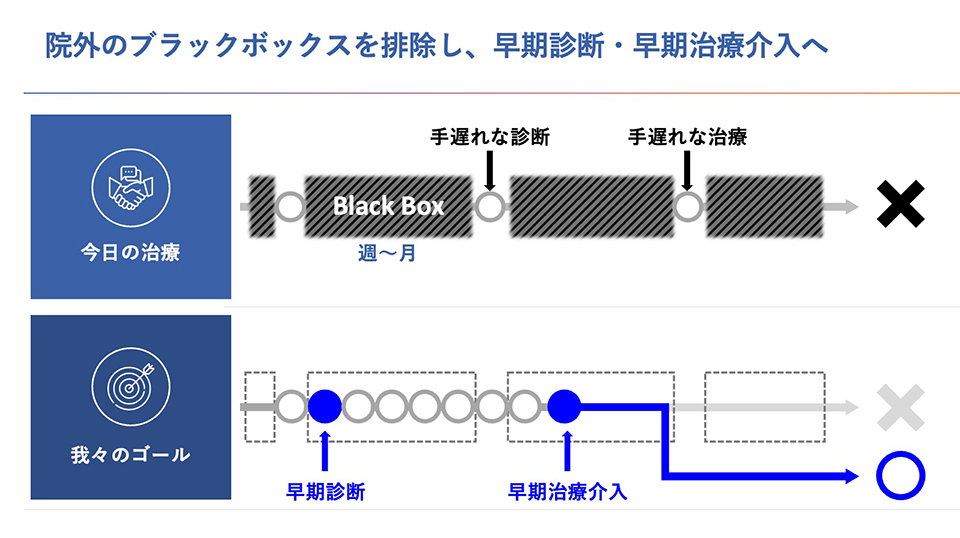 Current Issues: Current prenatal checkups cannot adequately capture the 'black boxed' pregnancy status outside the hospital, leading to insufficient therapeutic intervention.
Those thoughts led to the development of the first pregnancy foundation model system that uses AI technology to objectively grasp the pregnancy status.
Ito: According to WHO (World Health Organization) reports, global rates of preterm birth, stillbirth, and neonatal death remain at high levels. Even in modern medicine, preterm birth and stillbirth remain a mysterious area where it is difficult to even clearly define cases.
Therefore, I focused again on AI technology, which was beginning to spread rapidly. I thought that by processing and analyzing vast amounts of data, there might be a possibility to achieve results that break through the limits of current medicine, such as discovering signs that humans cannot measure.
Did you have any hesitation about taking on a completely new challenge as an entrepreneur instead of building your career as a doctor?
Ito: It would be a lie to say I had no hesitation, but it was my co-founders, Mr. Takasaki and Dr. Takano, who gave me a strong push. Dr. Takano was my superior during my residency in Iwate Prefecture and is my mentor for my overseas career; he guided me on the route of "studying public health abroad." I met Mr. Takasaki at a social gathering held at a pub in London while I was studying in the UK, and he presented the path of "entrepreneurship" as an option to realize the ideal I envisioned. Both are mentors who guided me at turning points in my life, even though they are doctors. I am able to keep running today because of their support.
You are currently developing a system aiming to improve preterm birth, stillbirth, and neonatal death as the first pregnancy foundation model. What kind of system is this?
Ito: The body during pregnancy is extremely complex, to the point where it is called a "black box" among doctors; accurately grasping and predicting the state of the mother and fetus is difficult. Furthermore, information in existing electronic medical records is merely a record of "points" (snapshots) acquired during checkups every few weeks or months. Until now, doctors have judged the condition of pregnant women based on such "point" data. However, we aim to shorten the interval between these points to the limit and visualize the physical condition of pregnant women as continuous "time-series data." In the medical field, statistical approaches combining such continuous biological data with IT equipment and AI are currently evolving, and we are working on this with a sense of mission to demonstrate the nature of "next-generation medical care."
So, by visualizing it with "time-series data" rather than just at the time of checkups, the pregnancy status can be grasped more clearly than before.
Ito: Yes. The causes of preterm birth, stillbirth, and neonatal death vary widely, including fetal or maternal abnormalities, pregnancy complications, and problems with the placenta or umbilical cord, but there are also sudden or unexplained events. In maternal and child health, there is the "Three Delay Model" which lists causes leading to maternal death: First delay is the "delay in the Decision to go to the hospital," Second delay is the "delay due to lack of transportation means or infrastructure," and Third delay is the "delay in response speed and quality of medical care after arriving at the hospital." Approaches to maternity health vary, but we believe it is extremely important to detect abnormalities and respond as early as possible before these delays cause danger to the mother or fetus.
How do you plan to use and disseminate nonat's system?
Ito: We believe there are roughly two methods. One is to develop and distribute a medical device for remote monitoring equipped with the developed algorithm. However, since medical devices require years to clear government guidelines and establish systems, we are also envisioning another approach: developing non-medical devices for health management and releasing them to the world with a sense of speed.
The first foundation model targets pregnant women, but are you considering expanding the target audience after that?
Ito: Yes. We will start with a model for "pregnant and nursing mothers," but in the long term, we envision a platform aiming to comprehensively support women's lifelong issues, such as infertility treatment, menopausal disorders, and adolescent concerns. Regarding the method of provision, we want to flexibly choose the optimal form—whether it should be via medical institutions or delivered directly to users—according to the medical circumstances of the country or region.
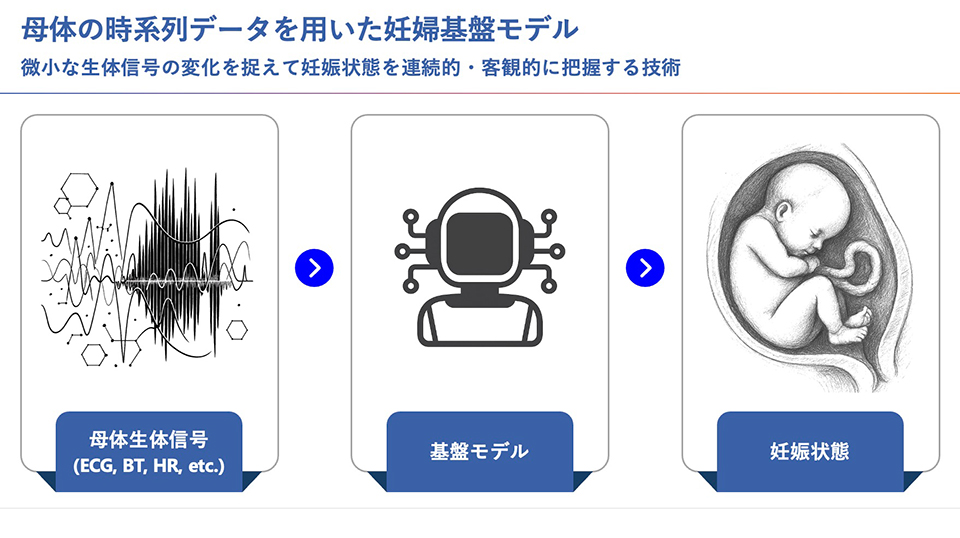 Technical Background: Pregnant Woman AI Foundation Model that captures pregnancy status objectively and continuously from minute changes in biometric data that humans cannot perceive
In October of this year, you released a mobile measurement platform for R&D called "Mikazuki." Is there any connection between "Mikazuki" and the foundation model for pregnant women currently under research?
Ito: "Mikazuki" was originally created because we hit a wall where "there was no appropriate device" for proceeding with our own R&D, and we made it to overcome that. For AI, the minute data and noise that humans discard are actually important. However, medical data obtained from electronic medical records and medical devices is processed cleanly for human use. With this, we cannot conduct the AI research we want to do.
Also, while specialized research devices do exist, most of them often require separate software or large equipment, making them unsuitable for measurement in clinical settings where space is limited.
So, we decided to make something ourselves that allows researchers to "easily" obtain the "raw data" they really want at the patient's bedside using just a smartphone.
Currently, it is in full operation not only for our company but also as an R&D support service customized to individual needs so that many AI researchers and companies struggling with data collection can use it.
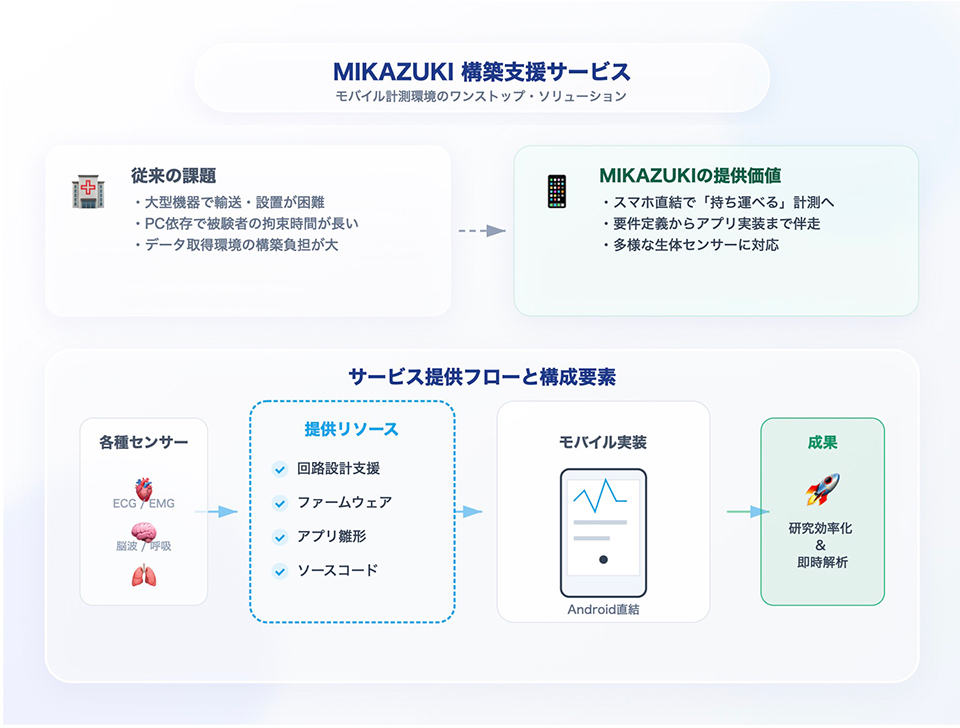 Overview of MIKAZUKI: R&D support service providing "raw data" "easily" tailored to "individual needs"
I believe the trigger for founding the company was your realization overseas. Are you indeed looking at overseas expansion in the future?
Ito: Yes. We have been thinking about global expansion since our founding. The themes of preterm birth and stillbirth that we are challenging with our first pregnancy foundation model are not problems specific to any one country, but global issues. Since the sense of the issues felt in African medical settings is at our core, we are strongly conscious of building algorithms that are biologically universal and do not depend on specific countries or races during development.
Once again, please tell us about the future nonat aims for.
Ito: My starting point is the reality I saw in Africa: "lives that should have been saved are lost due to the environment." That is why the future we aim for is simply "a world where lives that can be saved, are saved." However, there are still countless patients in society who are out of reach of medical care and needs that have not been noticed. The challenges we must consider regarding how to intervene in these areas are endless. But first, we want to focus on "intervening before it's too late" to reliably save the lives that can be saved, and solve issues one by one.
How has it been participating in the ICT Startup League?
Ito: The financial support is of course appreciated, but what became an invaluable asset even more than that was meeting "comrades" with the same mindset. Through the sessions, interacting with peers fighting in the same phase and senior entrepreneurs who are a step ahead, I realized that even though the fields are different, the worries we face, such as IP strategy, are surprisingly common. In startups, which can often be a lonely battle, I feel that gaining a place where we can share issues and learn from each other is the greatest value of participating in this league.
Editor's Note
"We have only looked at the world since our founding." There is not a single cloud in those words, likely because the issues of stillbirth and preterm birth they are facing are universal, existing regardless of race or borders. What was impressive was the perspective that "for AI, the noise that humans discard is important." The truth is hidden in vast amounts of "raw data," not data processed to be easy for humans to see. I was amazed by the execution ability and thoroughness to build even the platform "Mikazuki" for that purpose in-house. I feel I caught a glimpse of the strength unique to a team of doctors who know the field.
■ICT Startup League
A support program that started in FY2023, triggered by the "Startup Creation Type Emerging Research and Development Support Project" by the Ministry of Internal Affairs and Communications.
The ICT Startup League supports startups through four pillars.
1. R&D Funding / Accompaniment Support
Up to 20 million yen in R&D expenses is provided in the form of subsidies. In addition, in the accompaniment support, the selection evaluation committee members who were involved in the selection of league members stay close after selection to promote growth. For companies that the evaluation committee members evaluated as "absolutely want to adopt," a support system is built that is akin to "Oshi-katsu" (enthusiastic fan support), where the evaluation committee members themselves continue to support by providing advice on business plans and growth opportunities.
2. Discovery & Cultivation
We provide places for learning and encounters that promote the business growth of league members.
We also deploy discovery for those aiming to start businesses in the future, aiming to expand the base.
3. Competition & Co-creation
It is a place for positive competition like a sports league, where startups learn together and improve themselves through friendly rivalry to win the necessary amount of funds (up to 20 million yen). We also provide a place for co-creation where league members collaborate to expand their businesses through various opportunities such as sessions by selection evaluation committee members.
4. Dissemination
We will disseminate the initiatives of league members in cooperation with the media! By letting many people know about the businesses, we aim to expand the field for new matching and chances.
■Related Websites
nonat Inc.
/
nonat Inc. (LEAGUE MEMBER)
/
ICT Startup League
💡 Read Next
After exploring the on-the-ground stories of our startups, discover the "big picture" from the top leaders driving Japan's startup ecosystem.
▶︎ Experts Discuss How Startups Should Compete in the Future
For more details on STARTUP LEAGUE's startup support, please see here.