
International logistics connects Japan to the world. While maritime transport acts as the "infrastructure of trade," carrying over 90% of imports and exports by weight, it remains plagued by "inefficiency" and "analog" issues—such as frequent ship delays with uncertain arrival times and fragmented, cumbersome information sharing among stakeholders.
Harbitt Inc. aims to eliminate these "negative aspects" of international logistics through the power of data and technology, striving to realize a "world where we can predict cargo delays and act proactively."
Representative Director Koji Nakata is set on revolutionizing the industry with "Harbitt," an international logistics DX cloud service. He tackles the lagging digitization of maritime transport by automating cargo tracking and supporting advanced supply chain management based on delay predictions.
Drawing on his experience at NYK Line and consulting at Accenture, we asked Mr. Nakata why he decided to start his own business to solve these problems and about his grand vision to change global logistics through "prediction."
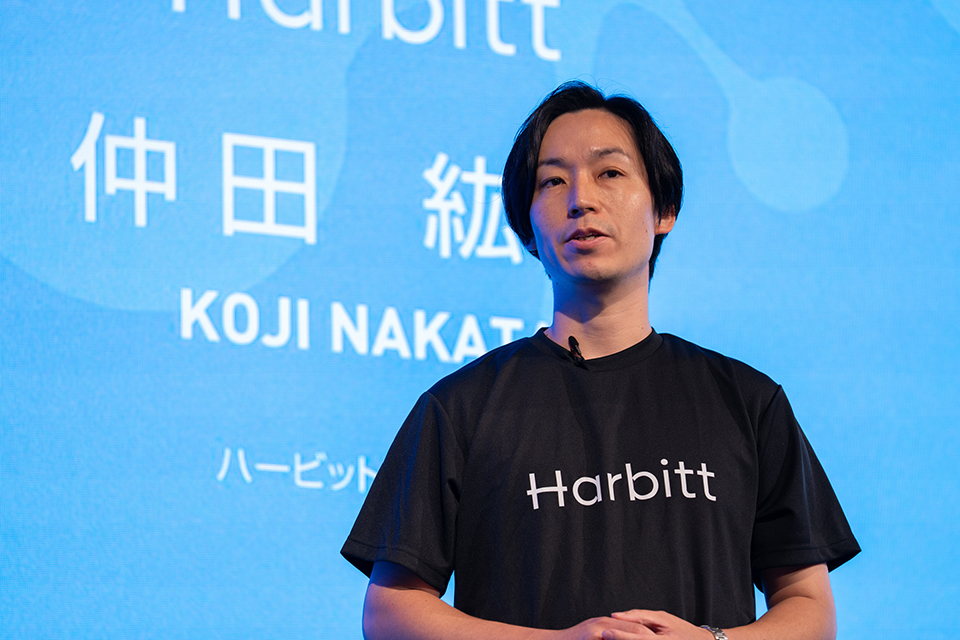 Koji Nakata, Representative Director, Harbitt Inc.
First, could you tell us what triggered you to start this business and what issues you were aware of?
Nakata: At university, I majored in agricultural economics and was interested in global fields such as food trade. I chose a shipping company because I was fascinated by container ships that transport everything from food to automobiles, and I thought it would be the perfect entry point for my career.
However, at that time (and honestly, not much has changed today), both shipping companies and their business partners were still heavily reliant on analog operations. When I was in sales for container ships, I experienced things like receiving a phone call in the middle of the night just to check, "Has the ship left port?"
This was because information for "tracking"—managing the vessel's current location and route in real-time—was not being shared among shipping companies and business partners.
Did you have the mindset that things should be digitized even back then?
Nakata: Yes. I felt strongly that if basic information, such as the estimated arrival date of cargo, were simply digitized, many simple tasks like status checks and inquiries could be eliminated, making everyone happier.
After working at Accenture and other places, what was the deciding factor for starting your own company?
Nakata: When I moved to Accenture, I was attracted by the economic impact of supporting large corporations. However, after moving to a company that supports startup innovation and interacting with various startups, I came to the conclusion that "since you only live once, it must be more interesting to build something from scratch yourself."
When I started thinking about starting a business, I wanted to choose a field where "my experience would be useful" and where I could "challenge myself globally." International logistics met these conditions perfectly, and since it was an area where digitalization was significantly lagging, I decided to start my business in this field.
What specific issues does the service provided by Harbitt solve?
Nakata: We provide a cloud service that allows cargo owners (such as manufacturers and trading companies) and logistics companies called forwarders to centrally manage their shipping status.
By simply registering the booking number (basic information necessary for reservation identification, cargo tracking, and information sharing among parties involved in import/export) used in maritime transport, tracking starts automatically, and the latest transport status is visualized. Furthermore, based on the acquired data, we perform analyses such as reviewing ordering timing by understanding delay trends per route or identifying costs that can be reduced, like container demurrage fees. By centrally managing this information, we also promote information sharing both internally and externally.
Cargo tracking is taken for granted in land transport. Is it difficult in maritime transport?
Nakata: Yes, it is said that the maritime sector is 10 years behind the land sector in terms of technology adoption. For proper delivery management, it is necessary to automatically update transport status—where the cargo is currently located and when it will depart or enter port. However, maritime transport data formats vary scattered across different shipping lines, so we have to start by creating a common format.
Additionally, most systems provided by shipping lines or forwarders are limited to providing information only on the cargo they handle. Large cargo owners who use multiple shipping lines or forwarders are forced to use different systems for each company.
That sounds like a form of vendor lock-in, but your company is building a system with versatility regardless of the shipping line or forwarder used. Has no company addressed this to such an extent in the past?
Nakata: If another company had the same level of industry knowledge and tried to build the same thing, they might be able to, but to my knowledge, no company has pursued it this deeply in the past.
This is because providing services to large cargo owners requires supporting dozens of shipping lines, but in many cases, data definitions, notations, and granularity differ across companies, making the data inconsistent.
For example, out of 100 cargo items, you might be able to digitize 70, but get no data for the remaining 30. Instead of ending with "we can't get data for this shipping line," we carefully untangle each case and standardize it into a common format so that the data structure is consistent regardless of which shipping line or forwarder is used. Completing this "gritty work" is one of our company's major values.
This is less about technology and more about a "deep understanding" of the maritime transport business and the "ability to organize information."
What strengths or differentiation from competitors have emerged from this thorough data preparation?
Nakata: It is our proprietary prediction algorithm. In our cloud service, in addition to the estimated arrival date provided by the shipping line, we provide our own arrival prediction. For example, even if a shipping line says "Scheduled to arrive on November 15th," our cloud might provide the user with a unique prediction like "It will be delayed by another 3 days."
Why is such high-accuracy, proprietary prediction possible?
Nakata: The prediction algorithm itself is created with the cooperation of excellent data scientists, but more importantly, we combine it with my industry-specific domain knowledge.
Because I used to work for a shipping line and am familiar with internal operations, I can tune the prediction algorithm with insights like "including this factor reduces accuracy" or "considering this improves it."
What kind of specific cases can you imagine?
Nakata: Ship arrival and delay predictions involve various factors such as typhoons, wave height, and ship speed. However, there are cases where shipping lines intentionally sail slowly to reduce fuel consumption. Since that intention cannot be known from the outside, trying to predict based on ship speed alone can sometimes lead to failure.
Also, as a result of the "gritty work" I mentioned earlier, the fact that standardized data is input without omissions leads to high prediction accuracy. Regardless of which shipping line is used, whether for export or import, or which country the project is from, having a complete set of data forms the foundation for high-precision prediction. I believe this "complete data" aspect will lead to strengthening our superiority as AI utilization continues to advance.
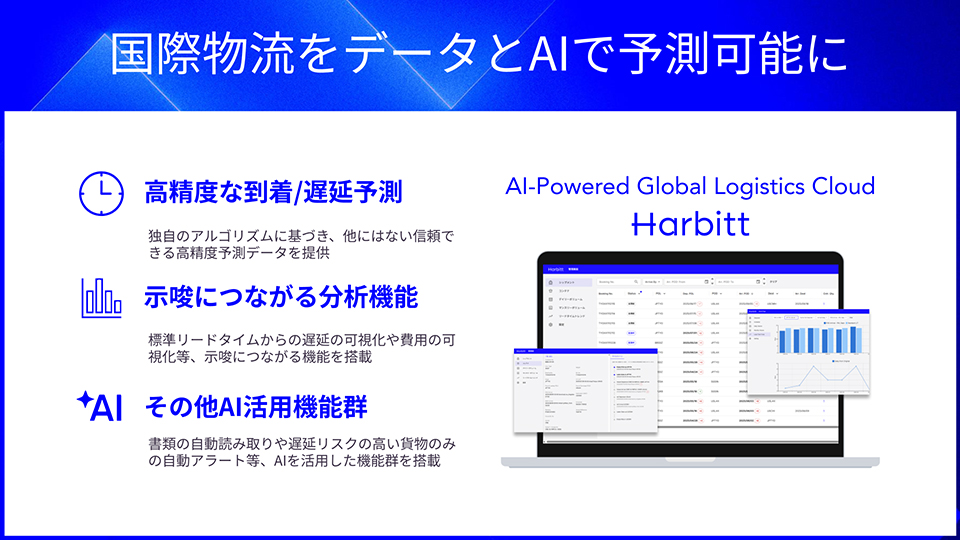 International Logistics DX Cloud "Harbitt"
Could you tell us about your medium- to long-term vision for the next three to five years?
Nakata: On a timeline of about three years, we definitely want to take on the global challenge. We are currently focusing on Japanese companies, but we are thinking about expanding overseas.
Do you aim to capture market share in the international logistics domain as your next goal?
Nakata: Yes. Even when considering providing services to Japanese companies, their business partners in import/export—such as suppliers—are overseas companies. If we are only recognized in Japan, overseas companies might think, "Why do we have to use this unknown Japanese system?" which makes it inconvenient for Japanese companies trying to implement a common global system. We want to expand globally and capture a certain market share to address this.
I heard you have a grand long-term vision to "revolutionize global logistics." How do you want to change the industry?
Nakata: The current international logistics field lacks consolidated data, leaving many analog tasks, and operations revolve around the "gut feeling, experience, and grit" of a few individuals. Because there is no common data, it is also a world of "reactive response"—working hard only after trouble occurs.
We want to thoroughly digitize this and ensure that anyone can make the same decisions based on data. And we want to enable specific actions and decision-making in transport operations that allow people to predict where trouble is likely to occur and resolve it beforehand.
What are the benefits of predicting and acting proactively?
Nakata: For example, if you can predict that a shipment will "ultimately be one week late," you can load it on a ship that is one week earlier, making the arrival time the same. The major benefit is eliminating preventable delivery delays and the resulting economic losses, such as stockouts.
Also, sticking to a reactive style makes it difficult for workers to take time off and creates dependency issues where "only that person understands the situation." If "anyone can do it," work can be shared, reducing the burden on specific individuals, making it easier to work, and likely improving the staff's QOL. This is an approach possible only because we understand the difficulties of the industry in "international logistics"—a field that supports the foundation of our lives yet suffers from a serious lag in digitalization.
Finally, what are your expectations for this year's ICT Startup League?
Nakata: Compared to when we participated last year, our product phase has advanced, and we are particularly focused on "optimal route search for maritime transport" aimed at reducing delivery delays.
Products such as high-precision tracking and predictive analysis are already available for use at any time, so we would be happy if you could introduce us to companies with such needs.
Editor's Note
As the company name "Harbitt" implies—combining "Harbor" (the starting point of logistics) with the digital term "bit" and the maritime term "bitt"—the company is advancing the digitalization of logistics. by solving the "unglamorous but massive problem" of unlinked data around the world, they are poised to transform the future of international logistics into something smarter and stress-free.
Mr. Nakata aims to put an end to the inefficiency of the maritime transport sector, often ridiculed as being 10 years behind the land sector. His revolutionary vision is to evolve the industry from a world of "gut feeling, experience, and grit" to a predictable world where proactive moves can be made based on data. Nakata's challenge, essential for the stability of globally massive and complex supply chains, holds the potential to fundamentally change the nature of the industry and the environment for those working within it.
■ICT Startup League
This support program started in FY2023, triggered by the "Startup Creation-type Germination Research and Development Support Project" by the Ministry of Internal Affairs and Communications.
The ICT Startup League supports startups through four pillars:
1. R&D Funding / Hands-on Support
Up to 20 million yen in R&D funding is provided in the form of grants. In hands-on support, the selection and evaluation committee members who were involved in the selection of league members continue to stay close and promote growth after selection. A "fan-like" support system is built where evaluation committee members continue to support companies they evaluated as "definitely want to adopt," offering advice on business plans and providing growth opportunities.
2. Discovery & Incubation
We provide opportunities for learning and networking to promote the business growth of league members.
We also expand our search to discover people aiming to start businesses in the future, aiming to broaden the base.
3. Competition & Co-creation
It serves as a place for positive competition like a sports league, where startups learn together and improve through friendly rivalry to win the necessary funding (up to 20 million yen). We also provide a place for co-creation where league members collaborate to expand their businesses through various opportunities such as sessions by selection and evaluation committee members.
4. Dissemination
We will disseminate the initiatives of league members in cooperation with the media! By letting many people know about the businesses, we aim to expand new matching and chance opportunities.
■Related Websites
Harbitt Inc.
/
Harbitt Inc. (LEAGUE MEMBER)
/
ICT Startup League
💡 Read Next
After exploring the on-the-ground stories of our startups, discover the "big picture" from the top leaders driving Japan's startup ecosystem.
▶︎ Experts Discuss How Startups Should Compete in the Future
For more details on STARTUP LEAGUE's startup support, please see here.