
In Japan, one out of every three couples divorces. Even among those who do not, over 60% of child-rearing households experience a deterioration in their marital relationship after childbirth. The biggest cause is a "lack of dialogue." However, only 10% to 20% of couples actually practice daily "discussions."
Yuka Atsuta, CEO of Sukidayo Inc., is tackling this "crisis that anyone can face" from the realm of "CoupleTech" using AI dialogue support. The company's new app, "Riamo," uses the power of games to overcome the biggest challenge in CoupleTech: the "asymmetry of enthusiasm" (specifically, the reluctance of men to participate). Remarkably, the invitation rate from men has reached 47%.
Having pursued the possibilities of "dialogue" stemming from the cultural barriers she felt in childhood, why is Atsuta now challenging the ultimate cross-cultural barrier known as "couples" or "spouses"? We explore the vision of a company accelerating its global expansion with the support of the ICT Startup League.
 Sukidayo Inc. aims to realize "Relationship Well-being" globally.
Could you tell us about the background behind your interest in the "CoupleTech" field?
Atsuta: I lived in Los Angeles, USA, from the age of three to five. When I returned to Japan, I felt like I was "neither American nor Japanese," which made me intensely aware of the fun and difficulty of communication. Since then, the question "How should I talk to people with different values?" has been a central theme for me.
Is that why you majored in International Communication at university?
Atsuta: Exactly. I became interested in the academic field of "Intercultural Communication." Even during my study abroad in Illinois, I was researching the dating culture of American college students (laughs). To me, a "couple" is the closest and most difficult form of "cross-cultural communication."
You consider a "couple" to be a "cross-culture"?
Atsuta: Yes. Japanese people, in particular, tend to speak based on the premise that "we are the same." However, in reality, people hold completely different values, ranging from how to fold socks to their views on life, such as whether they want children. If the other person is American or of a different nationality or race, you can start from the recognition that "it is natural to be different." But Japanese people tend to impose their own norms, thinking, "Isn't this normal?" I believe that's where misunderstandings arise. That is why I had such a strong interest in this area.
After graduating from university, you joined a major IT company as a new graduate. Were you conscious of entrepreneurship back then?
Atsuta: No, not at all (laughs). The company I joined was a comfortable place to work, and I intended to just be a regular office worker. However, my interest in the "family domain" was strong. From my first year as a working adult, I helped with male-targeted marketing for Kidsline's babysitter service as a side job, had a column called "Marriage 2.0" in New R25, and continued to touch on this area as my life's work.
From there, you founded "Sukidayo" in 2019. What was the trigger?
Atsuta: Triggered by my own marriage, I began to want to solve social problems related to partnerships and families. In 2019, I launched "Futari Kaigi" (Couple's Meeting), a dialogue support app for dual-income couples, and founded Sukidayo Inc.
At that time, you were still employed at the company you joined as a new graduate, correct?
Atsuta: Yes. At the time, the word "CoupleTech" didn't even exist, and people around me told me repeatedly that "there is no market." I thought they might be right. So, while continuing as a full-time employee at the IT company, I focused on simply keeping my company alive. I worked as an employee five days a week and quietly operated "Futari Kaigi" like a sole proprietorship during the rest of my time.
Wasn't it difficult to start a business parallel to your main job?
Atsuta: Looking back now, I think the method of proceeding with the business you want to do as a side project while holding a main job is something I can recommend to future entrepreneurs. If I had quit my company suddenly, I might have failed in hiring or cash flow in a non-existent market and gone under quickly. Having a main job extended my runway (period of continued activity), allowing me to listen to users' voices slowly while making mistakes and improving my management skills. I believe I am here today because of those three years.
Why did you continue in that state for three years?
Atsuta: Now that the matching app market has been established, I was convinced that the next wave—the market for "maintaining and improving relationships"—would definitely come. But I am an amateur at B2C app development. So, I was waiting for "someone more suitable than me who could solve this problem better" to appear during those three years.
However, around 2022, you shifted fully to your own business.
Atsuta: I watched the market for three years, but in the end, no player appeared who could understand the delicate emotions of couples and translate them into a product. Several competitor-like apps appeared, but they couldn't grasp the insights of couples and disappeared.
Couples' insights?
Atsuta: Yes. The reason most services fail in this area is the asymmetry of enthusiasm. In CoupleTech apps, there is a gap in motivation between men and women. Services that cannot overcome this gap are used by no one and eventually close. Having watched that history for three years, I slowly made up my mind, thinking, "Ah, there's no one else but me who can do this." From there, I participated in an accelerator program, raised funds, quit my job, and decided to dedicate myself solely to this business.
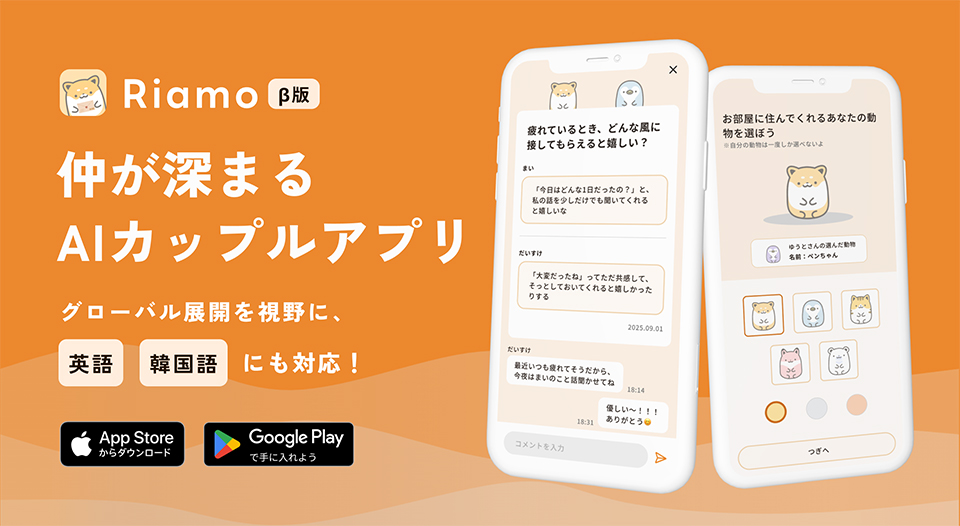 AI couple app "Riamo" for deepening relationships between couples and spouses
From operating "Futari Kaigi," which is still available, what awareness of issues led to the development of the new "Riamo"?
Atsuta: "Futari Kaigi" was used by over 70,000 people without advertising, but there was a major point of reflection. It only reached "highly conscious couples." Because it was an app that presented difficult themes like "sex," "infertility treatment," and "division of housework," only people who were already aware of the problems could use it. This meant it wasn't reaching the layer we really wanted to reach: those who "are not able to discuss things." So, I developed Riamo as a new app with much lower hurdles.
What kind of app is Riamo specifically?
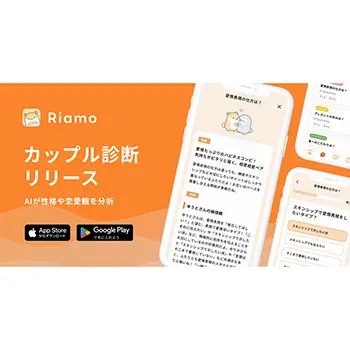
Atsuta: In Riamo, couples receive "questions that deepen their bond" every day, and they can manage a "bucket list" (things they want to do) together. We thoroughly refined the UI/UX to overcome the biggest barrier, the "asymmetry of enthusiasm"—in other words, to ensure men don't find it troublesome.
What specific refinements did you make?
Atsuta: First, we allowed each person to choose a character and created a fun worldview similar to a "Hakoniwa game" (a simulation game where you create, observe, and interact with your own little world). We also utilize "question personalization." The tension and content of the dialogue needed for a couple dating for one month are completely different from those needed for a married couple of 10 years with children.
How are the results?
Atsuta: Thankfully, since releasing the open beta version in September, it has been performing very well. In just four weeks since release, we've received over 200 reviews with a star rating of 4.7 out of 5. And above all, the percentage of men—who were previously the ones finding it "troublesome"—inviting their partners to "Let's do Riamo" has reached 47%. I feel this is a major breakthrough in this field.
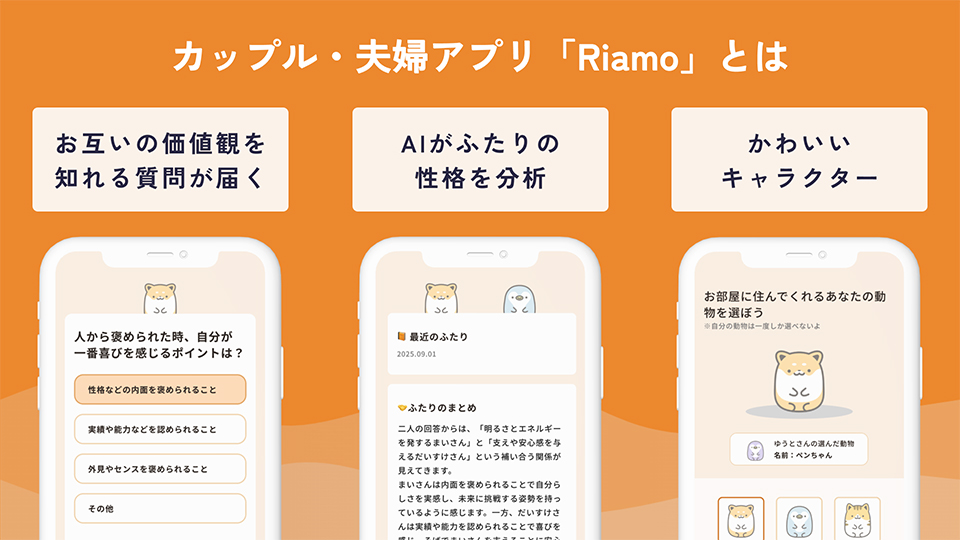 Offering various functions to deepen bonds. Continuous service improvements are planned for the future.
I heard that Riamo has been eyeing global expansion from the start.
Atsuta: Yes. From day one of release, we supported three languages: Japanese, English, and Korean. Within two weeks of release, it was being used in over 35 countries. Actually, there are now 40 to 50 couple tech apps emerging globally, and we have entered the "CoupleTech Warring States Period."
How do you intend to survive this "Warring States Period"?
Atsuta: The need to "improve relationships" is a universal human issue. On the other hand, love and family cultures differ completely by country. The questions preferred by American couples differ from those preferred by Asian couples. This is where the knowledge of "Intercultural Communication" I studied comes alive. We have already set up localization teams in the US, Korea, Spain, Taiwan, etc., and are optimizing for each country's culture.
That is exactly your research theme at the ICT Startup League.
Atsuta: Yes. What we are developing with the League's support is precisely this "Personalized AI." The AI analyzes cultural differences, the couple's relationship status (just started dating vs. 10th year), and individual personalities to deliver the "dialogue the two need right now" to couples around the world. I believe the data accumulated by this AI will eventually become an "infrastructure" supporting couples worldwide.
Finally, how was your experience participating in the ICT Startup League?
Atsuta: It is a truly wonderful program. First, thanks to the grant (R&D funding), we were able to release the app version of Riamo. Also, our assigned mentor has experience with international relationships, so the "resolution" of the accompanying support is extremely high, and I feel we are being supported very carefully.
The "enthusiasm" of the operations team, such as in the League's video streams, comes across strongly. I am truly glad we were selected, and I want to give back by ensuring "Sukidayo," as a League alumnus, produces results globally so that you can feel "it was good that we selected them."
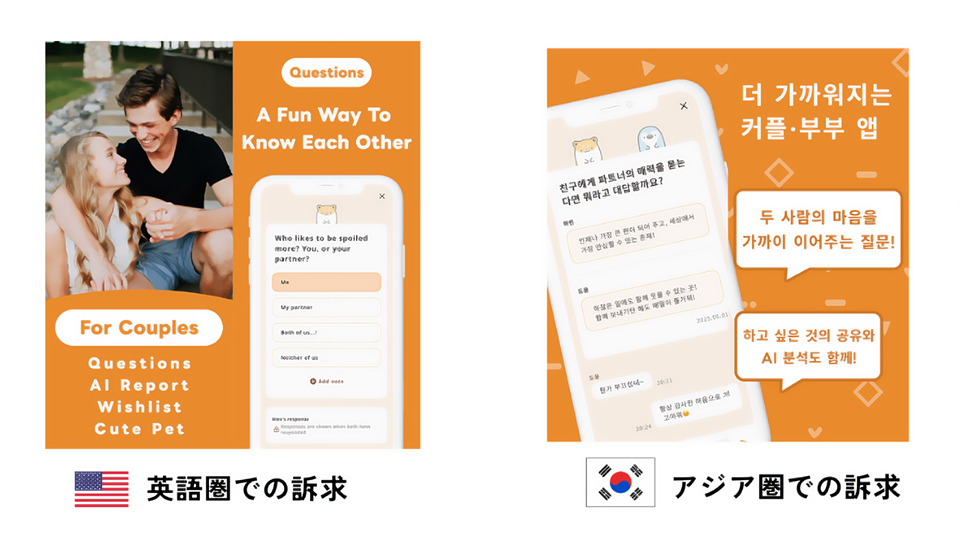 Aiming for global from Day 1, implementing appeals and localization based on cultural differences. Plans to expand to over 10 languages.
Editor's Note
Before the interview, what overflowed from Atsuta's SNS, which I viewed for research, was a life-sized feeling of "I love my partner." However, now that the interview is over, that feeling looks like a powerful engine.
The "boldness" to dare to wait three years without moving, and the process of steeling herself to think "I have to do it myself." What I saw there was the "audacity" that only a true leader possesses, contrary to her soft demeanor.
The strength to raise the company name "Sukidayo" (I love you/I like you) beyond even embarrassment. That is the very measure of her seriousness regarding this issue. The day she changes the world with "love" is surely not far off.
■ICT Startup League
A support program that started in FY2023, triggered by the Ministry of Internal Affairs and Communications' "Startup Creation-type Germination Research and Development Support Project."
The ICT Startup League supports startups through four pillars.
1. R&D Funding / Accompanying Support
Up to 20 million yen in R&D expenses is provided in the form of subsidies. In addition, for accompanying support, the selection evaluation committee members who were involved in the selection of league members continue to stay close after selection to promote growth. For companies that the evaluation committee members rated as "absolutely want to adopt," a support system is built that is truly "Oshi-katsu" (fan support activity) style, where the evaluators themselves provide continuous support such as advice on business plans and providing growth opportunities.
2. Discovery & Development
We provide places for learning and encounters that promote the business growth of league members.
We also deploy discovery efforts for those aiming to start businesses in the future, aiming to expand the base.
3. Competition & Co-creation
It is a place for positive competition like a sports league, where startups learn together and improve themselves while competing to win the funds they truly need (up to 20 million yen). We also provide a place for co-creation where league members collaborate to expand their businesses through various opportunities such as sessions by selection evaluation committee members.
4. Dissemination
We will disseminate the initiatives of league members in cooperation with the media! By letting many people know about the businesses, we aim to expand new matching and opportunity fields.
■Related Websites
Sukidayo Inc.
/
Sukidayo Inc. (LEAGUE MEMBER)
/
ICT Startup League
💡 Read Next
After exploring the on-the-ground stories of our startups, discover the "big picture" from the top leaders driving Japan's startup ecosystem.
▶︎ Experts Discuss How Startups Should Compete in the Future
For more details on STARTUP LEAGUE's startup support, please see here.