
In the construction industry, labor shortages—the so-called "2024 Problem" caused by overtime regulations introduced in April 2024—have made productivity improvements an urgent challenge. Against this backdrop, verbal and dialogue's app "Cheez" is revolutionizing the massive task of organizing "construction photos," a job that places a heavy burden on site supervisors. Yoshiki Morikawa, the company’s representative, had built a steady career at a major corporation, so why did he leave that stability to start his own business? The answer lies in his passion for improving the work environment and his deep commitment to the future of the construction industry. We delve into his uncompromising approach to app development and the untold challenges he faced along the way.
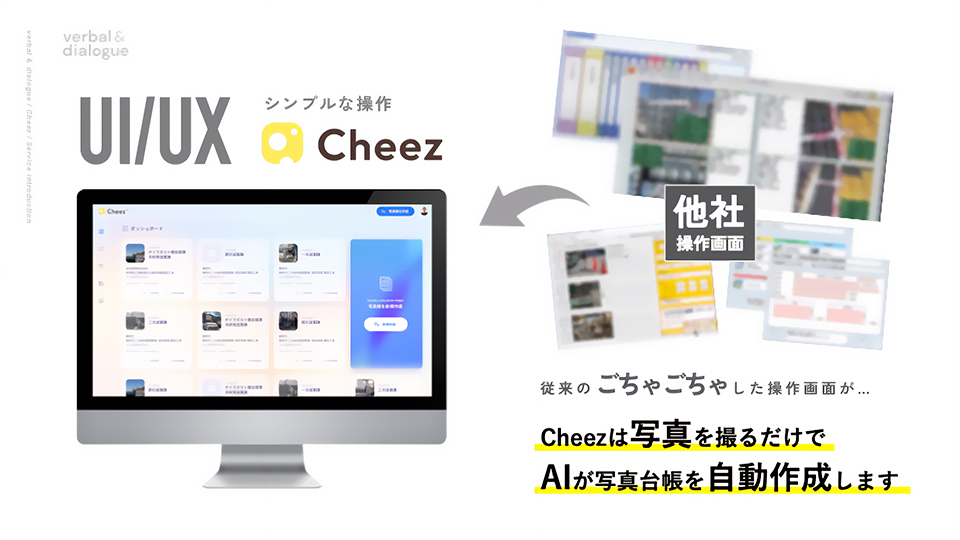 The "Cheez" app interface, designed for user-friendly UI/UX
"Cheez," which verbal and dialogue officially launched in May 2025, is a service designed to streamline the creation of "photo ledgers" in the construction industry, isn't it?
Morikawa: Yes. I spent many years in the construction industry, involved in starting various projects and managing schedules. I also have experience as a plant site supervisor. One of the critical duties of a supervisor is creating "photo ledgers." These reports compile photos and text to document progress, quality, and safety measures for stakeholders. However, it’s an incredibly labor-intensive and time-consuming task. I had been constantly thinking about how to reduce this operational cost.
What is the typical workflow for creating a photo ledger?
Morikawa: First, you take photos at the site to show progress, then return to the office to review them. From there, you sort them into folders by process, paste them one by one into ledger software, and input descriptions for each. Only then is it ready for submission. For a single project, this can result in a volume equivalent to 20 to 30 large binder files.
Depending on the project's scale, we take anywhere from 10,000 to 26,000 photos. Currently, supervisors spend at least one to two hours every day on this, and in busy months, nearly 90 hours can be consumed by photo organization alone.
90 hours a month! Just imagining that makes me dizzy.
Morikawa: It really is overwhelming. Analog methods are still deeply rooted in the construction industry. Meanwhile, labor shortages are chronic. Unless we proactively improve these time-consuming tasks, the industry as a whole won't achieve the necessary productivity gains.
You had a career at major manufacturers. Weren't you worried about starting your own business?
Morikawa: To be honest, since I have a family, I struggled with the idea of starting from scratch. I actually had the concept for "Cheez" about four years before I founded the company, but I couldn't bring myself to take the leap.
That’s when I learned about the Ministry of Economy, Trade and Industry’s "Secondment Startup System." It’s a framework that allows you to start a business while remaining employed by your company, minimizing initial risk while pursuing new business creation. I was able to take that first step thanks to this system. Now that the foundation of the service is set, I have become independent to focus entirely on the development of the "Cheez" system.
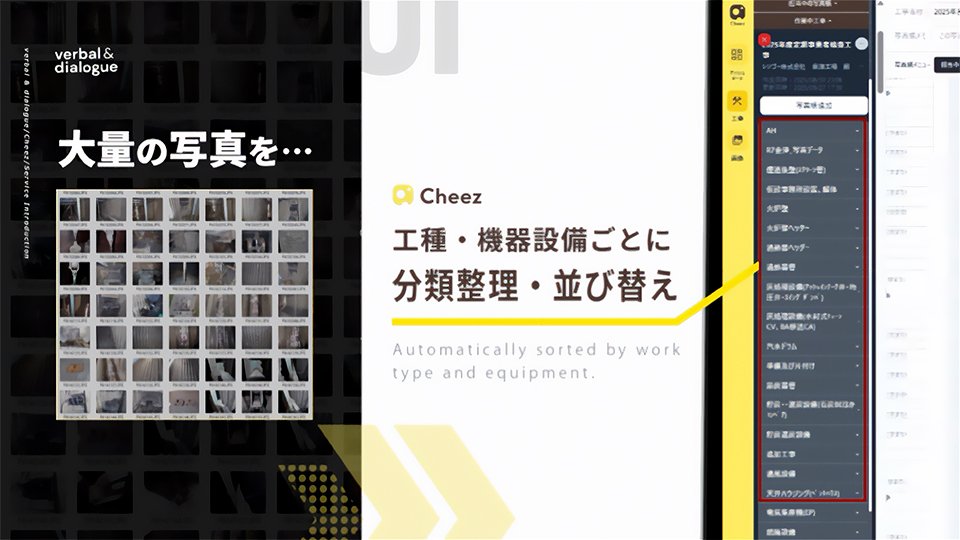 Massive volumes of photos can be easily organized using AI
Tell us more about the specifics of the photo ledger app "Cheez."
Morikawa: To create a photo ledger, you normally need to take photos, organize them, sort them, and input information. With our "Cheez" app, workers simply "snap a photo and upload it" at the site, and the creation work is done. No other administrative work occurs. This can reduce traditional workload by over 90%, completely eliminating the dozens of hours previously spent on photo and data organization.
How does the system actually work?
Morikawa: Usually, when taking construction photos, a "construction blackboard" containing the project name, details, date, and location is included in the shot. "Cheez" is equipped with AI that uses OCR to read the text on the blackboard and automatically tags it with the project information. Based on that, it automatically categorizes, sorts, and inputs data by work type or equipment, handling everything until the final photo ledger is complete.
So you can offload the most tedious and time-consuming part of data organization. That’s a huge relief!
Morikawa: "Cheez" also includes several other features useful on-site. For example, the "Delivery Note Data Management" function allows users to photograph delivery slips (which are often managed as paper originals) and convert them into QR codes to track material procurement and transport status (traceability). There is also a "Voice Input" function to eliminate the hassle of manual typing.
One of the most appreciated features is the "Missed Shot Prevention" function. Since there are many required photo locations and it's difficult to go back and retake them later, giving instructions and handovers takes a lot of time. However, "Cheez" turns the items to be photographed into a To-Do list on the screen, providing detailed instructions on the target and angle. This not only prevents missed shots but also allows beginners to take over photography tasks that used to rely on individual experience, making site resource allocation more flexible.
The service has three plans: "Compact," "Lite," and "Standard." What are the differences?
Morikawa: You can choose based on the number of photos to be processed. The amount of data required for a ledger varies by project scale. The plans are divided by capacity: Compact handles up to 500 photos, Lite up to 3,000, and Standard up to 10,000. Core features like "Delivery Note Data Management," "Voice Input," and "Missed Shot Prevention" are available in all plans.
How does "Cheez" differ from systems offered by competitors that support photo ledger creation?
Morikawa: I believe there are three main differences. First, "Cheez" was developed starting from the "plant industry," which involves the design and construction of large-scale production facilities. It condenses the expertise I gained from years of site supervision and inspection work in plants. Systems specialized for the complex plant industry were virtually non-existent before.
Second is the depth of functionality. We have obtained patents for our unique features, including "Missed Shot Prevention," "Voice Input," and "Delivery Note Data Management," as well as the seamless flow of completing a ledger just by taking a photo.
Third is our "Hybrid Strategy" that supplements AI automation with human oversight. A photo ledger is a massive document, but because it is submitted as an official record, errors are not allowed. "Cheez" efficiently processes about 80% via AI, while the remaining 20% is handled by professionals. In addition to myself, we have a team of professional staff with site supervision experience who perform final reviews and adjustments before delivery.
So you balance the "efficiency of massive data processing" that AI excels at with the "reliability of professional confirmation" that AI alone cannot provide.
Morikawa: Exactly. In our pursuit of the ultimate UI (User Interface) and UX (User Experience), I poured every idea I had into "Cheez." The various patented features are the realization of the "I wish it worked like this" moments my staff and I had during our time in the field. The core focus of developing and operating "Cheez" is "how much we can reduce the effort of the work."
You mentioned there haven't been many photo ledger systems for the plant industry. How does it differ from systems for general construction or civil engineering?
Morikawa: In general construction and civil engineering, there are unified standards set by the Ministry of Land, Infrastructure, Transport and Tourism, so preparing the required data formats isn't that difficult. In contrast, the plant industry has varied specifications depending on the local government or the client, and the needs are diverse. Therefore, it’s hard to handle with a generic package, which I believe created a high barrier to entry.
By leveraging the experience of myself and my staff, we have built logic that can flexibly adapt to various specification documents. By accurately reflecting different entry items and rules for each client, we make it compatible with any site. Of course, it can be used perfectly well by those in general construction and civil engineering as well.
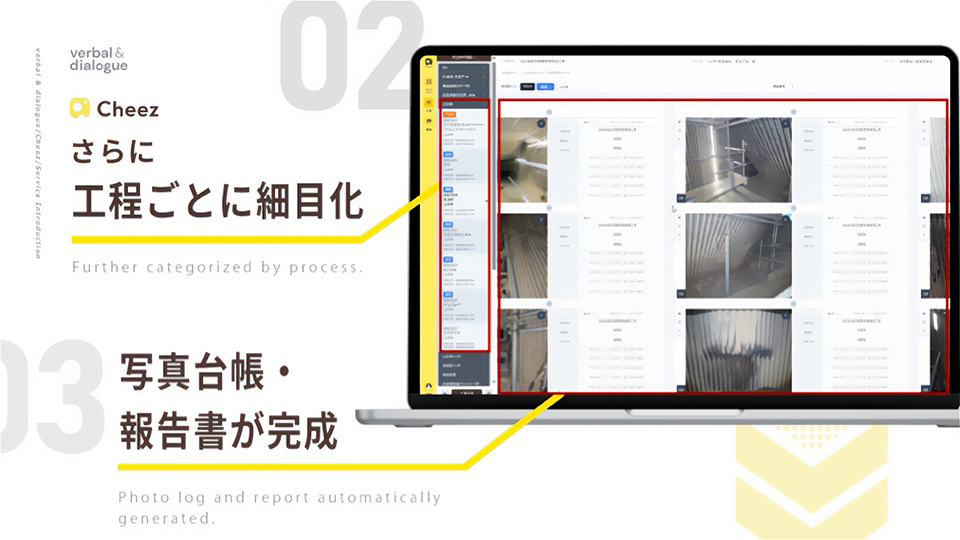 Even detailed processes are made easy to visualize
What kind of challenges did you face during the development phase?
Morikawa: It took a long time to prepare the system to ensure that organization and data processing for such a massive volume of photos were done without errors. We had to train the AI by setting prompts for every single construction photo, like "this is this type of photo." We had to feed it an enormous amount of images covering construction phases, details, and locations. It was grueling, manual work. It took about three years to reach a processing accuracy that I was satisfied with.
What has been the feedback from users since the official launch in May 2025?
Morikawa: Everyone has been very pleased. We’ve received wonderful feedback, such as "overtime has decreased" and "I have more time with my family," thanks to the simple configuration anyone can use and the dramatic increase in work efficiency.
Is there demand for photo organization tasks outside of the construction industry?
Morikawa: Yes. The task of processing and compiling large amounts of photo data exists in real estate, building maintenance, and logistics, not just construction. All of these sectors involve high labor costs and significant time. Based on our own estimates, we believe the market for photo organization tasks is approximately 400 billion yen.
Are you looking toward other industries or overseas expansion in the future?
Morikawa: Our priority right now is to meet the expectations of those who have already contacted us, but in the future, we are considering both other industries and overseas expansion.
While our current focus is on construction and plants, there are many sites in other industries where manual data management still remains. We want to leverage the technology developed through "Cheez" to expand horizontally.
For overseas expansion, we are looking at Asian countries like Vietnam and Thailand, where infrastructure development is booming. On sites with multinational workers, language barriers can become a bottleneck for management. However, our app is designed with a simple UI—"just press the button and take a photo"—so it can be used intuitively. We want to start by approaching Japanese companies' overseas sites.
What kind of future do you see as "Cheez" expands?
Morikawa: My original motivation remains my feelings for the construction industry I grew up in. The job of a site supervisor is inherently creative and wonderful—it's a job that "stays on the map." However, many old-fashioned methods remain, and the reality is that supervisors spend much of their time on administrative tasks. Because of this, they struggle to find time for "quality control" or "safety management"—where they really want to focus—as well as the "joy of making things." I've also seen the struggle to prioritize holidays or family time.
By streamlining operations, I want people in the field to be able to focus on their primary work, go home early, and rest their bodies. I want to make this an industry that young people look at and think, "Construction is cool, I want to work there."
Finally, could you share your thoughts on the ICT Startup League?
Morikawa: First of all, I was simply happy to be selected; it gave me great confidence. I am also very grateful for the generous support from the secretariat. In the League, I want to work on demonstrating the "time-cost reduction effect" of using AI and OCR with concrete figures, and improving the "text prediction function" to make input even smoother. My goal is to improve the app, increase user satisfaction, and evolve it into a service that can be expanded not only to the construction industry but to other sectors as well.
 "Cheez" supports the first step in implementing Digital Transformation (DX)
Editor's Note
The strategy of using "human supplementation" as a selling point alongside overwhelming AI efficiency is fascinating. It’s a decision made by someone who knows the reality of work sites where 100% accuracy is indispensable, and it’s rooted in deep love and respect for the industry. By using technology to eliminate "drudge work" and create time for humans to exercise their original creativity, Morikawa-san is aiming for more than just efficiency—he is working to enrich the very "lives" of those working in construction.
■ICT Startup League
A support program started in FY2023, triggered by the Ministry of Internal Affairs and Communications' "Project for Supporting Budding R&D for Startup Creation."
The ICT Startup League supports startups through four pillars:
① R&D Funding / Hands-on Support
Up to 20 million yen in R&D funding is provided in the form of subsidies. In hands-on support, selection committee members who were involved in choosing League members stay close to the companies after selection to promote growth. For companies that committee members evaluated as "must-select," the members themselves provide ongoing support, such as advice on business plans and providing growth opportunities—a truly "devotional" support system.
② Discovery & Cultivation
Providing opportunities for learning and networking to promote the business growth of League members. It also aims to discover people aspiring to start businesses and expand the entrepreneurial base.
③ Competition & Co-creation
Functioning like a positive competitive arena similar to a sports league, startups learn together and strive to win the funding they truly need (up to 20 million yen). It also provides a space for co-creation where League members collaborate to expand their businesses through various opportunities such as sessions with selection committee members.
④ Dissemination
Broadcasting the initiatives of League members in collaboration with the media! By letting many people know about these businesses, the program aims to expand opportunities for new matching and business chances.
■Related Websites
verbal and dialogue Co., Ltd.
/
verbal and dialogue Co., Ltd. (LEAGUE MEMBER)
/
ICT Startup League
💡 Read Next
After exploring the on-the-ground stories of our startups, discover the "big picture" from the top leaders driving Japan's startup ecosystem.
▶︎ Experts Discuss How Startups Should Compete in the Future
For more details on STARTUP LEAGUE's startup support, please see here.