
Japan Roost Inc., founded in Kagawa Prefecture in 2024, is dedicated to developing "Local Chicken Sexing AI." While the various local chickens (Jidori) produced across Japan are beloved ingredients known for their rich, authentic flavor, the poultry industry currently faces a major challenge: a shortage of professional chick sexers capable of identifying the sex of newborn chicks. To address this and ensure the preservation of Japan's long-standing local chicken culture, Japan Roost is developing its own sexing AI and expanding its implementation nationwide.
We spoke with Yusuke Nakano, Representative Director of Japan Roost, about the development process, the background of the project, and its future potential.
We understand that before founding Japan Roost Inc., you established and served as the representative for Denmark Co., Ltd. Could you briefly share your journey leading up to the establishment of Japan Roost?
Nakano: After graduating from university in Tokyo, I founded Denmark in my hometown of Kagawa Prefecture in 2000 to realize my dream of "doing something related to IT." Later, I enrolled in the Graduate School of Kagawa University to deepen my knowledge of IT technology and conduct research on information and communications. I was developing products that felt ahead of the IoT era, but the Great East Japan Earthquake in 2011 caused all projects to come to a halt. In response, I completely revamped the business and began working in the video industry, which was starting to boom globally. We focused on video production and live streaming for local events. While I concentrated on this for a while, my involvement in video streaming for the "G7 ICT Ministers' Meeting" held in Kagawa in 2016 reignited my interest in AI and robot technology—the themes of that meeting. It made me want to return to the field of research and development that I had stepped away from since the earthquake.
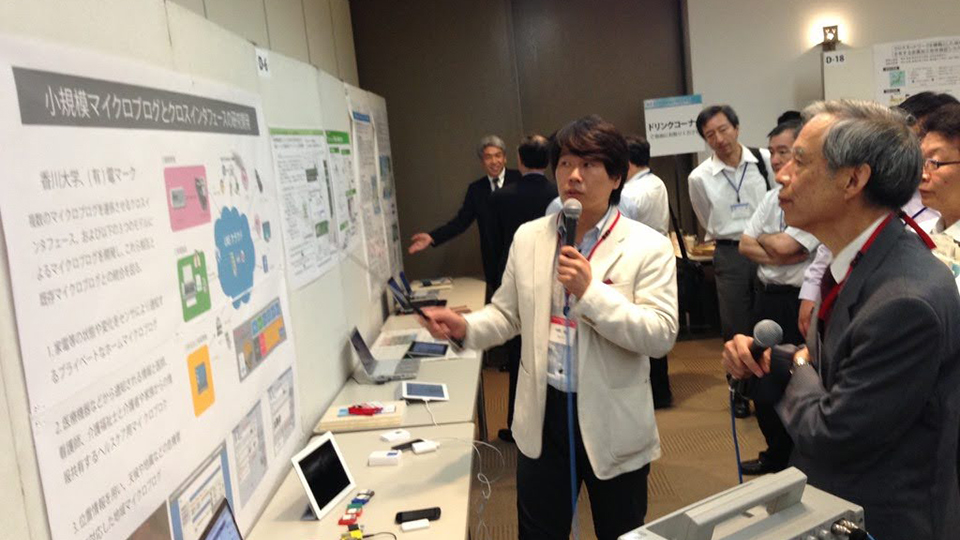 Mr. Nakano presenting research before the earthquake (2011)
From there, how did it evolve into your current business?
Nakano: First, working with a foreign engineer who was at Denmark at the time, we developed a "robot that gently cradles chicks" over a short period of about three months.
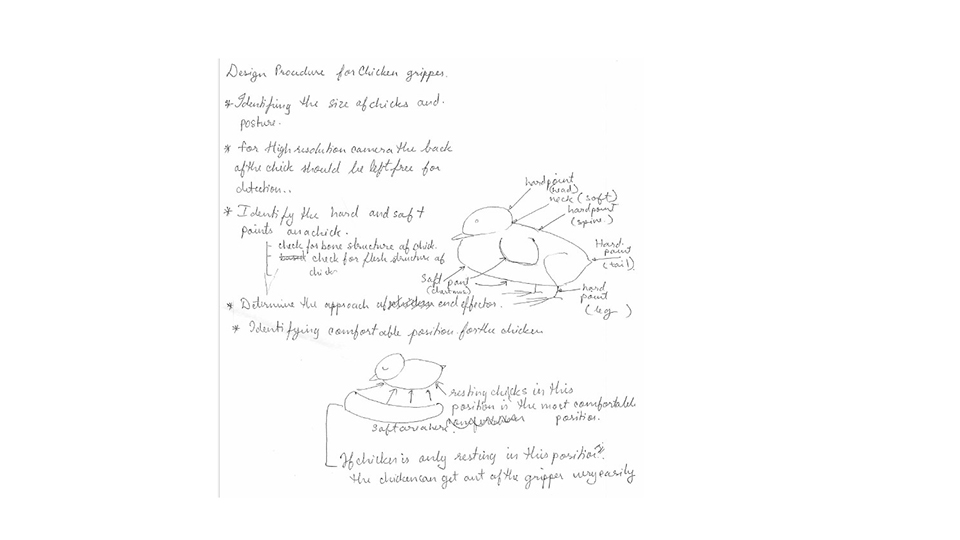 Concept proposal designed by the international team
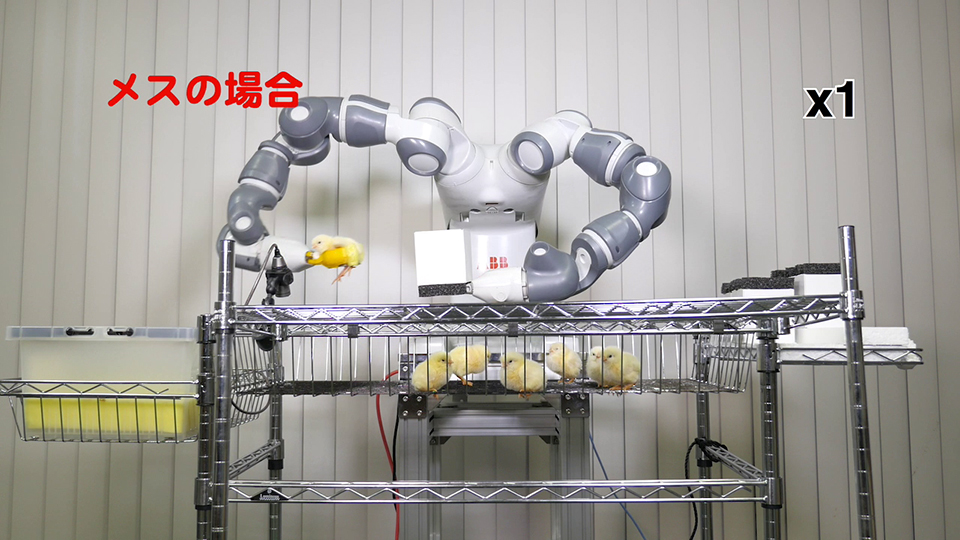 Manipulation of a dual-arm robot actually scooping up a chick gently
Why that specific kind of robot?
Nakano: From my experience in the event business, I place great value on the impact of "scenes that make people stop and stare." I thought it would be interesting to replicate a scene I saw in an anime as a child, where a giant robot gently lifts a person. While it’s common for robots to grab objects, I believed that if we could achieve the manipulation required to gently scoop up a living creature, it would capture a lot of attention.
After we actually developed it, we received an unexpected response. Because we had an intern from India on staff, we had the opportunity to show the robot to the Ambassador of India to Japan. He told us that there was a high demand for such technology in India. In India, for religious and cultural reasons, beef and pork are generally not eaten as much, whereas chicken is preferred, and poultry farming is thriving.
Having grasped this unexpected demand, you began developing a full-scale business handling chicks.
Nakano: Yes. While continuing the development of AI and robot technology for handling chicks, I founded Japan Roost in 2024 as a company centered on research and development related broadly to biological organisms and ecosystems.
Japan Roost is currently focused primarily on developing "Local Chicken Sexing AI." What was the catalyst for focusing on local chickens (Jidori)?
Nakano: In Japan, a vast variety of local chickens are produced across the country. When you travel within Japan, you can enjoy regional specialty chickens prepared with unique local methods. However, in recent years, there has been a shortage of chick sexers—the specialists who support the production of these chickens by determining their sex—due to aging and the difficulty of securing successors.
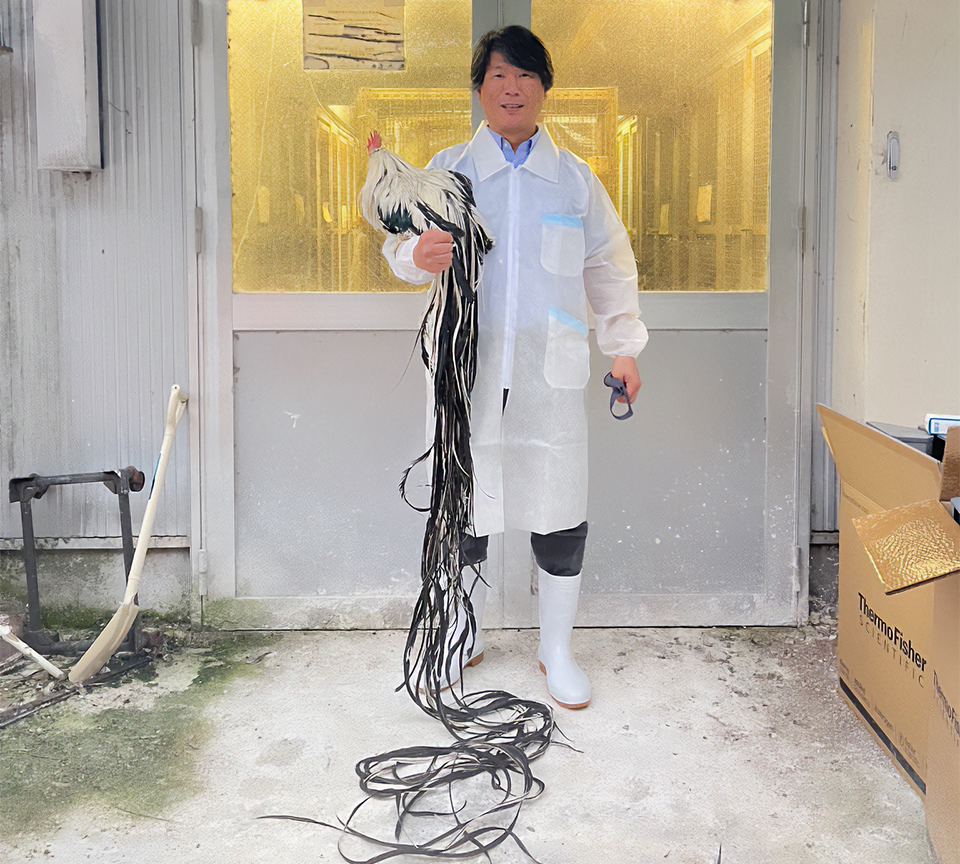 With the special national treasure "Onagadori" (Long-tailed Chicken) at the Japan Chicken Resources Development Project Research Center
What impact does the shortage of chick sexers have?
Nakano: Sexers determine whether a chick is male or female by examining its cloaca (vent) immediately after hatching. Determining sex at this stage requires specialized skills. If these highly skilled sexers disappear, farmers would have to wait until the chickens grow to a certain size to distinguish their sex. This would lead to increased production costs, such as feed, significantly burdening the farmers. To maintain local chickens—which have significant value for regional revitalization—it has become necessary to produce and distribute them more efficiently and stably, even with a limited workforce.
So, you are developing AI technology to replace these sexers to solve this situation.
Nakano: Male chicks have a very small protrusion in their vent, but the size varies between individuals, and sometimes females appear to have similar protrusions. We have collected over 30,000 high-resolution images of these vents with such individual differences to train the AI. In the product we developed, simply pointing the chick's vent toward the camera displays the sex determination instantly.
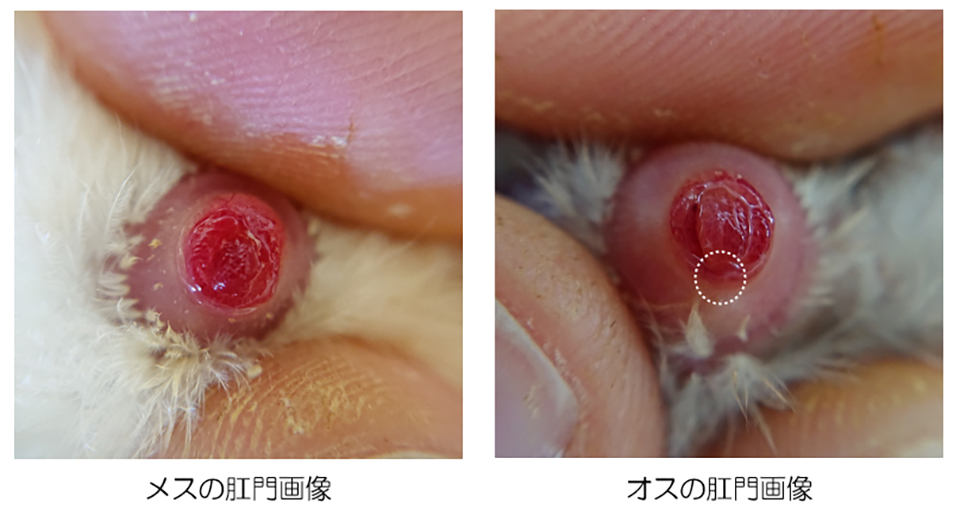 Differences in vent shape (genital protrusion visible in the dotted area)
What are the strengths of Japan Roost's AI technology?
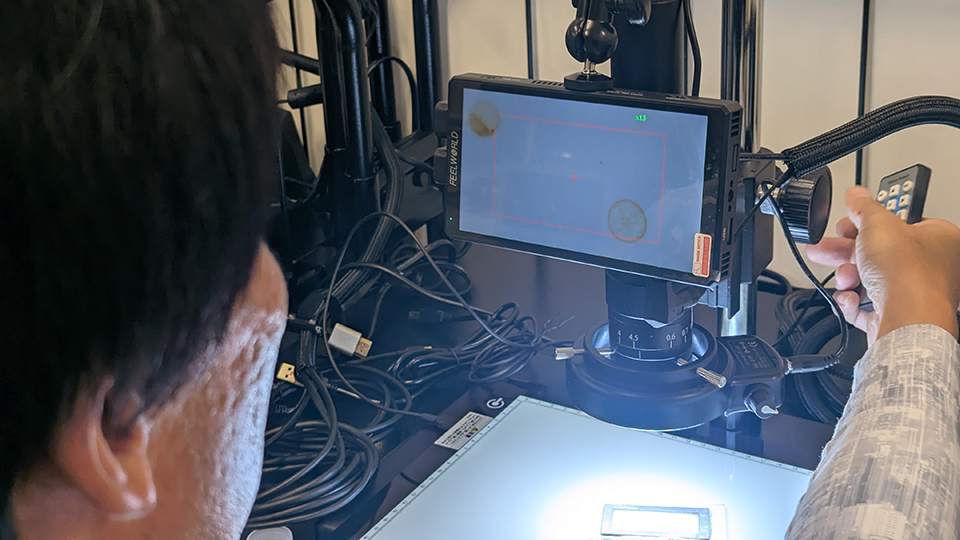
Nakano: Leveraging the know-how cultivated in Denmark's video business, we don't just feed the AI a vast number of images; we also use computer control to set the camera to capture images in a way that is easiest for the AI to judge, thereby improving accuracy. We have refined the technology by innovating the imaging environment, aiming for a determination accuracy of over 98%.
Is the local chicken sexing AI business currently in the operational phase?
Nakano: Yes. We are working to have it adopted by poultry farmers and public experimental stations nationwide, with implementation and evaluation experiments currently underway. We are currently working on a full-scale introduction in Kochi Prefecture, having received an order for the sexing of the rare "Tosa Jiro" local chicken. We are also visiting public experimental stations and universities in Kumamoto, Ehime, and other regions to photograph various types of local chickens and improve the AI's accuracy.
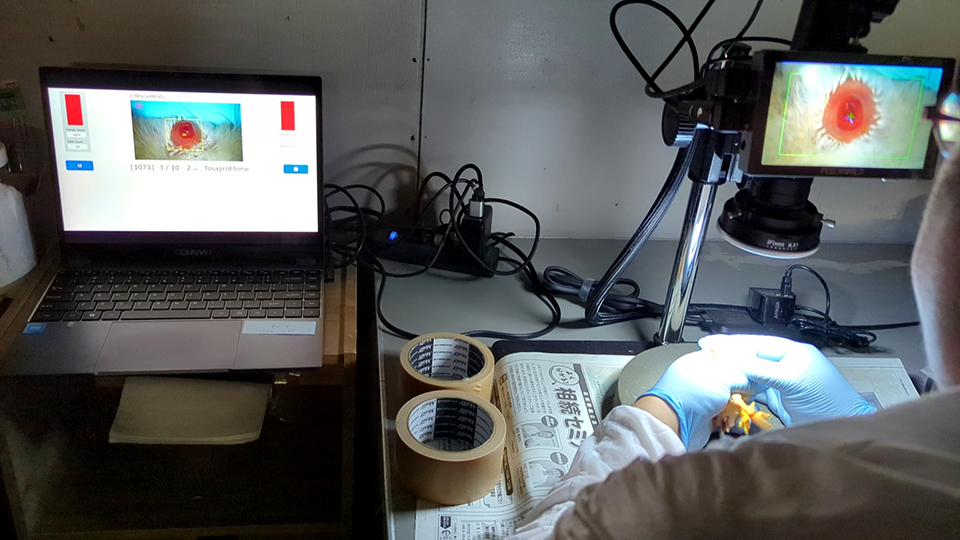 Evaluation experiment at the Kochi Prefectural Livestock Experiment Station (December 2025)
How do you build these relationships with public experimental stations and universities?
Nakano: A major factor was our selection for the Ministry of Internal Affairs and Communications' "Inno-vation Program (Disruptive Challenge Category)" in 2018. At the time, we were prototyping a chick sexing model, but thanks to the program, we gained recognition, and our collaborative network has expanded across multiple regions. Based on these partnerships, we hope to work with public stations and universities to solve the challenges faced by the poultry industry in each region.
In the first half of the interview, you mentioned the demand in India. Does the global poultry industry face the same challenges as Japan?
Nakano: Globally, chicken consumption is expanding compared to pork and beef. This is because there are few religions where chicken is considered taboo, and there is a growing preference for chicken in the West and Japan due to health consciousness. While demand is rising, there is a global shortage of sexers, similar to the situation in Japan. To efficiently produce chickens worldwide, it is crucial to make sex determination as low-cost and accurate as possible.
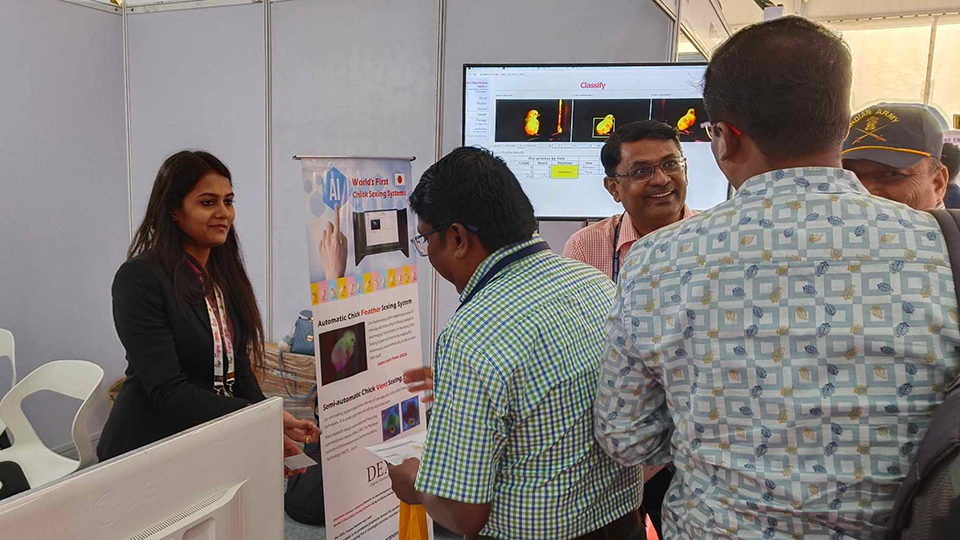 PoultryIndia exhibit booth in India
This suggests high expectations for the global expansion of sexing AI technology.
Nakano: While we are currently focused on Japanese local chickens, we plan to expand our sexing AI technology to include "broilers," which are crossbred for meat and are currently the most distributed type of chicken in Japan. Since broiler production and distribution are common globally, we anticipate being able to expand into the global market using the same technology.
Are there other projects you are working on besides the "Local Chicken Sexing AI"?
Nakano: Currently, we are also addressing the issue of "red tide," which is caused by the proliferation of plankton. When red tide occurs, it has a significant impact on marine life, fisheries, and aquaculture. Therefore, measures are being taken across Japan to prevent its occurrence or worsening. We are conducting research and development to see if we can automate plankton counting using AI.
 Plankton detection
What kind of damage does red tide actually cause?
Nakano: In Kyushu, red tides cause a decrease in underwater oxygen, resulting in billions of yen in damage to fisheries in some years, making it a pressing issue. While red tide has not occurred recently in our home of Kagawa Prefecture, warnings are sometimes issued. When a warning is out, feeding of farmed fish like yellowtail (Hamachi and Buri) must stop to prevent a full-scale outbreak or worsening of the red tide. If they cannot be fed, the fish often fail to grow large, which significantly impacts the aquaculture business.
Beyond red tide, there is a problem in the Seto Inland Sea and Ariake Sea where farmed nori (seaweed) does not turn black. The suspected cause is a large phytoplankton called *Coscinodiscus*, which increases in summer. It is thought that its continued presence into early autumn leads to a lack of nutrients in the sea.
So, a wide range of issues are occurring even in familiar seas.
Nakano: Because seawater temperatures and the scale of fisheries and aquaculture vary by region, there are differences in awareness and perspectives on these issues across Japan. We want to use not only AI and technology but also the video technology we originally possess to solve these regional problems one by one.
How do you envision the growth of your company and business in the future?
Nakano: I believe the technology we are developing now will be necessary for humans to continue producing food when we expand into space, not just overseas.
Into space!
Nakano: In 30 years, I think humanity will have reached Mars, and eventually, an era may come where 100 or 200 people live in a base on Mars. According to some calculations, a human eats nearly one ton of food per year. Naturally, a stable food production system will be needed in space.
I imagine it will start with building something like a plant factory. But if we want to eat delicious fruits or vegetables, we cannot separate ourselves from natural ecosystems—we would need pollinators like honeybees. There will surely be a demand to eat chicken as well. Therefore, I believe there is a massive market for our biological and ecosystem AI technology beyond Earth.
That is a grand vision.
Nakano: It would be fascinating if, in the future, people say, "The first to produce chickens in space was Japan Roost." To achieve such a grand goal, we will continue our research and development to become a company where people think, "If it's about living things, I want to consult Japan Roost." By participating in the ICT Startup League, we have more opportunities like this to be introduced in the media, and I would be happy if more people learned about Japan Roost's business and vision.
Editor's Note
Japan Roost is increasing the amount of AI learning and further improving system accuracy to determine the sex of chicks more precisely. However, Mr. Nakano says, "As long as we are dealing with living creatures, I want to ensure we don't just pursue AI evolution while closing our eyes to biodiversity." Since the sudden expansion of life known as the "Cambrian Explosion," organisms have continued to diversify in response to the natural environment. This interview captured Mr. Nakano's attitude of respect toward Earth's rich ecosystem, which remains difficult for humans—and even AI—to fully manage.
■ ICT Startup League
This is a support program launched in FY2023, triggered by the Ministry of Internal Affairs and Communications' "Project for Supporting Seed-stage R&D for Startup Creation."
The ICT Startup League supports startups through four pillars:
1. R&D Expenses / Hands-on Support
Up to 20 million yen in R&D expenses are provided in the form of subsidies. In terms of hands-on support, the selection and evaluation committee members involved in choosing the league members continue to support and promote their growth even after the selection. For companies the committee evaluated as "must-select," a support system is built where the committee members themselves provide continuous support—such as advice on business plans and growth opportunities—acting much like "dedicated fans" of the startup.
2. Discovery and Cultivation
We provide opportunities for learning and networking that promote the business growth of league members. We also work to discover those aiming to start a business in the future, aiming to expand the entrepreneurial base.
3. Competition & Co-creation
Operating like a sports league, this is a place for positive competition where startups learn together and strive to win the necessary funding (up to 20 million yen). We also provide a space for co-creation where league members collaborate to expand their businesses through various opportunities, such as sessions with selection and evaluation committee members.
4. Communication
We collaborate with the media to share the initiatives of league members. By making their businesses known to many, we aim to expand opportunities for new matching and business chances.
■ Related Websites
Japan Roost Inc.
/
Japan Roost Inc. (LEAGUE MEMBER)
/
ICT Startup League

InnoJin Integrates Telemedicine with Pharmacies: Resolving Fragmentation in Ophthalmology

iiba Signs Cooperation Agreement with Komaki City, Aichi to Develop Digital Childcare Map
For more details on STARTUP LEAGUE's startup support, please see here.


