

Approximately 500 species of fish inhabit the waters around Japan, allowing us to enjoy a rich variety of seasonal flavors. However, the fisheries industry that supports this supply is currently facing a serious labor shortage.
At local fish markets in particular, many manual processes—such as weighing landed fish and creating slips by hand—still remain. Employees of Fisheries Cooperative Associations (JF) are overwhelmed daily by the creation of vast amounts of paper documents, and this administrative burden has become a major factor in operational stagnation.
The dysfunction of these cooperatives could jeopardize the survival of the markets themselves and the maintenance of Japan's entire fisheries industry. Resolving this structural bottleneck is an urgent priority for the sector.
Keigo Ebata is a man tackling this challenge by bridging academic expertise and business. While serving as an Associate Professor at Kagoshima University's Faculty of Fisheries, he is also accelerating the social implementation of his research as the Representative Director and CEO of ZIFISH Inc.
Ebata developed the "ZIFISH Smart Weighing System," which utilizes AI and IoT to digitalize market operations with a "one-touch" process. By centrally managing information such as the weight and species of landed fish, the system has achieved dramatic labor and manpower savings.
Why did a fisheries researcher choose a startup as his vehicle for change now? We spoke with him about his prospects for success and his vision for the future of the industry.
To start, could you tell us what led you to enter the world of fisheries?
Ebata: I was born and raised in Takaoka City, Toyama Prefecture, facing Toyama Bay—the birthplace of the Etchu-style fixed net. I’ve been familiar with the sea since I was a child. At Hokkaido University’s Faculty of Fisheries, I studied fisheries engineering, focusing on fishing gear like purse seine and fixed nets, as well as creating artificial reefs for fish habitats.
After graduation, I worked in the distribution of marine products and was later appointed to Kagoshima University through an introduction from my mentor. For 25 years since then, I have been involved in education and research in the fisheries field here in Kagoshima.
As someone who has built a career as a researcher, why did you decide to found your own startup?
Ebata: My fisheries research is conducted alongside people in the industry. I go out to sea with fishermen through the Fisheries Cooperative Associations (JF), and it was there that I witnessed a crisis-level situation firsthand.
What kind of situation was that?
Ebata: JF staff arrive at 5:00 AM every morning to oversee the landing of fish. For example, if a fisherman brings in a red sea bream, they weigh it and record it on paper as "Red Sea Bream - 5.3kg." Each fish is sold via auction, and every result is handwritten. I saw staff members constantly buried under mountains of paper slips, struggling to input that data into computers.
So, very analog processes still remain.
Ebata: The challenges in the fisheries industry are numerous, but the labor shortage at local landing markets that connect the JF and wholesalers is extremely severe. There are over 1,000 such cooperatives across Japan. In small-scale cooperatives, I’ve seen 3 to 5 staff members struggling with the workload.
If the cooperatives stop functioning, we won't be able to land fish no matter how many are caught, and fish will stop reaching our tables. To protect Japan's rich fish-eating culture, we must first resolve this labor shortage. My desire to "save the front lines by digitalizing market operations buried in paper" is the origin of my entrepreneurship.
Could you explain specifically what kind of service the "ZIFISH Smart Weighing System" is?
Ebata: We developed a weighing system that integrates a tablet device equipped with a camera with existing scales. The usage is very simple: a fisherman places the fish on the scale and touches the tablet screen. With just that, the AI automatically identifies the species from the image, estimates the body length, and simultaneously records the weight from the scale.
This data is instantly digitalized and linked with pre-registered info like the producer’s name, the fishing ground, and the method (e.g., fixed net or bottom trawl), so there is no handwriting involved. Tag labels can also be printed immediately.
That sounds revolutionary. What kind of changes occur on-site once this is introduced?
Ebata: The biggest benefit is "labor saving." Previously, a series of manual weighing and recording tasks required 3 to 5 people. This system handles everything, so those extra hands are no longer needed.
At the Koyama Fisheries Cooperative in Kagoshima, which participated in our test rollout, they were able to reduce the on-site staff from three people to two, even on holidays. Additionally, the massive administrative task of re-entering handwritten slips into a computer was eliminated, which has been very well received.
They told us that once they experienced the convenience of being paperless, they could never go back.
How does this differ from systems offered by competitors?
Ebata: If you look only at the "weighing" function, similar systems do exist. However, the decisive difference lies in our ability to "automatically link with existing accounting software." Systems provided by major vendors are typically large-scale, requiring a complete overhaul of the market and accounting software costing tens of millions of yen. Most of the 1,000 small-scale cooperatives nationwide don't have that kind of budget.
We developed technology that automatically uploads the acquired weighing data to the cloud and inputs it directly into the accounting software each cooperative already uses. This allows for digitalization at a low cost, with affordable initial and monthly fees, without expensive system modifications.
Does this system offer benefits to fishermen and wholesalers as well?
Ebata: We are currently building a "Marine Product Information Platform" that allows real-time sharing of landed fish data on the cloud. If realized, it will significantly change how wholesalers and fishermen work.
Wholesalers will be able to source fish efficiently from multiple markets. Since the catch varies daily, they previously had to wake up at 4:00 AM and visit two or three markets in person to see what was available. With our system, they can check landing statuses at various locations on their smartphones before even leaving. This reduces unnecessary travel and allows them to collect fish that meet their customers' needs efficiently.
For fishermen, it speeds up the decision-making process for heading out to sea. Previously, there was a time lag; they would fish at night, land the catch at dawn, and wouldn't know the selling price until the next day. With our system, they can check the auction price on their phones the same day. This allows them to plan for the next day based on market conditions—whether to target a certain fish because the price is high or take a day off because it's low.
It truly is a "win-win-win" system. What phase are you in currently?
Ebata: We acquired the patent for the entire system at the end of July 2025, and we have finally entered the phase of full-scale expansion. Currently, we have inquiries not only from Kagoshima but also from Shizuoka and Mie prefectures, and we are proceeding with test installations. Since auction methods and business customs vary by region, we are in the middle of fine-tuning the system based on feedback from the field.
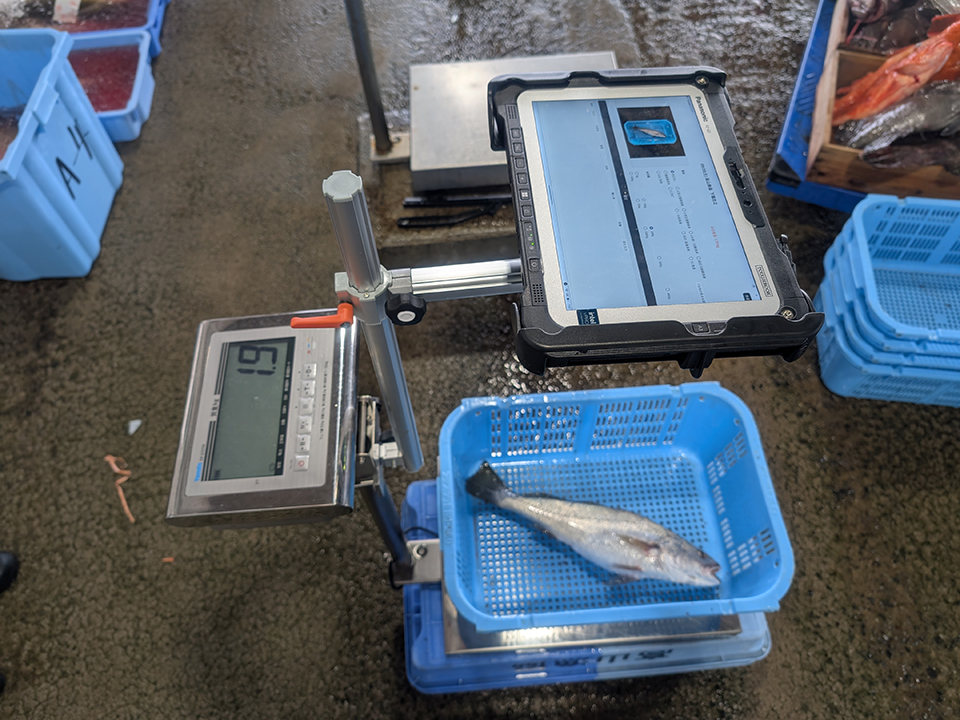 The Smart Weighing System
Please tell us about your medium-to-long-term vision for business expansion.
Ebata: While we are currently focused on Kagoshima, we plan to gradually move north to Kyushu and Western Japan, popularizing this system in cooperatives nationwide to make it a new infrastructure for marine product distribution. Our initial goal is to reach at least 10 locations, starting with Kagoshima, and expand from there.
Are you considering overseas expansion as well?
Ebata: Overseas expansion is already in motion. Many countries, especially in Southeast Asia, lack established catch data management, and we have received strong interest from government officials in Thailand and Malaysia. Just recently, we conducted a demonstration at a fishing port in Phuket, Thailand. Since many stakeholders like Fisheries Department officials were gathering, we brought an English version of the system.
What was the reaction?
Ebata: In Thailand, the UI (user interface), which allows for easy operation despite language barriers, was highly praised. This was the point I emphasized most during development. We thoroughly pursued a design that is easy to start up, set up, and operate with simple presses—ensuring the best usability without unnecessary stress. Seeing it resonate with the people in Thailand gave me a real sense of accomplishment.
This research project was made possible through connections with universities and research institutes with which I've conducted international joint research. I want to use this as a foothold to expand further overseas.
Selection for the ICT Startup League seems like it will be a tailwind for such expansion.
Ebata: Yes. Although I am based in Kagoshima, I need like-minded partners to expand across Japan and the world. I am looking forward to meeting key personnel in various regions.
Finally, please tell us about the "dream" you want to achieve through this business.
Ebata: I love fish, and I want to make this country happy through the power of fish. Japan has over 500 species of fish and a world-renowned, diverse fish-eating culture. However, from a resource perspective, the volume of fish will not increase. That is why I want to increase the value of every single fish through this system.
For instance, we know that treatments like "Ikejime" (nerve tightening) can dramatically improve the taste of fish. However, until now, unless the fish was part of a major brand, those detailed efforts were rarely reflected in the price, so fishermen often gave up. But with this platform, info like "who processed it and how" or "are there any scratches on the body" is visible at a glance, allowing us to deliver that added value directly to consumers.
I intend to spend my life seeing this through—creating a system where local fishermen can earn a living with pride and consumers can smile while eating delicious fish.
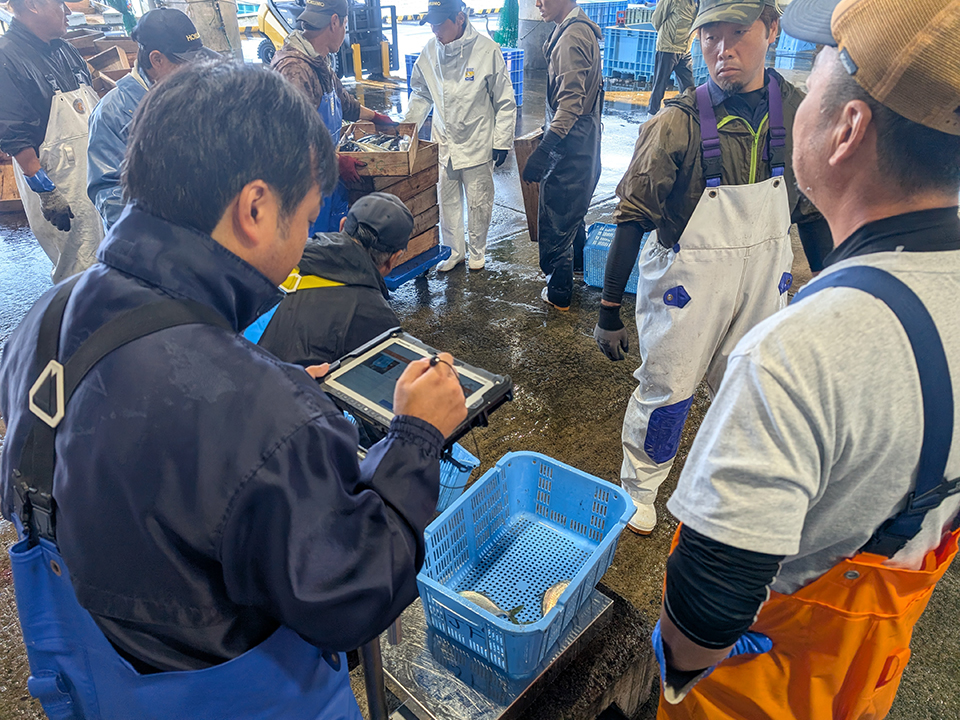 Landing a catch using the smart weighing system
Editor's Note
Toward the end of the interview, Mr. Ebata spoke with a boyish grin, saying, "When people eat delicious fish, they can't help but smile, right?" His words were filled with the pride of a researcher who has dedicated years to fisheries science and the pure love of a fish enthusiast.
Balancing his duties as an Associate Professor with a life where weekday nights and weekends are entirely devoted to his business cannot be easy. However, he is driven by a strong sense of crisis—that "at this rate, fish will disappear from Japanese tables"—and a passion for improving regions alongside his peers.
"I will stay in Kagoshima and keep doing this," Ebata declared. His determination and the "ZIFISH" system, refined through a field-centric perspective, will undoubtedly serve as a bridge connecting the fisheries industry of Japan and the world to the next generation.
■ ICT Startup League
This is a support program that started in FY2023, triggered by the Ministry of Internal Affairs and Communications' "Project for Supporting Seed-stage R&D for Startup Creation."
The ICT Startup League supports startups through four pillars:
1. R&D Expenses / Hands-on Support
Up to 20 million yen in R&D expenses are provided in the form of subsidies. In terms of hands-on support, selection and evaluation committee members continue to support and promote growth even after the selection. For companies highly evaluated by the committee, a support system is built where committee members provide continuous support, such as business plan advice and growth opportunities—a "fan-driven" support structure.
2. Discovery and Cultivation
We provide learning and networking opportunities that promote business growth for league members. We also work to discover future entrepreneurs to expand the startup base.
3. Competition & Co-creation
This is a place for positive competition, like a sports league, where startups learn together and strive to secure necessary funding (up to 20 million yen). We also provide a space for co-creation where league members collaborate to expand their businesses through sessions with committee members and other opportunities.
4. Communication
We collaborate with the media to share league members' initiatives. By making their businesses known to many, we aim to expand matching and opportunity potential.
■ Related Websites
ZIFISH Inc.
/
ZIFISH Inc. (LEAGUE MEMBER)
/
ICT Startup League

InnoJin Integrates Telemedicine with Pharmacies: Resolving Fragmentation in Ophthalmology

iiba Signs Cooperation Agreement with Komaki City, Aichi to Develop Digital Childcare Map
For more details on STARTUP LEAGUE's startup support, please see here.


