
With the decline in the agricultural workforce and extreme weather conditions like intense heat, stabilizing crop quality and prices has become increasingly difficult. Yusuke Sasaki, Representative Director and CEO of Kyuri Tomato Nasubi Inc., is tackling these issues by performing "health checkups" on crops, just as one would for humans.
Digital technology is being introduced to production sites where management policies were previously decided based on intuition and experience. The company has developed a system that automatically grasps growth conditions, quantifies them through 3D analysis, and recommends optimal cultivation decisions and harvest timings. Their mission is to support the nation's dietary life with smart agriculture solutions utilizing generative AI.
What sparked your interest in the field of agriculture?
Sasaki: I took a one-year leave of absence while I was an undergraduate in the Department of Applied Physics at the University of Tokyo, and during that time, I launched my first startup. Aside from video production, I was running a business to expand the base of Virtual YouTubers, which was trending at the time. Related to that, I became involved in a regional revitalization project to "think of the next step after mascot characters." While watching elderly people who didn't even know how to use LINE, I felt, "Couldn't even rudimentary digital technology significantly change towns centered on primary industries?"
Later, in graduate school, I came into contact with a technical field collaborating with greenhouse horticulture research in Kochi Prefecture. I heard many interesting stories from conversations with people at agricultural experiment stations, and my interest grew rapidly.
Why did you decide to start a business while still a student?
Sasaki: Until high school, I didn't have a specific idea of "what I wanted to be," but I had a vague desire to do something that would significantly change society. After entering university, when I considered that the two options to achieve this were joining a large corporation or starting my own company, I felt that my options would be limited after graduation, so I thought I had no choice but to start a business during my university years. However, when I tried it, it didn't go very well, and I had to close it down after about a year and a half.
Why did you subsequently get involved with JDSC Inc. as a data scientist while still in school?
Sasaki: JDSC (Japan Data Science Consortium) is an AI startup originating from the University of Tokyo. Since a professor from my graduate school served as an advisor, I had the connection to work there for about four years, starting from my first year in the master's program. From the experience of my failed startup, I felt I should understand society better, and I saw the benefit in being able to work while still enrolled in school, so I took the opportunity to learn there.
What led to the founding of your current company?
Sasaki: While working at JDSC and researching smart agriculture in graduate school, I was exploring the idea of starting a business again. I considered an internal venture, but as I learned about the realities of society and business at the company, I judged that it would be difficult to realize a project involving primary industries in terms of budget and scale design. I decided to become independent and founded Kyuri Tomato Nasubi Inc. in July 2023 jointly with Tatsuya Ishizuka and Masayasu Matsui, who were my research colleagues in the doctoral program and at JDSC.
What is the core business you have been promoting since the establishment?
Sasaki: We have been developing cultivation solutions for cucumbers, tomatoes, and eggplants—which are in our company name—since our founding, and we continue this as our central initiative. These three items, which are representative summer vegetables, need to be cultivated throughout the year, but in recent years they haven't been circulating much in the summer, causing prices to soar. How to survive the summer has become a critical issue, and this is an area where advanced cultivation management technology based on accumulated data is required.
However, in actual agricultural settings, production sites that have introduced sensors are limited. Even if sensors are introduced via subsidies and data is acquired, there are many cases where that data isn't checked or scrutinized, and eventually, management policies are decided relying on experience and intuition.
On the other hand, the core concept of our solution is to record morphological information such as flower size, fruit growth, and stem thickness to utilize for cultivation decisions. A key feature is that it allows for grasping the plant's condition and managing it like a health checkup.
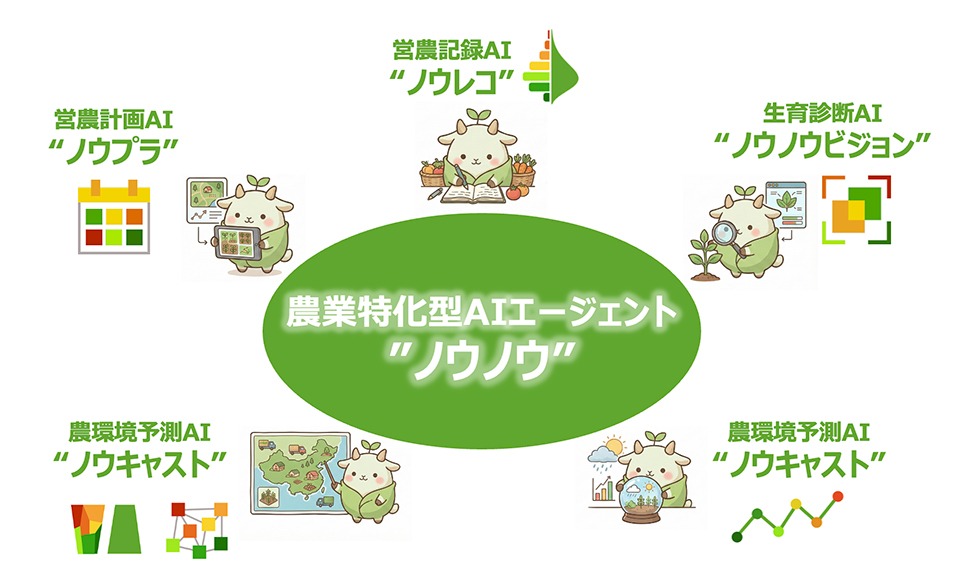 Agriculture-specific AI agent series scheduled for release in January 2026
What was the motivation for developing the "Cultivation Management Support System Based on Digital Twins of Shiitake Mushroom Fields," your research theme for the Startup League?
Sasaki: While talking to a Shiitake farmer introduced by an entrepreneur acquaintance, I judged that there was room for our solution to be utilized, so we began research and development. For Shiitake mushrooms grown in fungus beds, information regarding "shape" is important for the optimal harvest time and the timing of bud thinning for pest control, so I thought it was very compatible with this system.
Please tell us what kind of system it is.
Sasaki: First, we photograph the inside of the farm once or twice a week. Users can choose between stable automatic shooting by a robot or cost-effective manual push-cart shooting. The captured data is uploaded to the cloud from cameras set up by us. 3D processing and analysis are performed, and the results are provided in a format viewable on tablets or computers. Currently, it is in the trial operation stage and has not yet reached the stage of full implementation and judgment.
What kind of feedback did you get from the demonstration experiment conducted at a farm in Shiwa District, Iwate Prefecture?
Sasaki: When producers visually check the growth status on-site based on analysis results, carrying a tablet reduces work efficiency. We are trying methods using head-mounted displays or VR as alternatives, but operational issues such as the weight of the device have been raised, so improvements based on these points are necessary.
It is scheduled for full-scale operation from 2026, but what are your assumptions for sales routes and targets?
Sasaki: We envision greenhouse farmers with a farmland area of roughly 50a (5,000 square meters) or more as our main target. Although the number of such eligible farmers is not large, medium-sized and larger farmers have built relatively good relationships with local governments, so we want to make introductions from local governments our main distribution route. Also, we are building a system that anyone can use normally, even if the producers actually using it are not familiar with AI technology.
Can this cultivation management system be applied to crops other than vegetables and Shiitake mushrooms?
Sasaki: We have received consultations from local governments across Japan asking if our digital technology can be utilized for the cultivation and management of tea and fruit trees. We plan to conduct development regarding Tencha (tea used for matcha) cultivation, which was adopted by Aichi Prefecture's "Aichi Agricultural Innovation Project," and we were selected as a cultivation DX partner for wine grapes by Hachinohe City, Aomori Prefecture.
Fruit tree cultivation poses challenges for monitoring due to shooting environments and tree arrangements that differ from greenhouse horticulture or field crops. However, I feel there is a high possibility that our solution can contribute to considering how to shape the trees as well.
 Using VR glasses in an actual Shiitake mushroom field
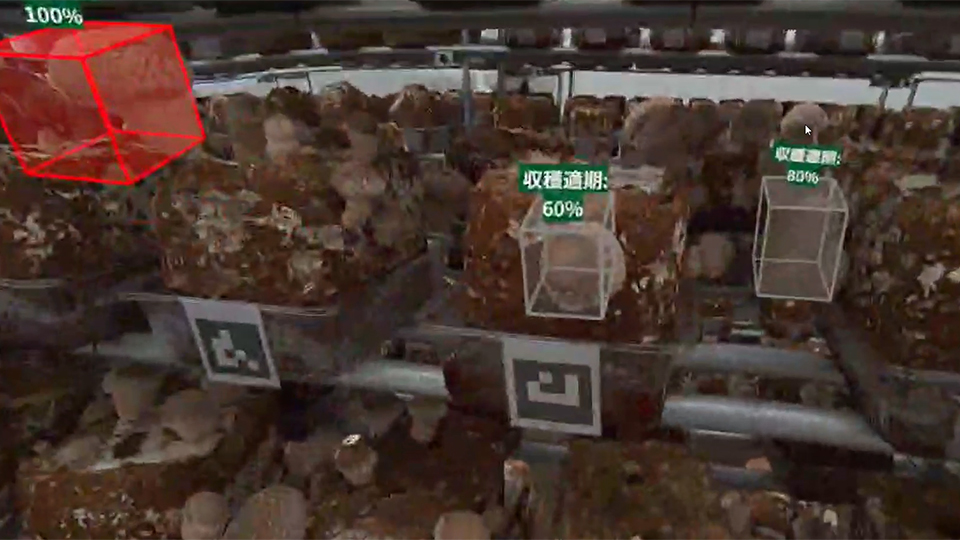 Shiitake harvest guide using optimal harvest time determination
Do you have plans for products following the cultivation management system?
Sasaki: We have started developing an agricultural solution using generative AI—an agent that is essentially an agricultural version of ChatGPT. We plan to deploy it as a mechanism that connects field and crop condition diagnoses with daily work logs, allowing users to grasp the day's work content and health status. We are already proceeding with verification in a beta version, and it is scheduled for official release in January 2026.
How do you want to change society with your company's technology?
Sasaki: Agriculture and food are fields directly linked to daily life, and improvements in productivity have a major impact on people's lives. I recognize that the so-called "Reiwa Rice Riots" had multiple factors, and that the lack of precise diagnosis, labor shortages due to scaling up, and insufficient coordination with distribution, intermediate wholesalers, and small and medium-sized businesses led to yield declines and price increases. Therefore, by utilizing generative AI to connect everything from production to distribution and resolving information asymmetry and inefficiencies, we believe we can contribute to preventing similar price crises.
What is the future vision for the company?
Sasaki: We aim to be the number one agritech company in Asia. I recognize that this is an industry that takes more time than other startups, but we intend to expand our business by providing a common AI platform for various crops.
What about overseas business expansion?
Sasaki: Of course, we want to expand overseas. When targeting the world, a major point will be how to interact with the Netherlands and Spain, which are greenhouse horticulture powerhouses. However, Europe has a relatively stable climate, which differs from the situation in Southeast Asia, where the majority is monsoon climate. Therefore, it would be a good strategy to get involved in the construction and introduction of new facilities tailored to the climate and local conditions of the Southeast Asian region.
That said, stabilizing the technology is the top priority at the moment. In short-term small-scale demonstrations, yields increased by a few percent, and improvements in pest detection rates and management man-hours were confirmed. We want to consider overseas expansion after verifying that these effects appear continuously throughout a full annual crop cycle.
What did you feel after participating in the Startup League, and what do you expect in the future?
Sasaki: It was very refreshing to be able to proceed with development while receiving some funding and to be connected with subsidy-related service operators. Also, closely exchanging opinions with other selected members and working cooperatively like a team was very significant.
I feel there are many other operators like us who want to actively collaborate with local governments. However, while there is a strong network centered in the city, the further away physically one gets into the regions, the harder it is to connect, making it difficult for each company to approach them individually. It would be very appreciated if there were support to create contact points with local public bodies, such as hosting briefing sessions.
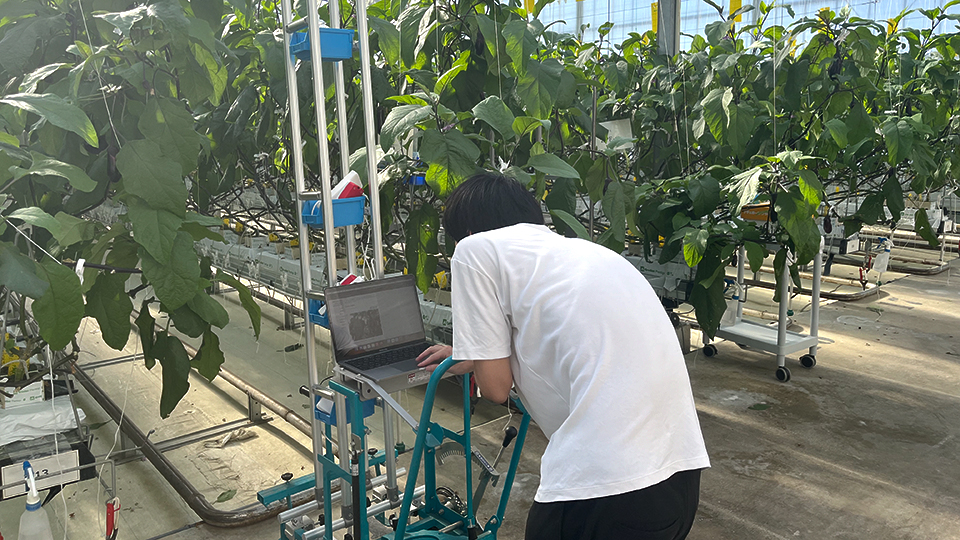 Shooting in an eggplant farm
Editor's Note
When I asked Mr. Sasaki why he used vegetable names directly for the company name, he answered that in addition to them being the first three items the company started working on:
"In the case of agricultural companies, you can often tell where their focus lies—whether it's rice farming or fruit trees—by the company name. So, I thought it would be quite easy to understand that we are a company doing greenhouse horticulture."
However, since they now support not only vegetables but also Shiitake mushrooms, fruit trees, tea, and more, he sometimes ponders, "Should I add items and make the name longer, or should I rename it?" It seems to be a happy dilemma accompanying business expansion.
■ICT Startup League
This support program started in FY2023, triggered by the "Startup Creation-type Embryonic Research and Development Support Project" by the Ministry of Internal Affairs and Communications.
The ICT Startup League supports startups through four pillars.
① R&D Funding / Hands-on Support
Up to 20 million yen in R&D funding is provided in the form of subsidies. In hands-on support, the evaluation committee members involved in the selection of league members continue to stay close after selection to promote growth. For companies that the evaluation committee members evaluate as "absolutely want to adopt," a "push activity" (Oshi-katsu) style support system is built where the evaluators themselves provide continuous support, such as advice on business plans and providing growth opportunities.
② Discovery & Development
We provide opportunities for learning and networking to promote the business growth of league members.
We also deploy discovery initiatives for those aiming to start businesses in the future, aiming to expand the base.
③ Competition & Co-creation
It serves as a place for positive competition like a sports league, where startups learn together and improve themselves to win the necessary funds (up to 20 million yen). We also provide a place for co-creation where league members collaborate to expand their businesses through various opportunities such as sessions by evaluation committee members.
④ Dissemination
We will disseminate the initiatives of league members in cooperation with the media! By letting many people know about the businesses, we aim to expand new matching and opportunity fields.
■Related Websites
Kyuri Tomato Nasubi Inc.
/
Kyuri Tomato Nasubi Inc. (LEAGUE MEMBER)
/
ICT Startup League
💡 Read Next
After exploring the on-the-ground stories of our startups, discover the "big picture" from the top leaders driving Japan's startup ecosystem.
▶︎ Experts Discuss How Startups Should Compete in the Future
For more details on STARTUP LEAGUE's startup support, please see here.