
"Legal justice" is supposed to be equal for everyone. In reality, however, barriers of cost and effort force many to give up on seeking relief. The legal world faces a reality known as "20% Justice," where only 20% of those needing legal support actually access it. This is especially true for "small claims" disputes ranging from tens to hundreds of thousands of yen, where lawyer fees often exceed the amount recovered—a "cost-benefit reversal" that has become normalized, creating a vacuum in the judicial system.
AtoJ Inc. is tackling this massive social issue through "Technology × Law × Design." Their service, "OneNegotiation" (hereinafter "OneNego"), is Japan's first ODR (Online Dispute Resolution) service specialized in financial troubles to receive certification from the Minister of Justice. It replaces traditional procedures with smartphone input and chat-based negotiation, achieving affordable and rapid resolution. It is garnering attention as a new social infrastructure that eliminates the need to "give up and cry yourself to sleep" just because the amount is small.
Why did a lawyer step off the stable path to launch a startup? The answer lies in the deep human insights gained from 20,000 debt collection cases. We spoke with Nobuo Tomita, Representative Director and COO of AtoJ Inc., about his origins and vision.
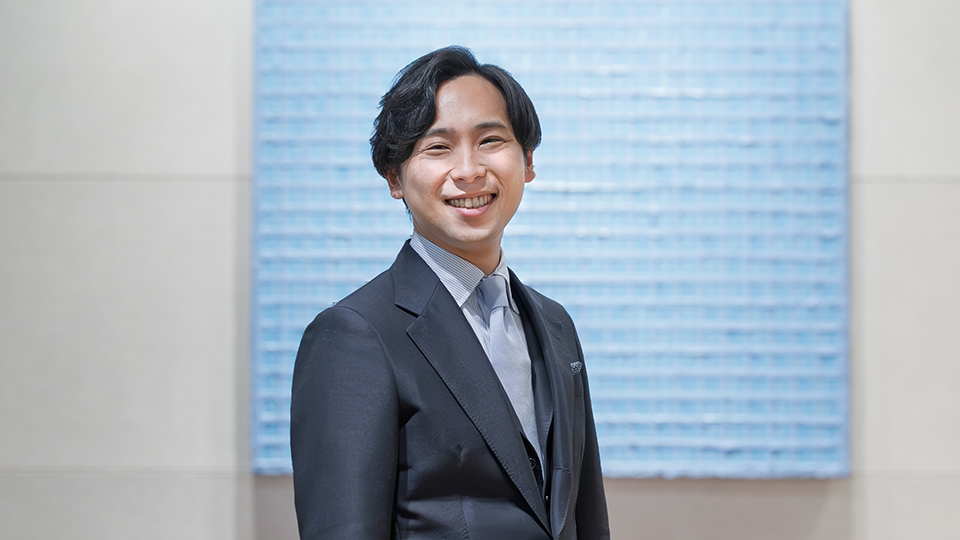 Mr. Tomita, Co-founder and Representative Director/COO of AtoJ Inc.
I'd like to start with your roots, Mr. Tomita. When did you first aspire to become a lawyer?
Tomita: I started consciously thinking about it when I was in high school.
Before that, when you were younger, what were you interested in?
Tomita: "Making things." Both of my grandfathers were entrepreneurs. My paternal grandfather designed and manufactured rudders for large ships, and my maternal grandfather ran a design firm as an architect. My paternal grandfather expanded his business globally with unique technology, and my maternal grandfather was a man of backbone who expanded his business solely as a prime contractor, never taking subcontract work. Growing up watching the backs of such "makers" and "artisans," I always held admiration and respect for them; you could say that is my origin. My father also took over the family business and produced many inventions in the field of automated ship navigation.
So you come from a family of "makers." Why, then, did you aim for the completely different profession of "lawyer" during high school?
Tomita: The trigger was a casual remark from my father: "The lawyer qualification has a certain interesting quality to it." I'm not sure what his true intention was. However, to be honest, I was not a "serious model student" in my school days. Watching my classmates proceed on the "elite course"—from top-tier universities to major corporations—I realized early on, "I can't live that way."
Did you have an awareness of "entrepreneurship" around that time?
Tomita: Influenced by my grandfathers and father, I did have an admiration and romanticized view of entrepreneurship. However, the younger me didn't have groundbreaking ideas raining down on me like Steve Jobs. Looking back, I think I was instinctively seeking a "weapon" that would allow a "nobody" like me to compete with the elite and do something interesting when I went out into society.
A "weapon," you say.
Tomita: Yes. It's something I felt after actually becoming one, but the lawyer qualification was like a "Fast Pass" to society. As long as you have the lawyer's badge, you can meet all kinds of people—from corporate presidents to craftsmen—from the very first day you step out into the world. At the time, I couldn't verbalize it that clearly, but I dove into the legal world with the feeling that "if I have this, it could be the ultimate weapon."
Also, the influence of my mentor during graduate school was significant. He was someone who designed social structures, such as creating international standard mechanisms for telecommunications and running supercomputer projects. He taught me the perspective that "Law is also one of the 'mechanisms' that move society to give form to people's dreams."
Not just knowing the law, but a perspective on how to use it to design society.
Tomita: Exactly. Lawyers are often imagined as those who protect existing rules, but fundamentally, they are also creators who "build new systems to give form to people's dreams." Meeting a mentor who had turned dreams into reality awakened me to that excitement, which connects to my current business.
 System review meeting
After passing the bar exam, what kind of work did you do initially?
Tomita: At the law firm I joined, I was mainly in charge of business turnaround cases. It was a harsh environment where we accompanied small and medium-sized enterprises on the brink of bankruptcy, aiming to rebuild companies and individuals. While thinking about turnaround sites 24/7/365, I was simultaneously supporting industry-academia collaboration as a university researcher and helping with my family business. I was living a life moving between three different places—a "three-sword style" life—right from my first year.
"Three-sword style" from year one... that sounds incredibly busy.
Tomita: Looking back now, it sends shivers down my spine. I worked without rest, to the point where people asked, "What kind of time schedule are you living on?" Within that, I had an intense experience that could be called the origin of my entrepreneurship. As part of the firm's pro bono (public interest) activities, I was in charge of collecting "small unpaid debts" occurring in hospitals and public housing.
Specifically, what was the scale?
Tomita: In total, it exceeded 20,000 cases. Usually, such high-volume, small-amount collection work is outsourced to call centers, but our firm had a conviction that "lawyers should stand on the front lines." We lawyers did everything from drafting documents to telephone negotiations. Day after day, I faced thousands, tens of thousands of "people who couldn't pay (debtors)" directly over the receiver.
That sounds like a grueling environment. Did you have any realizations after touching upon 20,000 actual cases?
Tomita: The biggest shock was that "there are almost no root-evil villains." The world might have an image of "people who don't repay debts = sloppy people." But when I actually listened to their stories, the circumstances were completely different. They were people who "simply forgot," "thought it was resolved at the window," or "had life difficulties and priorities shifted"... mostly people who had absolutely no malicious intent. And that made a lot of sense when I recalled the debtors I ran around with to rebuild businesses in my turnaround work.
So it's not that they don't have the will to pay.
Tomita: That's right. In some cases, there was a trivial dissatisfaction with the business operator, and they became stubborn, thinking, "I don't want to pay because I can't accept how they handled that situation." In other words, most of these were not "legal problems" but cases that developed into trouble due to communication gaps or buttoning the shirt wrong, so to speak.
Communication gaps, you say.
Tomita: Yes. Yet, because the amounts were small, they couldn't hire lawyers and couldn't access legal resolution methods. As a result, the problems were left unresolved, relationships worsened, and debtors continued to harbor guilt. Of course, the creditors doing the collection work didn't enjoy the task either. I saw staff members suffer mental health issues due to that work. I became convinced that these "troubles occurring in massive quantities for small amounts" were a huge area submerged beneath the iceberg that the existing judicial system failed to save. I felt that unless we built a mechanism to solve this, we weren't delivering true "legal peace of mind."
 Mr. Tomita conducting a team meeting
So that original experience led to the founding. Can you tell us about the process of starting the business?
Tomita: Around 2020, my co-founder Mori (CEO of AtoJ) told me he wanted to "start a business with ODR (Online Dispute Resolution)." Mori and I were both members of the Osaka Bar Association's Venture Support Project Team; I was researching AI, and Mori was researching ODR.
What was the content of Mori's proposal?
Tomita: He said, "The wave of ODR is coming globally, so I want to commercialize it in Japan." However, at the time, global ODR examples were mainly focused on divorce, inheritance, and online shopping troubles. There were other founding members researching ODR, so we got into heated debates like, "Isn't there more need for Divorce ODR?" or "Can a simple selection mechanism really be called ODR?"
So opinion was divided even within the team.
Tomita: Yes. But I told Mori clearly: "Divorce and inheritance already have lawyers attached to them. What we should make into a business is the area of 'small-amount, high-volume troubles' where no solution exists. Unless we implement ODR technology here, there is no meaning." If we could solve that "pain" I saw in the 20,000 collection cases, it would be worth doing. I set a condition: "If we aren't going to solve the issues of this market, I won't do it. If we can do this, I'll do it with you."
That's incredible passion. What was Mori's reaction?
Tomita: Mori said, "If it doesn't work, let's pivot. But, just in case, let me acquire the trademark for 'AmicableDivorce.com' (EnmanRikon.com)." So we co-founded the company, but as a result, we were able to proceed in this domain without pivoting, and we can now see even further scalability.
 "OneNegotiation" UX review session
It is an astonishing figure that OneNego achieves a resolution rate of about 60% in an area where previously people had "no choice but to give up" (almost zero resolution rate) due to cost ineffectiveness. What is the secret?
Tomita: When the service started, the resolution rate was about 25%, but what we polished thoroughly was the "UI/UX (User Experience)." Parties to a dispute harbor complex emotions like anxiety, guilt, and anger. If you force cold legal procedures onto them there, they will close their hearts.
Indeed, suddenly receiving a notice saying "Legal action will be taken" is scary.
Tomita: Exactly. That's why OneNego thoroughly pursued "softness" and "simplicity." We made it complete on a single smartphone, where you don't even need to type text; you can convey your intent just through options. You can express thoughts like "I have circumstances preventing payment" or "I can pay if it's in installments" with a single tap. This "low psychological hurdle" is important.
I see, not having to type text is an advantage.
Tomita: Thinking of sentences is stressful. Also, by having a neutral system or mediator intervene, we can organize emotional conflicts and adjust communication gaps. Debtors also have a desire somewhere in their hearts to resolve this "unsettled state." OneNego functions as a "soft communication infrastructure" that gently pushes them forward.
So the knowledge you gained in the field is packed into the design and choice of words.
Tomita: Precisely. My experience in corporate branding, where I pursued "how to convey things to move people's hearts" together with creators and designers as an extension of business turnaround, is alive here. Design is not mere decoration; it is a vital function for access to justice.
 Founding members of the company
AtoJ was selected for the ICT Startup League this fiscal year and took the stage at the Value Up Session at the Academy on October 22nd. The mentors seemed convinced by the business content you presented there.
Tomita: We are receiving a lot of stimulation from the mentors and other selected companies through the League. Especially at the Academy, regarding our somewhat complex domain mixing "Fintech (Finance × Tech)" and "Legaltech (Law × Tech)," they strongly encouraged us, saying, "This is a necessary infrastructure for society." It renewed our conviction that our efforts are not mistaken and gave us a new sense of mission to communicate this more widely.
Finally, please tell us about your future outlook.
Tomita: Our goal is not merely to provide a trouble resolution tool. By socially implementing the "OneNego" mechanism, we want to reduce the unfortunate disconnects born from misunderstandings and misconceptions, creating a world where people can interact more smoothly. Taking this selection as an opportunity, we intend to further accelerate R&D and social implementation to change "access to justice" throughout Japan and the world.
Editor's Note
Mr. Tomita laughs that he "was not a serious model student in his school days," but the fact that he passed the extremely difficult bar exam tells the story of the extraordinary effort behind those words.
From an admiration for "making things," choosing "lawyer" as a weapon to fight in society, and then "entrepreneurship" to solve the pain seen in the field—at first glance, it looks like a unique career path, but a single thick line runs through his journey: "I want to improve the world with my own hands." Because he has this unwavering belief, I cannot help but expect that he will accomplish the resolution of this difficult social issue as well.
What AtoJ is trying to build is a "new social infrastructure" that untangles the "knots" in human relationships. With the tailwind of the ICT Startup League, I strongly want to believe in a future where this "Gentle Judicial Revolution" takes deep root in Japanese society.
■ICT Startup League
A support program launched in FY2023, initiated by the Ministry of Internal Affairs and Communications' "Start-up Creation R&D Support Project."
The ICT Startup League supports startups through four pillars:
① R&D Funds / Accompaniment Support
Up to 20 million yen in R&D funds is provided in the form of subsidies. In addition, through accompaniment support, the selection evaluation committee members who were involved in selecting the league members continue to stay close and promote growth after selection. A true "support fandom" system is built where committee members provide advice on business plans and growth opportunities to companies they evaluated as "must-selects."
② Discovery & Development
We provide opportunities for learning and networking that promote the business growth of league members.
We also deploy initiatives to discover those aiming to start businesses, aiming to expand the base.
③ Competition & Co-creation
It serves as a place for positive competition like a sports league, where startups learn together and improve themselves to win the necessary funds (up to 20 million yen). We also provide a place for co-creation where league members collaborate to expand their businesses through various opportunities such as sessions with selection evaluation committee members.
④ Dissemination
We disseminate the initiatives of league members in cooperation with the media! By letting many people know about the businesses, we aim to expand new matching opportunities and chances.
■Related Websites
AtoJ Inc.
/
AtoJ Inc. (LEAGUE MEMBER)
/
ICT Startup League
💡 Read Next
After exploring the on-the-ground stories of our startups, discover the "big picture" from the top leaders driving Japan's startup ecosystem.
▶︎ Experts Discuss How Startups Should Compete in the Future
For more details on STARTUP LEAGUE's startup support, please see here.