
It is no exaggeration to say that the burden of document creation and administrative work at construction sites is one of the biggest bottlenecks in the construction industry. An enormous amount of time is spent on recording and reporting after field work, taking away time that should be dedicated to quality control and safety management. This is a primary cause of long working hours and the drift of young people away from the industry. Streamlining these tasks is the absolute top priority in the work style reform of the construction industry.
KENCOPA is an AI startup proposing fundamental solutions to these structural issues found at construction sites. They provide AI agents specialized for the construction industry, as well as flexible AI specifically designed for construction management to meet diverse needs.
Representative Sosuke Yasumura graduated from the University of Tokyo and, after working as a consultant at McKinsey & Company, founded KENCOPA in 2024. Under the management philosophy of "Copilot for Construction—Helping to 'Rebuild' Japan's Infrastructure with the World's 'Best' Quality," the company aims to realize the autonomy and automation of construction sites. We spoke with Mr. Yasumura about the AI agent service that fundamentally transforms the way people work on-site.
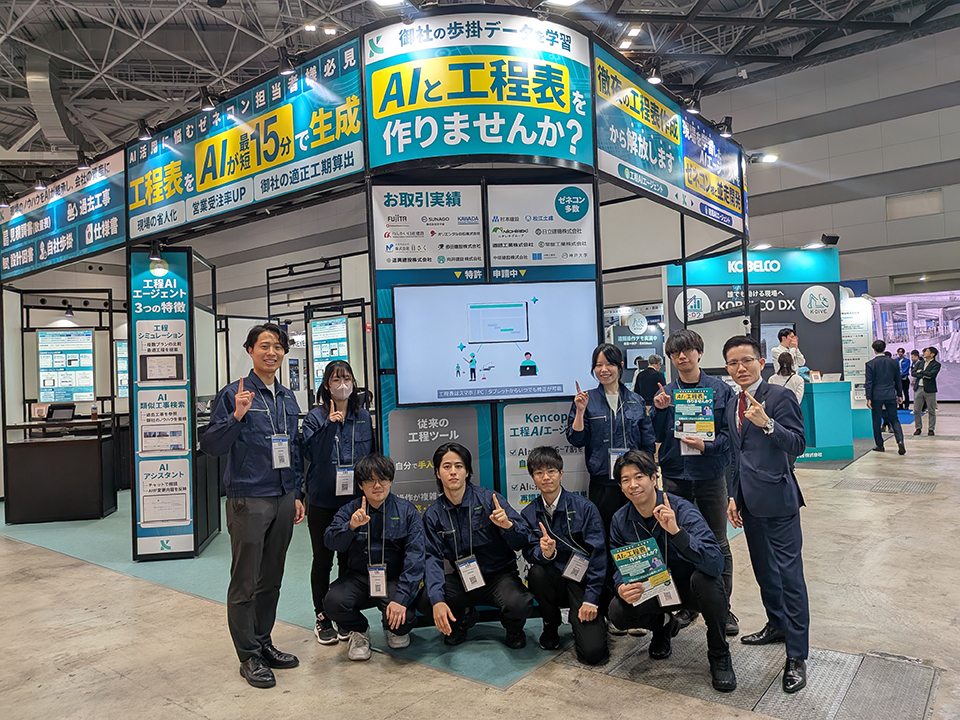 Team group photo at the Construction DX Exhibition booth
What triggered you to start the business?
Yasumura: Since I was a student, I have been interested in B2B core industries and heavy industries. At McKinsey, I supported construction companies and telecommunications firms, worked on overseas expansion strategies for security companies, and supported university-launched startups. Regarding the construction industry, I was involved in consulting work such as BIM/CIM (building information modeling) and DX promotion support. Through this support, I keenly felt the challenges of the sites that support Japan's infrastructure. My desire to contribute to the construction industry with my life grew stronger, leading me to found KENCOPA.
Why did you choose the path of entrepreneurship?
Yasumura: One of the reasons leading to my entrepreneurship is that I really love the attitude of setting high goals as a team and working towards them. During my student days, I lived a life immersed in basketball 6 days a week, and conversely, I have little memory of doing anything else. I won a national championship in elementary school, and in junior high school, I matched up against Okuda Junior High School led by Rui Hachimura at the National Junior High School Basketball Tournament. From such experiences, "working hard on high goals together with trusted teammates" is a strong foundational experience for me.
What are the challenges in the construction industry?
Yasumura: As a major premise, I love the construction industry. When I return from overseas, I am moved by the beauty of Japan's infrastructure. Whether it's roads or buildings, everything is detailed and high quality is maintained. On the other hand, there are points I notice when looking at the industry from a bird's-eye view as a consultant. For example, in the manufacturing industry, automation through robotics and mechanization has progressed, enabling mass production. In the logistics industry, driver shortages are currently an issue, but this will likely move towards resolution with the spread of autonomous driving in the future. However, when thinking about the future of the construction industry, a future where everything is automated by robots is not easily envisioned. This is because the construction industry relies heavily on areas dependent on high-level intelligence, such as the skills and "intuition" of craftsmen. I feel great significance and importance in the challenges to be solved there—the interest in human-centric technologies that cannot be automated, and the aspect of it being like "Mixed Martial Arts" that involves not just technical capabilities but also engaging diverse stakeholders.
Where does the origin of that passion lie?
Yasumura: The background to keenly feeling the industry's issues lies in an unforgettable experience during the founding period. My co-founder's family runs a paving company, and I had the opportunity to live with them. Seeing them leave at 5 AM to head to the site, I felt the harshness of the work firsthand. Also, despite cutting-edge construction work being done on-site, the reality behind the scenes was being chased by complicated paperwork, and technology transfer was personalized and not systematized. In particular, witnessing temporary staff and young employees who had just joined being bewildered, saying "I don't know how to learn the techniques," made me strongly realize, "This is a major issue for the whole industry."
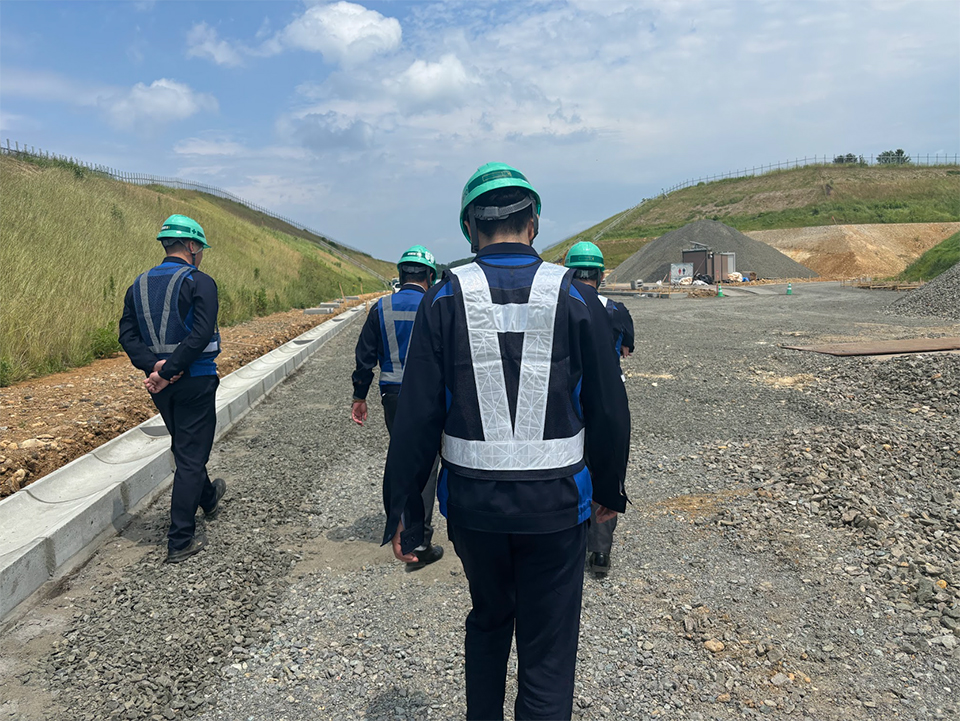 Checking current conditions and fieldwork at a construction site
Please tell us about the services you provide.
Yasumura: We mainly develop the "Construction AI Agent Business" and the "i-Con 2.0 Co-creation Business" (initiatives aimed at improving construction site productivity) through joint development and research with individual companies. Currently, we are focusing particularly on the development and provision of the "Schedule AI Agent." This is an AI agent where the AI automatically reads site data such as design documents (drawings, specifications, estimates) and automatically generates a construction schedule. Behind this development are three major issues in schedule management.
The first is "creation man-hours and lack of experience." It takes weeks for young and mid-level employees to create an overall schedule after receiving an order. Also, due to the small number of experienced cases, it is difficult to deal with building types they have not experienced.
The second is "skills are not being passed down." Past data is saved as PDFs or old versions of Excel, and is not inherited as know-how for each construction company.
The third is the "burden at the estimation stage." When creating a rough schedule before receiving an order, busy site personnel create it instead of sales staff who do not know the site. There is also the problem that if the order is lost, that effort is wasted.
To solve these, our service provides a mechanism that can automatically generate a schedule in as little as 15 minutes just by having the AI read site data such as drawings and specifications.
Who is the target audience?
Yasumura: The target for support is the "construction managers" (Sekokan) who perform project management for the entire site. Their work is managed using Excel, PDF, CAD, etc., and they have to manually correct it every time a change occurs. Furthermore, if you count the tasks of construction managers that the Construction AI Agent business aims to solve, they constantly have 70 to 90 tasks, including detailed documents with strict deadlines such as documents to be submitted to government offices and road usage permits. Managing these with analog methods seems to exceed the limits of human cognitive ability—it is that harsh, and I felt that the current situation where systematic management is not possible is truly difficult.
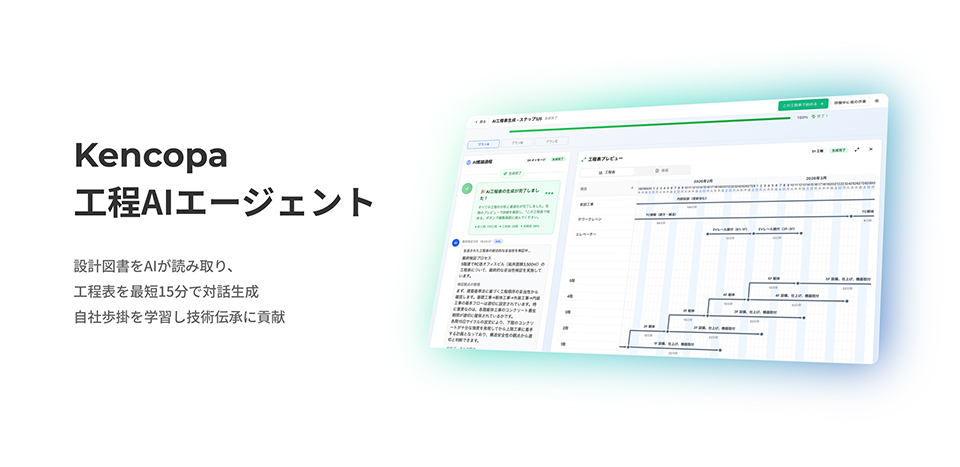 Product Overview of 'Kencopa': Schedule Management AI Agent
What are the strengths of the Construction AI Agent?
Yasumura: It can understand instructions in natural language (spoken language) and autonomously execute tasks by operating across existing software and databases. It goes beyond simple automation to accelerate "technology transfer" and "training of young people" on-site, transforming the very way of working at construction sites. When generating schedules from documents, the AI presents the basis (inference log) for "why that process was organized" on the screen. Since it visualizes "where in the specific information it is based on" rather than being "something made randomly," reliability is guaranteed. It not only generates but also evaluates and proposes "safety and quality points to note" and "schedule duration risks."
Being able to correct it is convenient, isn't it?
Yasumura: Yes. The content corrected by an expert against the AI's proposal is learned and accumulated as "ground truth data." The more it is used, the more a database filled with that company's unique know-how is built. The evidence (inference logs) and advice presented by the AI serve as living learning materials for young employees. It not only saves labor on tasks from weeks to tens of minutes but also accelerates the growth speed of young employees by learning through the AI's thought process. In the future, users will simply give instructions in natural language, and the system will operate multiple software in the background to complete tasks (LLM Brained Agent).
The challenges of the construction industry have been highlighted, but why hasn't DX progressed?
Yasumura: The reason is that it is blocked by four major walls. First are the "Regulatory Wall" and the "Structural Wall." The construction industry is a strictly regulated industry, and document creation based on laws and regulations is mandatory. In addition, due to the multi-layered subcontracting structure, numerous companies are involved in a single site. From the subcontractor's perspective, the prime contractor changes for each site, and different methods are required each time, so they have no choice but to rely on the analog universal tools of "paper and phone" rather than unification by system.
Next stand the "Consciousness Wall" and the "Environmental Wall." Because it is an industry involving human lives, the construction industry assumes infallibility, meaning absolutely no failure. Therefore, familiar and certain methods are chosen over the risk of introducing unknown digital tools. Furthermore, construction sites are surrounded by high walls, and the people working there spend their time inside from early morning until late at night. The opportunity to touch upon common sense from other industries or new technologies is physically cut off—this isolated environment may be the biggest factor making it difficult for waves of change to reach the site.
Please tell us about the competitive situation and differentiation.
Yasumura: Regarding differentiation, first of all, there are currently no AI agents in Japan that specialize in this schedule domain. While there are simple services made as extensions of ChatGPT, there are no companies yet developing domain-specific AI agents that seriously interpret site data and generate output with unique tuning. This technical uniqueness is a major differentiation factor. Also, not only differentiation in terms of functionality, but we are strongly committed to delivering value and excitement to customers. We pride ourselves on maintaining high quality in every single service, including the use of the evidence (inference log) mentioned earlier, and we believe that the quality of such experience itself leads to differentiation from other companies.
Please tell us about points you were particular about in the service development process, or any feedback from users actually using it that left an impression.
Yasumura: The biggest selling point in development is the UI/UX designed so that usage is understood intuitively and naturally. There are many systems in the world that force stress and burden on users due to design or structural convenience, but we believe that "delivering value to the customer" is the essence. The function of an AI agent is merely a means. We thoroughly pursued functions that would be felt as stress-free and rather easy to use for the core task of "thinking about and creating a schedule from scratch."
What was impressive in the feedback from construction company site personnel was the moment they leaned forward in excitement seeing the function where the AI was generating the schedule, saying "This is amazing." Witnessing such reactions gave us confidence to proceed with development. We just started providing the beta version in November 2025, and the official product version is scheduled to be released in March 2026.
Please tell us your vision for the society or world you want to realize.
Yasumura: In response to the serious challenges of the construction industry, namely the retirement of skilled technicians and the shortage of successors, we will first use AI agents to automate and make autonomous the complicated construction management tasks (such as document creation). This creates an environment where young technicians can concentrate on their original work and promotes smooth technology transfer via AI. We will revive the appeal of the industry and fundamentally transform the way of working on-site.
In the future, I want to go beyond software and collaborate with hardware as well. We aim for a world where all technologies at construction sites intersect and cooperate autonomously, with the AI agent acting as the command tower (starting point). Also, going beyond mere autonomy of management, we are looking at the autonomy of construction itself, envisioning a future where site operations are optimized unmanned. I want to package the system that combines Japan's proud high construction technology with AI as a "Japan Model" and expand it overseas. Restoring Japan's infrastructure and construction industry to the world's "best" quality and showing a global presence as a construction startup representing the world. That is the world we want to create.
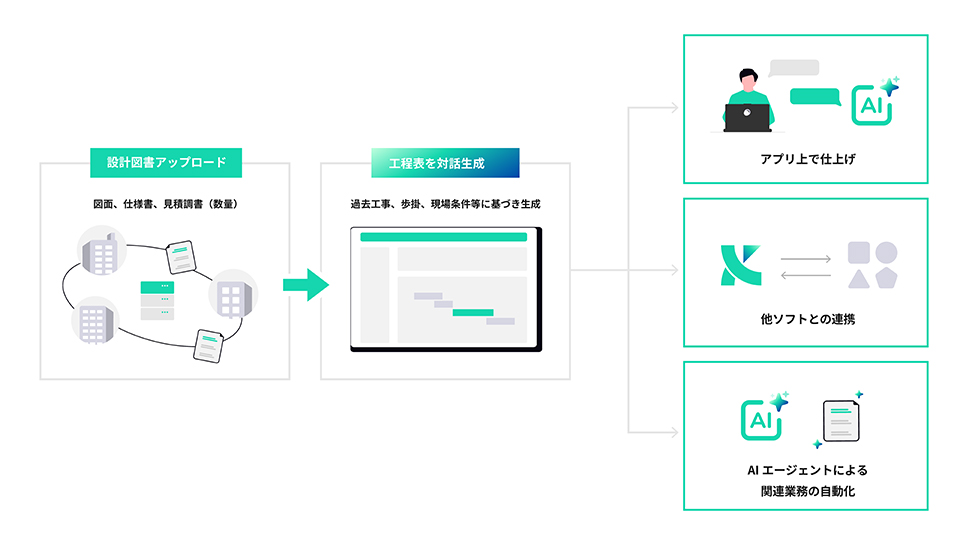 Kencopa System Architecture: Flow from blueprint analysis to schedule generation via conversational AI
Editor's Note
The construction industry faces several "walls" such as regulations, multi-layered subcontracting structures, and the unique insularity of the sites. What is innovative about the AI agent developed by KENCOPA is that it not only reduces man-hours but also visualizes the basis (inference log) of the schedule derived by the AI. The idea of giving persuasiveness to AI decisions, which tend to be a black box, while simultaneously functioning as a technology transfer and educational tool for young people, presents an essential solution in the fusion of analog and digital.
First, as a work style reform, it liberates workers from enormous document creation and reclaims time that should be focused on quality and safety management. And in the future, Mr. Yasumura's vision of exporting the "Japan Model," which fuses Japan's advanced construction technology with AI, to the world, felt like it was presenting a new path to victory not only for the construction industry suffering from severe labor shortages but for Japan's industrial world as a whole. When the company's AI agent becomes established as a "buddy/partner" on-site, Japan's infrastructure industry may regain the power to lead the world once again.
■ICT Startup League
A support program that started in FY2023, triggered by the "Startup Creation-type Germination Research and Development Support Project" by the Ministry of Internal Affairs and Communications.
The ICT Startup League supports startups through four pillars.
1. R&D Funding / Accompaniment Support
Up to 20 million yen in R&D funding is provided in the form of a subsidy. In addition, in the accompaniment support, the selection evaluation committee members who were involved in the selection of league members will continue to stay close after selection and promote growth. A support system that is truly like "Oshi-katsu" (supporting one's favorite) is built, where evaluation committee members provide advice on business plans and growth opportunities to companies they evaluated as "definitely want to adopt."
2. Discovery & Incubation
We will provide opportunities for learning and meeting to promote the business growth of league members.
We will also expand the discovery of people aiming to start businesses in the future and aim to broaden the base.
3. Competition & Co-creation
It is a place for positive competition like a sports league, where startups learn together and improve each other while winning the necessary funds (up to 20 million yen). We also provide a place for co-creation where league members collaborate to expand their businesses through various opportunities such as sessions by selection evaluation committee members.
4. Dissemination
We will disseminate the initiatives of league members in cooperation with the media! By letting many people know about the business, we aim to expand new matching and chance opportunities.
■Related Websites
KENCOPA Inc.
/
KENCOPA Inc. (LEAGUE MEMBER)
/
ICT Startup League
💡 Read Next
After exploring the on-the-ground stories of our startups, discover the "big picture" from the top leaders driving Japan's startup ecosystem.
▶︎ Experts Discuss How Startups Should Compete in the Future
For more details on STARTUP LEAGUE's startup support, please see here.