
The growth environment for the next generation of children is a major theme in modern society. In recent years, social media has become a particular subject of debate. With the spread of smartphones and tablets, risks such as children falling victim to sexual crimes and cyberbullying have become serious global issues. In Australia, a law prohibiting SNS use for children under 16 has been enacted as a national first. In the United States, relevant laws have been passed in at least 16 states, making the relationship between "Children and SNS" an urgent issue.
A startup is attempting to use technology to fundamentally resolve the dilemma between the need for child safety and the need for children to use SNS to develop their abilities and creativity. That company is 4kiz, Inc. They have developed an SNS platform that children can use with peace of mind. Furthermore, to fundamentally change the traditional SNS culture where negative information tends to spread, they have introduced "AI Sentiment Analysis," providing a platform where positive content is more likely to go viral.
We spoke with Representative Director and CEO Katsuhiro Motoyama—who has a unique background of overcoming what he describes as "extreme poverty" to complete degrees at the University of Tokyo and Harvard Graduate School of Education through self-study, and launching numerous new projects at the Nippon Foundation, one of Asia's largest international NGOs—about his vision for balancing children's creativity with safety.
 4kiz Representative Katsuhiro Motoyama
First, could you tell us about your profile and the background leading up to the founding of the company?
Motoyama: I grew up in a poor family in Oita Prefecture. From high school onwards, I supported the household finances through part-time jobs while studying on my own to enter the University of Tokyo, Science I. After that, I went to the Harvard Graduate School of Education alone to study abroad. After graduating, I joined the Nippon Foundation in 2007, and established 4kiz, Inc. in 2021.
Preparing for entrance exams through self-study while working part-time must have been a considerable struggle. Looking back, what aspects of that experience do you think are useful to you now?
Motoyama: The catalyst for aiming for UTokyo was reading the manga Oi! Ryoma (Original story by Tetsuya Takeda) and Ryotaro Shiba's Ryoma ga Yuku during my childhood in rural Oita. I was deeply impressed by Ryoma Sakamoto and other patriots of the Bakumatsu period. Inspired by the phrase "I shall cleanse Japan once more," I simply wanted to become a leader who could guide Japan in a good direction, so I chose UTokyo, which has produced many leaders.
The UTokyo entrance exam convinced me that even from a harsh environment involving financial struggles and the absence of parents, one can change their situation with their own power if they try hard enough. This became my primal experience that "learning has the possibility to make dreams come true and the power to open up life." Based on this experience, my desire to provide the next generation of children with opportunities to challenge their dreams and goals is, in no small part, connected to my current entrepreneurship.
Your career path after entering university is also quite unique.
Motoyama: At UTokyo, I chose the "Department of Systems Innovation" in the Faculty of Engineering, which was newly established that year. I was attracted to the concept of "creating social change using technology" beyond the academic frameworks of humanities and sciences.
Many of my classmates became bureaucrats, joined large corporations, or went on to graduate school at UTokyo, but I felt somewhat uncomfortable belonging to existing systems. Re-examining my starting point—that what I really wanted to do was change society—I set a goal to support youth "learning" through education. To gain a broader perspective, despite being poor at English, I decided to study abroad at the Harvard Graduate School of Education and completed the International Education Policy Master's program.
After studying education and returning to Japan, you launched over 30 new projects, including the establishment of the Paralympic Support Center, at the Nippon Foundation. Is there any work that was particularly memorable?
Motoyama: My time as the person in charge of the "Children's Third Place" project is deeply memorable. We promoted a project to set up facilities that serve as "another home" distinct from family and school, where children can spend time safely, receive meals and learning support, establish lifestyle habits, and have opportunities for experiences, with a goal of 100 locations nationwide.
However, the COVID-19 pandemic struck subsequently. While I had always realized the importance of physical spaces, I was also made aware of the possibilities and challenges of online spaces. At that time, seeing situations where children were forced to use existing online meeting apps under adult supervision, I recognized the "absence of a platform where children can connect directly and safely" as a major issue. The lingering feeling I had then became one of the triggers for starting my own business.
In that context, could you tell us in detail about the episode as a father of six that became the deciding factor for finally founding "4kiz"?
Motoyama: When my eldest daughter, who was 11 at the time, tried to post digital art she had drawn on social media, I learned that all major SNS platforms had a "13 and older" usage restriction. I painfully felt the "contradiction of society where children cannot use the internet because it isn't safe, even though we live in an era where they naturally use it." Combined with my previous misgivings, I thought, "If other companies won't do it, I have to do it myself," and decided to start the business.
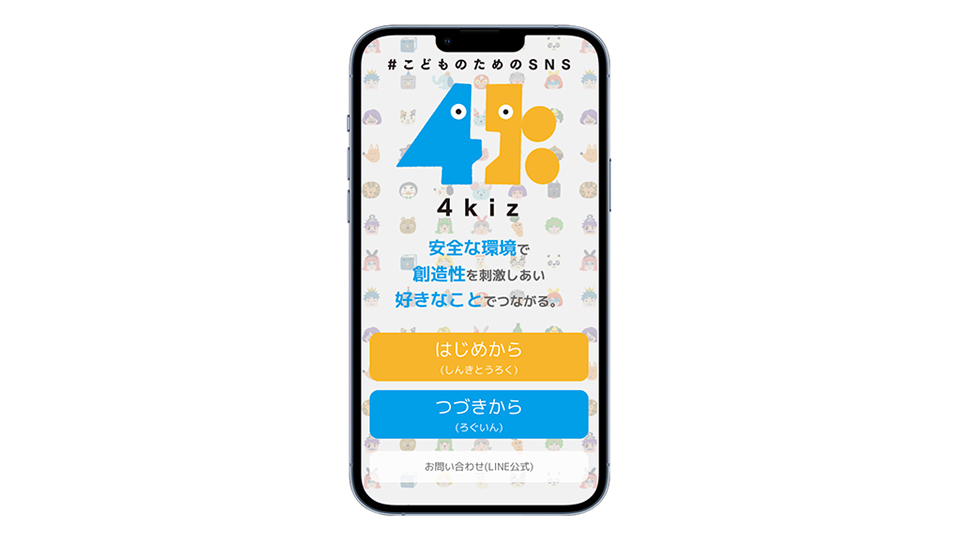 Initial screen of the 4kiz app
Please tell us about the services 4kiz currently provides.
Motoyama: While major SNS platforms are restricted to users aged 13 and over by their terms of service, 4kiz develops and provides "4kiz," a safe and secure SNS service for children under 15. On this SNS, users can enjoy video and image posting functions as well as community functions for group chats.
First, please tell us about the merits of SNS as you see them.
Motoyama: The greatest merits of SNS are "empowering individuals" and "connecting people." From my own experience of achieving my goal of studying at Harvard by gaining support from many people through publishing exam blogs and the like, I want to provide a place where children can empower each other and give courage to others taking on similar challenges by broadcasting their own challenges and experiences.
On the other hand, regarding the currently problematic dangers of children's SNS use, what specific problems can be cited?
Motoyama: To begin with, while SNS operators claim to restrict use by those under 13, the reality is that many children use services by lying about their age. Within this situation, there are two major problems becoming serious.
One is sexual crimes. Victimization such as "sexual grooming" and "child prostitution" by malicious adult users has become a problem. The other is the increase in cyberbullying. Just counting what schools are aware of, there are over 20,000 cases annually in Japan, with a rapid increase among elementary school students specifically. It also remains high among junior high students. Very harsh words like "die" or "disappear" fly around daily, and in serious cases, it can lead to suicide.
Until about 10 years ago, the mainstream thinking was "don't let children use SNS because the risk is high." However, now, due to the "GIGA School Program" promoted by the Ministry of Education, Culture, Sports, Science and Technology and the rapid spread of online devices due to the COVID-19 pandemic, it has become an era where it is natural for children to use smartphones, tablets, and the internet. Since we cannot turn back the clock, I believe it is necessary to "provide the positive aspects and merits of SNS to children in a safe and secure environment" after reducing risks as much as possible.
To protect children from such risks, what kind of technology and design are prepared in "4kiz"?
Motoyama: In "4kiz," we have built multiple defensive walls.
The first is "restrictions by design." We have intentionally not included a 1-on-1 direct message (DM) function, which can be a hotbed for trouble and crime. Interaction is always limited to open communities and comment sections.
The second is our unique "Parent-Child Authentication System." To prevent malicious adults from impersonating children and intruding, we have introduced an authentication system where parents and children jointly record and submit a video, guaranteeing the cleanliness of the entire service.
And the third is "pre-posting NG word detection and AI review of inappropriate content," along with the "AI Sentiment Analysis" for which we were selected for the ICT Startup League. Slander and violent expressions are automatically blocked before posting, and additionally, specialized staff review some posts with human eyes. In addition to this, by introducing sentiment analysis, we can detect strong negative words and interactions that might slip through NG word filters, establishing a double and triple check system.
You aim to build "the world's most positive SNS" with this "AI Sentiment Analysis." Could you explain that in detail?
Motoyama: "AI Sentiment Analysis" is a technology that supports what our business aims for. In cyberbullying, people sometimes hurt others without using direct abusive language. The AI analyzes expressions that induce negative emotions but don't get caught by NG words, such as "So-and-so seems to think they're a genius. I don't want to be friends with them," or "It's So-and-so's drawing again. I'm bored of it. I want them to stop."
"4kiz" reflects these analysis results in the algorithm, rather than just using them for restrictions. Specifically, we adjust the display order and exposure so that negative interactions are less likely to spread, while conversely building a mechanism to prioritize the display and diffusion of positive posts like "That's amazing," "Let's do our best," and "I empathize," as well as constructive feedback.
What 4kiz aims for is a worldview where "doing positive things goes viral and spreads via the algorithm more than doing negative things." Through a culture of "praising each other" that draws a line from the flaming often seen in current SNS, we believe children will naturally learn to respect others and engage in constructive interaction.
This is a slightly mean question, but there is a concern that excessive regulation deprives children of free expression. How do you balance this?
Motoyama: It is a difficult problem, but first of all, "4kiz" does not prohibit all negative expressions. Children can express negative but honest feelings like "Homework is a hassle~ I wish it would disappear." On the other hand, it is true that the most important thing for this SNS is "safety." We are careful to design a balance where we ensure freedom of expression while creating an environment where children can comment and post with peace of mind through an algorithm where negative words are less likely to spread.
Are there any other appeal points of 4kiz?
Motoyama: I think there are exciting possibilities in collaboration between users. In communities where people with common hobbies gather, new works are being born one after another through requests like, "I want to create a story based on this character, can someone draw a picture for me?"
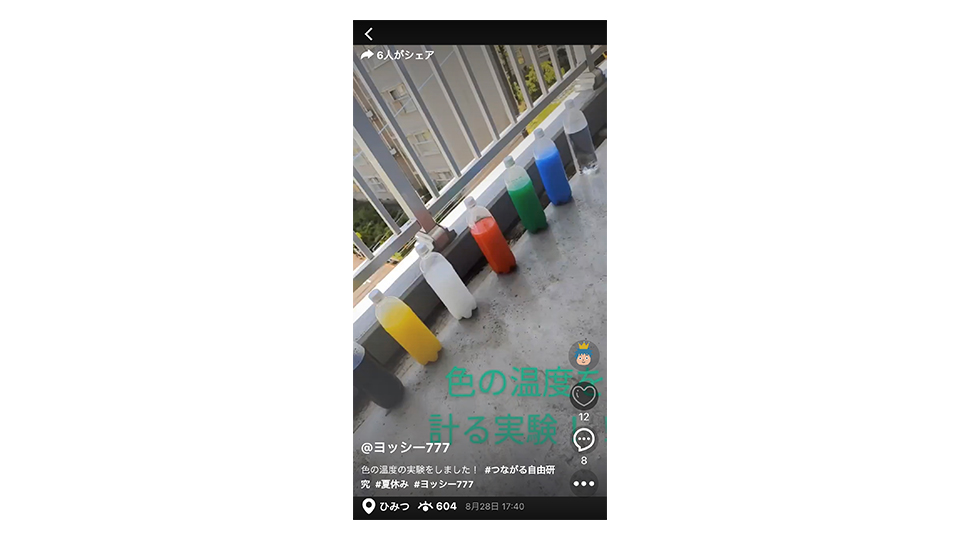 Independent research post
Please tell us about your future growth strategy and revenue pillars.
Motoyama: The three pillars of our revenue model are "subscriptions," "advertising," and "corporate tie-ups." 4kiz is currently growing at a pace of about double every quarter, and the number of comments has surged to 150,000 per month. The main focus at the moment is corporate tie-ups, such as holding contests for children jointly with companies. This matches the needs of companies wanting to safely implement projects related to education and creativity, so we are focusing on it the most.
In the medium to long term, we are strategizing to make segmented advertising businesses for children and parents, as well as subscription businesses for items that revitalize communication like stamps and avatars, into our main revenue sources as we expand the user scale, which is about 70,000 users as of October 2025.
Please tell us what results or networks you gained by participating in the ICT Startup League.
Motoyama: I am grateful that it wasn't just a bureaucratic process ending with selection; in addition to the subsidy project, they backed us through various initiatives. This interview is one example, and we received support to boost startups in various forms. Also, through the academy and other events, I was blessed with opportunities to hear stories from many stakeholders, which was very stimulating.
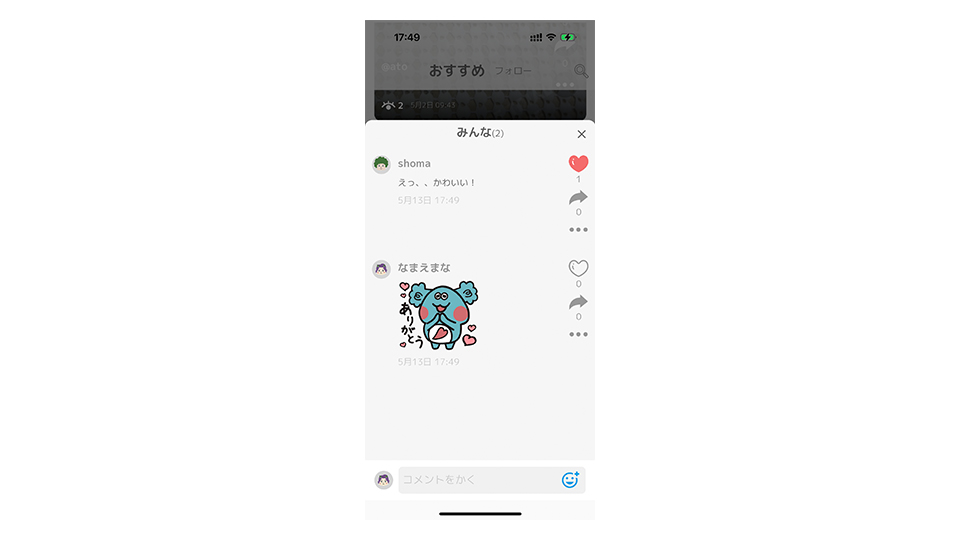 Comment section with many compliments and stamps
With regulations on SNS for children being strengthened globally, how do you view future market trends? Please also tell us about your superiority over competing overseas services.
Motoyama: The trend of strengthening regulations in Australia and the US will likely spread worldwide. And I believe this movement will actually further heighten the social significance of our platform, which prioritizes safety.
There are similar services overseas, such as "Zigazoo" which specializes in video posting, but they do not have interaction features like communities or comments. This is because there are barriers in both technology and operational structure to meeting children's communication needs while guaranteeing safety.
On the other hand, "4kiz" has established a unique position globally by balancing safety and interaction functions through AI and sentiment analysis. This is a decisive advantage, providing not just a place for content consumption, but a "community for praising each other and supporting challenges." We have already released a global version in 6 languages, and aim to expand overseas in parallel while prioritizing domestic growth.
Finally, what kind of future do you want to build for society through "4kiz"?
Motoyama: Our mission is "to create connections around the world that draw out children's infinite potential."
From my own experience of reaching UTokyo and Harvard through self-study from extreme poverty, I strongly believe that "opportunities to grow oneself through learning should be equal for all children." By utilizing AI and technology, we provide an online place where children can connect in their own way in a safe environment, empower each other, and develop their individual talents. Children around the world cheering each other on across borders, circumstances, and talents. Building such a future is our goal.
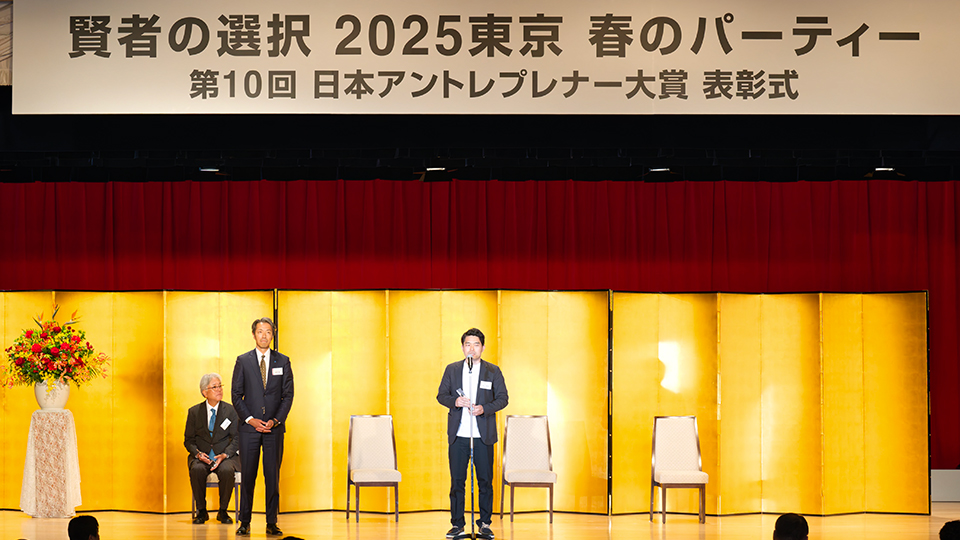 Received the Divisional Award at the 10th Japan Entrepreneur Award
Editor's Note
Mr. Motoyama's career path is that of a "Social Change Leader" who carved out a path through self-study from difficult circumstances, linked his experience in business construction cultivated at the Nippon Foundation to the social awareness he faced as a father of six, and is trying to build the foundation of society for the children who will carry Japan's future.
His vision of overcoming the negative issues held by traditional SNS with the power of AI sentiment analysis to create the "world's most positive" SNS is not merely a business, but a Reiwa-era restoration in the next generation's educational environment. In a world where regulations are tightening, I look forward to seeing what kind of growth the children using "4kiz" will show.
■ICT Startup League
A support program that started in FY2023, triggered by the Ministry of Internal Affairs and Communications' \"Startup Creation-type Embryonic Research and Development Support Project.\"
The ICT Startup League supports startups through four pillars.
1. R&D Funding / Accompaniment Support
Up to 20 million yen in R&D funding is provided in the form of subsidies. In addition, in accompaniment support, the selection and evaluation committee members who were involved in the selection of league members stay close even after selection to promote growth. For companies that the evaluation committee members evaluated as \"definitely want to adopt,\" a support system is built that is akin to \"Oshi-katsu\" (fan support), where the evaluation committee members themselves provide continuous support such as advice on business plans and providing growth opportunities.
2. Discovery & Development
We provide places for learning and encounters that promote the business growth of league members.
We also expand the search for those aiming to start businesses in the future, aiming to broaden the base.
3. Competition & Co-creation
It serves as a place for positive competition like a sports league, where startups learn together and improve themselves through friendly rivalry to win the funds they truly need (up to 20 million yen). We also provide a place for co-creation where league members collaborate to expand their businesses through various opportunities such as sessions by selection and evaluation committee members.
4. Dissemination
We will disseminate the initiatives of league members in cooperation with the media! By letting many people know about the businesses, we aim to expand new matching and opportunity fields.
■Related Websites
4kiz, Inc.
/
4kiz, Inc. (LEAGUE MEMBER)
/
ICT Startup League
💡 Read Next
After exploring the on-the-ground stories of our startups, discover the "big picture" from the top leaders driving Japan's startup ecosystem.
▶︎ Experts Discuss How Startups Should Compete in the Future
For more details on STARTUP LEAGUE's startup support, please see here.