
Imagine changing your look as freely as a chameleon with the touch of a button. Kohei Arai, a former Mercari engineer, felt a sense of crisis seeing apparel shops closing one after another during the pandemic and founded Metachrosys Inc. The company has developed an AI image generation tool that utilizes generative AI technology to create realistic trial fitting images on e-commerce sites. By addressing the cost issues associated with model photography—a major challenge for e-commerce sites—they aim to improve efficiency across the entire apparel industry. We spoke with him about the background behind his goal to fuse engineering expertise with a burning passion for fashion to realize a completely new shopping experience, and the future he envisions.
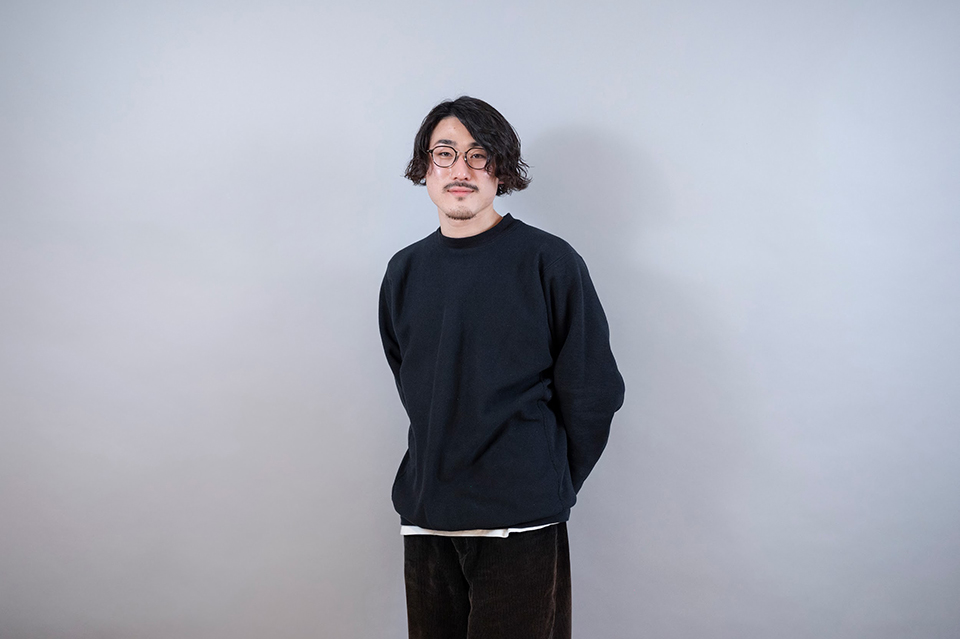 Kohei Arai, CEO of Metachrosys Inc.
Could you tell us about your profile and the events leading up to the founding of the company? I understand you worked as an engineer at Mercari, Inc., and then switched to the fashion industry after studying at a fashion school.
Arai: Yes. At Mercari, while working as an iOS engineer to improve the listing experience, I also worked on machine learning and AR technologies. I even filed a patent for automatic measurement that can automatically calculate dimensions when listing clothes.
When I decided to launch Metachrosys, I felt I lacked fundamental knowledge of garment production and the industry as a whole, so I attended a fashion school. The school I attended had a unique curriculum that allowed me to learn both the basics of clothing making and 3D modeling technology for clothes simultaneously.
What exactly is 3D modeling in the apparel industry?
Arai: 3D modeling is a technology for designing and creating three-dimensional objects on a computer. In the apparel industry, it mainly refers to the process of designing and producing clothes based on 3D models.
What motivated you to challenge yourself in the apparel industry, which was quite different from your previous career?
Arai: During the COVID-19 pandemic, the sense of entrapment in society and daily life grew stronger. While I was anxious about how long this situation would last, I saw the vintage clothing stores and select shops I frequented closing one after another. I was driven by a sense of crisis, thinking, "I can't let this happen; I have to do something." I became independent during the pandemic and launched Metachrosys around August 2022, just as the situation was beginning to settle down to some extent.
Specifically, what kind of issues made you feel "I can't let this happen"?
Arai: I love the time spent trying on clothes in stores and communicating with shop staff. I felt that the enjoyment unique to physical stores was a value distinct from the convenience of online buying and selling.
Witnessing many stores closing due to the pandemic, I feared that this element of the "store experience" might be lost from the industry. I started wondering if I could create a system that allows for a purchasing experience similar to physical stores, even online.
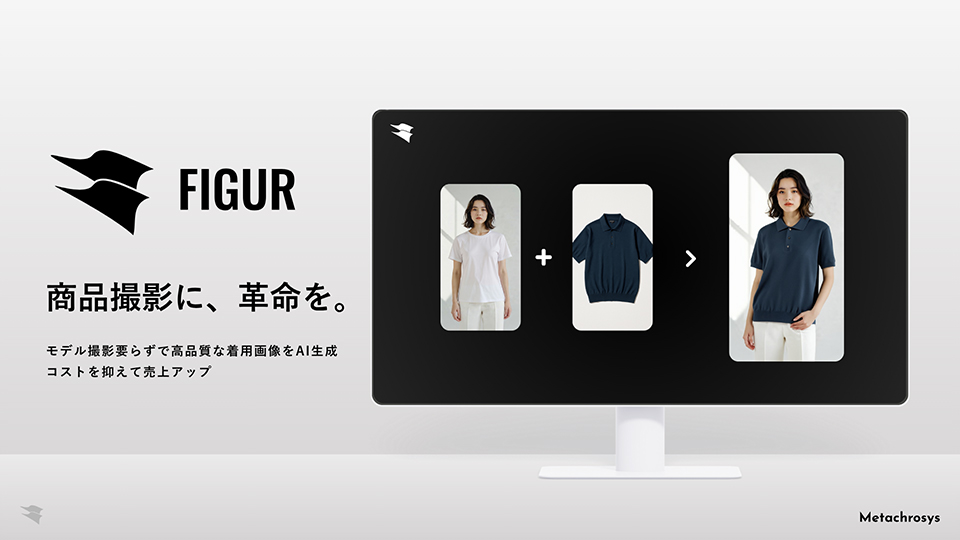 AI Image Generation "FIGUR"
So, the desire to provide a "purchasing experience like a real store" led to the virtual fitting business.
Arai: Exactly. I believed that if the fun of carefully examining product quality and fit could be made possible online, the time spent choosing clothes would become much richer. Our product, "FIGUR," which we are developing for apparel companies, is an image generation application that reveals realistic images of clothes being worn.
What kind of innovation will "FIGUR" bring to the apparel industry?
Arai: The presence of e-commerce sites in the apparel industry continues to grow every year, and enriching the published information while producing it efficiently has become a major challenge. Currently, for many brands, less than half of the products on e-commerce sites include images of models wearing them. It is said that conversion rates (the probability of purchase) improve when model images are included compared to just product images. However, due to reasons such as shooting costs and time, many companies find it difficult to prepare enough wearing images. This lack of photos means they cannot fully appeal to the product's charm, leading to a situation where they are left holding a lot of inventory. With "FIGUR's" generative AI, wearing images can be created at low cost and in a short time, significantly improving the issues of photography and the shortage of wearing images.
Compared to the past, how much cost improvement and efficiency can be expected?
Arai: This is a model estimate, but with standard photography, it often takes 30 minutes to an hour per product from product arrangement to photo delivery. With "FIGUR," a wearing image can be generated in as little as about 30 seconds. Image production costs can also be reduced to about 1/30th to 1/60th.
The speed and cost reduction are drastically improved! I heard that for the development of "FIGUR," you are particularly particular about "expressing realistic size."
Arai: The sense of size when worn is a point that is strongly emphasized during fitting. In Japan especially, both end-users and companies have a high awareness of size, and there are unique Japanese measurement methods. We are focusing on building a system to realistically express the size, length, clothing wrinkles, and body lines when worn, as well as making proposals that align with Japanese apparel business customs.
There are cases where designs are elaborate, or the size feel is completely different depending on the brand even with the same size notation. Expressing that seems difficult.
Arai: The image generation itself can be made with just a single photo of the product item. Reflections of detailed designs such as back prints or collar/sleeves can be reproduced by utilizing additional photo data. Regarding size, we improve reproduction accuracy by having the system read photos of people actually wearing the clothes. We will continue to actively collect data and promote research to improve the accuracy and efficiency of image generation, as well as the learning of products with similar designs and sizes.
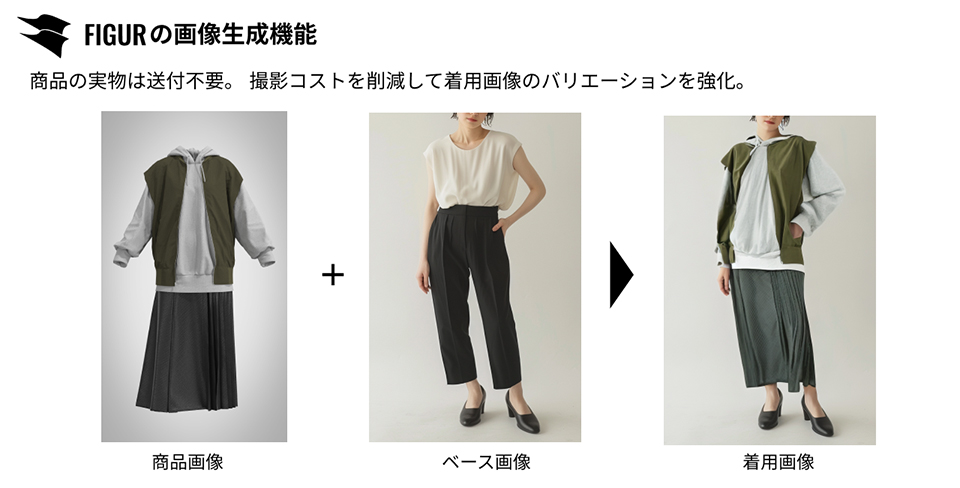 "FIGUR" Image Generation Function
Are there companies that have already adopted "FIGUR"?
Arai: Yes, there are apparel companies that have introduced it, and we also have initiatives where we generate and provide images as a paid PoC (Proof of Concept). We have received feedback from user companies such as, "Other AIs cannot create images with this level of precision," and "It would be difficult to sustain the business without FIGUR." It matches particularly well with the businesses of companies that employ AI influencers for sales promotion. Our strength lies in bringing development in-house, ensuring the accuracy of the base algorithm and speed in responding to customer feedback. Another characteristic is that, due to our unique learning logic, we excel at generating images that are easy for Japanese people to visualize.
Besides "FIGUR," what other businesses or services do you operate?
Arai: Under the theme of "Digital mannequins that make 3DCG clothes look beautiful," we provide a 3DCG mannequin called "Auin" for the apparel industry. This is a mannequin that can be used on software (3DCAD) for creating clothes via 3D modeling. It is a service that responds to feedback such as "Traditional Western-body type mannequins are hard for Japanese companies to use" and "Usage licenses for overseas enterprises are expensive." Additionally, we are proceeding with research and development on apparel DX operations using 3DCG and generative AI, as well as a digital human business where corporate executives and others are turned into AI avatars to communicate as clones.
What is the thought behind the company name "Metachrosys"?
Arai: "Metachrosis" refers to the ability of animals like chameleons to change their body color to match their environment. I named it with the hope of making changing clothes easy and exciting using Generative AI and 3D technology. At the same time, it embodies my desire as an engineer to constantly catch up with required technologies and continue evolving.
"FIGUR" and "Auin" are both B2B services, but listening to you, Mr. Arai, I feel that you also place importance on convenience and fun from the end-user's perspective.
Arai: That's true. While I want to help the industry as a whole, the root of the business lies in the excitement regarding realistic clothes selection that I felt myself. So eventually, I want to develop content that can approach end-users directly.
"FIGUR" is currently in its beta version, and we are considering an official release early in 2026. In the future, I hope to make it possible for users to perform virtual fittings using their own photos, allowing them to try on and choose clothes that suit them as much as they like. The technology for this is already ready, but since many companies and brands outsource their e-commerce site construction to external firms, the future themes involve adjustments on how to integrate it systematically and designing the business model.
I see. The technical foundation is established, so it depends on the approach.
Arai: Personally, I think there are difficult aspects to asking end-users to pay directly. For example, we are considering adopting forms such as SaaS for companies or affiliate models. To achieve that, I believe the first step is to reach various apparel companies with "FIGUR" and have them actually use it to realize its effectiveness.
How do you hope your company's business will change the apparel industry and consumer behavior in the future?
Arai: Before e-commerce sites became widespread, the general flow was to go to a store to see the clothes you wanted or liked, look at model wearing images, or try them on before purchasing. However, using the power of generative AI, even without searching yourself, clothes that suit you will be proposed in a state where they are already "tried on" on the screen. Furthermore, by aggregating this data, product planning can be done based on designs and trends that many users need (demand-pull type). I hope to bring about a revolution in the relationship between the traditional fashion industry and users, as well as the entire supply chain. We are also considering overseas expansion, but since competitors in the US and China are very strong, I want to continue considering how to approach them while building up our track record.
If clothes that suit us are proposed, the range of coordination seems likely to expand significantly!
Arai: Imagine an AI agent becoming your exclusive "Personal Stylist," proposing products according to each individual's body type, preferences, and budget. As you pointed out, I anticipate that the shopping experience itself will change dramatically with the addition of the "Personal Stylist's" perspective, not just your own.
Finally, please tell us why you participated in the ICT Startup League and your impressions.
Arai: Since this is a product that requires investment in research and development, mechanisms that support the product, such as subsidies, are truly appreciated. Also, having actually participated, I was surprised that sessions are held more frequently than I expected. I can hear practical advice from lecturers, and I am receiving significant backup in terms of knowledge as well. I am also happy to have a place to meet people with entrepreneurial experience and fellow entrepreneurs. I want to work even harder to meet expectations.
Editor's Note
Metachrosys aims for a future where everyone can easily enjoy the joy of choosing clothes, often called a "second skin." I felt that a future is right around the corner where AI-generated wearing images will not only stop at cost reduction for apparel companies but will eventually enhance our sensibilities and creativity. While supporting the industry's foundation with current B2B services, the goal is a world with a "Personal Stylist" where AI fully understands body types and preferences to present the optimal clothes. This new purchasing experience will likely evolve not only our closets but our consumption behavior itself significantly.
■ICT Startup League
A support program started in FY2023, initiated by the Ministry of Internal Affairs and Communications' "Start-up Creation-type Germination Research and Development Support Project."
The ICT Startup League supports startups through four pillars.
1. R&D Funding / Accompaniment Support
Up to 20 million yen in R&D expenses is provided in the form of subsidies. In addition, in the accompaniment support, the selection and evaluation committee members who were involved in the selection of league members will stay close after selection to promote growth. For companies that the evaluation committee members evaluated as "absolutely want to adopt," a support system likened to "Oshi-katsu" (supporting one's favorite) is constructed, where the committee members themselves provide continuous support such as advice on business plans and providing growth opportunities.
2. Discovery & Incubation
We provide places for learning and meeting that encourage the business growth of league members.
We also expand the base by discovering those who aim to start a business in the future.
3. Competition & Co-creation
It is a place for positive competition like a sports league, where startups learn together and improve each other while competing to win the necessary funds (up to 20 million yen). We also provide a place for co-creation where league members collaborate to expand their businesses through various opportunities such as sessions by selection and evaluation committee members.
4. Dissemination
We will disseminate the initiatives of league members in cooperation with the media! By letting many people know about the businesses, we aim to expand opportunities for new matching and chances.
■Related Websites
Metachrosys Inc.
/
Metachrosys Inc. (LEAGUE MEMBER)
/
ICT Startup League
💡 Read Next
After exploring the on-the-ground stories of our startups, discover the "big picture" from the top leaders driving Japan's startup ecosystem.
▶︎ Experts Discuss How Startups Should Compete in the Future
For more details on STARTUP LEAGUE's startup support, please see here.