
Fish Pass Inc., a startup specializing in "rivers," holds a unique position among the companies selected for the ICT Startup League. How are ICT and rivers connected? It all started with "recreational fishing tickets" (Yugyoken).
A recreational fishing ticket is essentially an "entry permit" for fishing. When fishing primarily in rivers, anglers obtain permission by purchasing a ticket issued by the local Fisheries Cooperative Association (Fisheries Coop) that manages that river. Fish Pass was the first in Japan to digitize this ticket, creating a system where it could be bought via smartphone. Improving convenience for anglers resulted in operational efficiency and increased revenue for the Fisheries Coops. Since then, Fish Pass has steadily built a network with coops nationwide, partnering with approximately 450 associations and holding a 60% domestic market share. Now, moving beyond just ticket sales, they are attempting to bring various transformations to the world of rivers, which has been a blank space for ICT.
The background of the representative leading the business, Narumi Nishimura, is also unique. Before founding Fish Pass, he managed multiple restaurants. It is said that when he conceived the Fish Pass business, the mobile phone he was using was a feature phone (flip phone), not a smartphone.
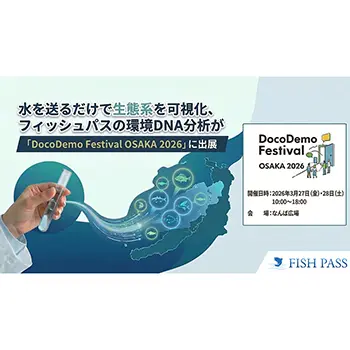
Incidentally, the research and business project they are undertaking in the League involves developing and demonstrating a "SaaS" project that visualizes corporate environmental contributions by utilizing environmental DNA (eDNA) technology to scientifically visualize river biodiversity. Through this, they aim to support ESG management and construct a new, simple infrastructure to protect biodiversity starting from rivers in Japan, expanding to Asia and the world.
We asked Mr. Nishimura about the path that led to this project and the details of his research and business.
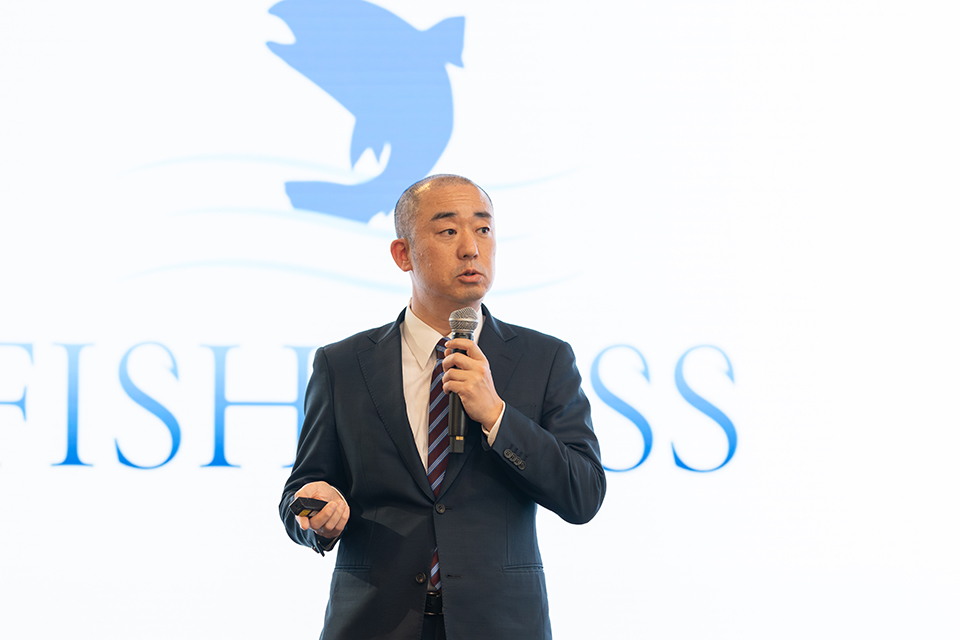 Narumi Nishimura, Representative of Fish Pass Inc.
I heard that you managed restaurants before founding Fish Pass. Looking at your background, you graduated with a degree in literature. It seems you didn't have much connection to ICT or tech; how did you come to found Fish Pass?
Nishimura: In high school, I liked Western history and was interested in going abroad. I thought language skills would be useful in any field, so I majored in German language and culture. I took a job at a chemical manufacturer, but the reason I was attracted to it was the possibility of working overseas. In fact, I was even posted to Switzerland as a member of the overseas division.
I still don't see the connection to Fish Pass at this stage (laughs).
Nishimura: Actually, since I was a teenager, I had a desire to start my own business someday. That said, it wasn't with any deep meaning or high aspirations. Perhaps because I often expressed opinions different from those around me, friends often pointed out that "personality-wise, you aren't the salaryman type"... I was only vaguely aware that might be true. However, during my time as a company employee, I hated the packed commuter trains so much that I wanted to quit every day (laughs), so I suppose I really wasn't suited for it.
So you moved into the restaurant industry. Why did you choose food service instead of the ICT field that connects to your current work?
Nishimura: My 20s coincided with the IT bubble, so I did have the notion that if I were to start a business, it should be in IT. The reason I turned to restaurants was triggered by reading a management magazine called "Harvard Business Review."
Was there an article that influenced you?
Nishimura: Yes. It was an article stating that among the young people who launched IT startups in Silicon Valley, many had first earned their business capital through the restaurant industry—in other words, a cash business. I thought, "I see," and decided to try the restaurant business first, timing it with a transfer offer from my company. It was also at that timing that I made a U-turn back to my hometown of Fukui, where we are still based. I thought that if I were to do food service, Fukui would be safer than a big city because I could keep the rent down.
So that was the flow of events!
Nishimura: However, once I started the restaurant business, it was harder than I imagined, and I realized I had underestimated it. In the end, it took several years to stabilize. Around the 10th year, when the number of managed stores had increased and I had some breathing room, the passion to start a business in the IT field boiled up again. Since the restaurants were franchise operations, the feeling of wanting to "do business with my own brand" also grew stronger.
It was a detour, but you hadn't forgotten your original independence goals.
Nishimura: Yes. First, to prepare for a new venture, I started by attending Fukui Prefectural University to get an MBA. During that time, there was an assignment to find my own research theme, and I was stuck finding one. I received advice saying, "If you observe your own footing again, such as your upbringing or hometown, you might find a research theme." Following that, I decided to go fishing in the river.
It looks like we're finally getting to the story of Fish Pass!
Nishimura: I remembered my grandfather taking me to the river to fish for char (Iwana) and cherry salmon (Yamame) when I was small. So, when I visited the river for the first time in a while, the mountains were desolate, sediment had flowed into the river, and the habitats for fish had decreased. The river of the past was no longer there. It was also at that time that I learned about recreational fishing tickets. This experience became the catalyst that led to research on regional revitalization at Fukui Prefectural University, the project to digitize fishing tickets, and ultimately the founding of Fish Pass.
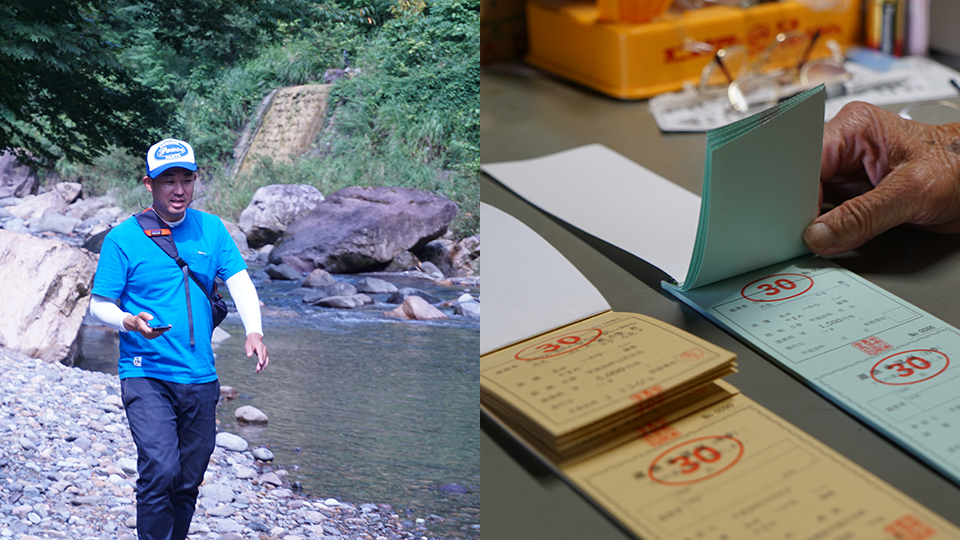 Mr. Nishimura at the river with a paper fishing ticket
Please tell us about Fish Pass's current business.
Nishimura: A major cause of the river's decline is the lack of successors and deteriorating management of the Fisheries Coops that manage them. The biggest problem in this management deterioration was the failure to purchase fishing tickets. There are quite a few people who fish without permission, not buying a ticket, and some anglers don't even know a ticket is required. Or, even if they knew, some didn't know where to buy one. The Coops conduct patrols and surveillance as countermeasures against non-purchase, but labor costs are high, and there are limits. So, we developed a system to digitize the fishing tickets and allow them to be purchased online 24 hours a day from a smartphone.
That is incredible initiative for someone who had been unrelated to the IT field until then.
Nishimura: I utilized startup support systems like business plan contests to obtain development funds. Regarding human resources, I consulted the Fukui Industrial Support Center and had them introduce me to experts and IT companies that could undertake app development. regarding the Fisheries Coops, I first conveyed my passion to the coop of the Takeda River in my hometown and got them to adopt it. Because fishing ticket sales there increased by 1.5 times, the number of coops adopting the system gradually increased.
And now, about 450 coops have adopted it.
Nishimura: Not only can users buy tickets, but we also roll out services useful for anglers, such as viewing river water level information through the app, receiving notifications in case of sudden water level rises, and automatically including accident insurance. Also, there was data showing that by using the smartphone's GPS function to grasp the location and status of ticket purchasers without going out on patrol, we were able to reduce the Fisheries Coop's angler location confirmation work by 57%.
It was a system with significant benefits for both anglers and Fisheries Coops.
Nishimura: Furthermore, being selected for the Excellence Award in the Ministry of Internal Affairs and Communications' "ICT Regional Revitalization Awards" in 2017 became the catalyst for nationwide expansion. By the way, the Kuzuryu River in Fukui is like a holy land for river fishing enthusiasts. Thanks to that, even in sales to remote Fisheries Coops, the greeting "I came from Fukui, home of the Kuzuryu River" served as a business card. I was often accepted immediately, and I realized this is a business born *because* it's rural, unique to the regions.
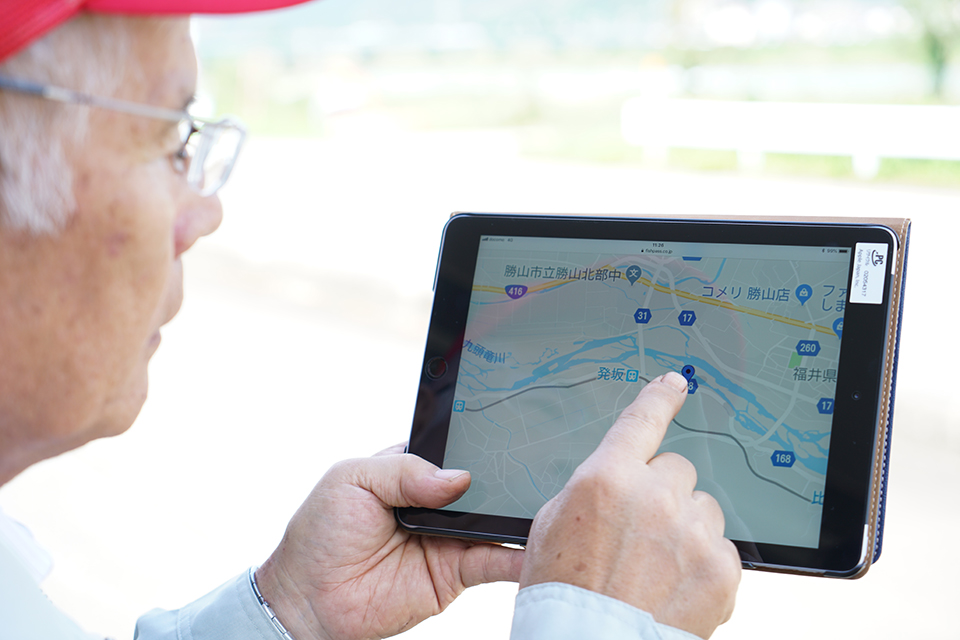 ICT implementation in Fisheries Coops_Remote Monitoring
Fish Pass is developing a business specialized in "rivers" starting from fishing tickets. Could you tell us in detail about the research and business content selected for the ICT Startup League?
Nishimura: After starting the smartphone sales business for fishing tickets, for a while, we proceeded with business centered on the nationwide expansion of this app. As a result, our network with Fisheries Coops nationwide expanded. During that time, various business ideas and consultations came up, but personally, I had a strong desire to be number one in this domain, to achieve a breakthrough purely via "rivers." Then, about five years later, I encountered the current research and business content: "Environmental DNA (eDNA) Technology."
What is "Environmental DNA Technology"?
Nishimura: Briefly explained, it is a technology that analyzes the DNA elements in a cup of river water to investigate the ecosystem of that river. Until now, ecosystem surveys were mainly done through analog methods, such as actually diving into the river. However, with this technology, easy investigation and analysis become possible, leading to the accumulation of data that can scientifically quantify the river's ecosystem.
Why was this technology important for Fish Pass?
Nishimura: For example, wild salmon swim upstream to the river where they were born in the autumn. However, depending on the year, there are years when not many come up. Then, the number of anglers buying tickets decreases, the Fisheries Coop's sales decrease, and our business is also affected. I always thought this wall would come someday. In other words, Fish Pass's digital ticket sales service is a business that cannot exist without a river with rich fish and ecosystems. That is why we need to constantly grasp the state of the river and check for ecosystem collapse or abnormalities. And we must protect rivers where rich ecosystems exist. Therefore, I believe environmental DNA technology will become more important in the future.
With Fish Pass's Fisheries Coop network, it seems you could analyze and accumulate ecosystem data from many rivers nationwide.
Nishimura: Because of the relationship of trust we have built so far, if we put out the word, samples gather from all over the country at once. We have also established our own analysis center capable of processing large amounts of samples quickly. By utilizing ICT and DX, we are looking into converting complex ecosystem data into valuable information that anyone can understand.
It seems this will also lead to the conservation and restoration of the river environments where you played and fished as a child, Mr. Nishimura.
Nishimura: Yes. "Wanting to improve the rivers of the region where I was born and raised" is the origin of Fish Pass's business. I want to advance the DX of rivers for the environmental conservation of rivers nationwide. I want to restore desolate rivers to the way they were when I was a child so that the next generation... so I can enjoy fishing together with my grandchildren's generation.
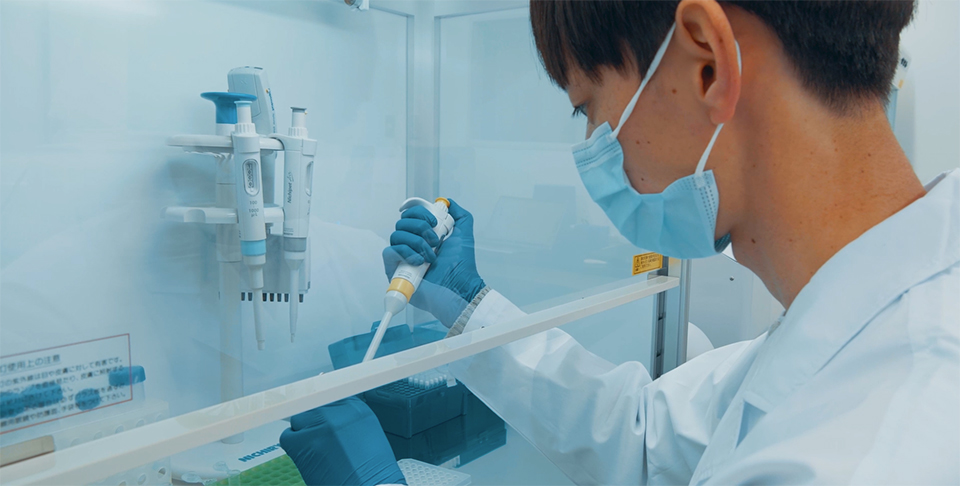 Environmental DNA Analysis Lab Scene
Please tell us your impressions of participating in the ICT Startup League.
Nishimura: The other day, I participated in the League Academy for the first time and spoke at the Value Up Session, but I was taken aback (laughs).
By what?
Nishimura: I have participated in various accelerator programs before, but the atmosphere is completely different. It feels like it's writhing tremendously... I feel an atmosphere that destroys something to create, in a good way. Accelerator programs are usually somewhat "honor student-like," but that image was smashed.
Specifically?
Nishimura: The questions regarding my business and, conversely, the advice I asked for, often transcend my assumptions. For example, when I explained Fish Pass, I received an opinion from everyone saying, "Why don't you try bear countermeasures too?" and in the end, three-quarters of the allotted time became a discussion about bear countermeasures.
It is true that bears often come out to towns along rivers... but that is different from the river ecosystem (bitter laugh).
Nishimura: But I think that's what "value up" means. For a startup hitting a wall or unable to break out of its shell to achieve a breakthrough, I feel it is sometimes necessary to be "destroyed" by advice from a deep drawer of knowledge and a high perspective. It's the first time I've felt that way in a public setting.
The fact that the ICT Startup League has a strong spirit of "doing what no one has done before to produce results" probably influences this.
Nishimura: Fish Pass's business is looking at overseas expansion in the future. When I mentioned that in the League, I received an idea: "If you're going to do it, why not export the Japanese Fisheries Coop system to East Asia together with fishing as a leisure activity?" It was the first time anyone had said that to me, and I found it interesting.
New talent will be necessary for overseas expansion, and it seems you might meet such connections in the ICT Startup League, which provides accompaniment support.
Nishimura: With environmental DNA technology, complex ecosystem data can be changed into an easy-to-understand form. If we do that, we should be able to create a place where companies, the government, and local people can discuss river environmental conservation from the same perspective. I want to build a mechanism for biodiversity conservation that spreads from local rivers to Asia and the world, realizing a future where people and nature coexist. I have high expectations for the ICT Startup League in that regard as well.
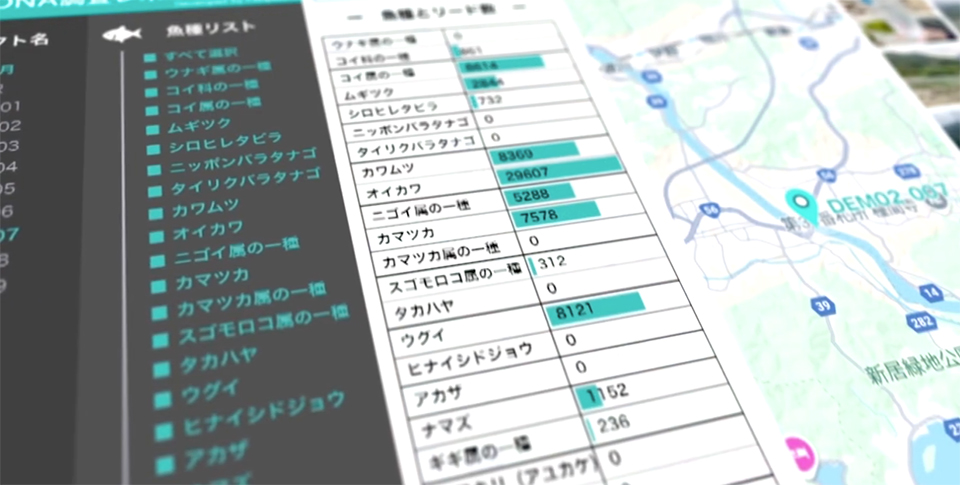 Biodiversity Visualization SaaS Demo Screen
Editor's Note
Mr. Nishimura had a longing for overseas and was a backpacker during his student days. Even now, when he can take a long vacation, he sometimes goes on solo trips. "I'm still a backpacker. I especially like going to Southeast Asia." However, now his eyes inevitably turn to the rivers.
"In Southeast Asian countries, I feel the vibrant breath of growth, that they are developing right now. Looking at dirty rivers and people fishing lawlessly there, I see it as a symbol of that and think, 'Maybe Japan in the past was like this too.'"
Fish Pass's overseas expansion will likely draw on such "field research" as reference material.
■ICT Startup League
This support program started in FY2023, triggered by the Ministry of Internal Affairs and Communications' "Startup Creation-type Germination Research and Development Support Project."
The ICT Startup League supports startups through four pillars.
1. R&D Funds / Accompaniment Support
Up to 20 million yen in R&D funds is provided in the form of a subsidy. In addition, in accompaniment support, the selection evaluation committee members who were involved in the selection of League members stay close after selection to promote growth. For companies that the evaluation committee members evaluated as "absolutely want to select," a "fan-like" support system is built where the evaluation committee members themselves continuously support by providing advice on business plans and growth opportunities.
2. Discovery & Development
We provide opportunities for learning and encounters that promote the business growth of League members.
We also expand the discovery of people aiming to start businesses in the future, aiming to broaden the base.
3. Competition & Co-creation
It is a place of positive competition like a sports league, where startups learn together and work hard, structured so that they win the funds they truly need (up to 20 million yen). We also provide a place for co-creation where League members collaborate to expand their businesses through various opportunities such as sessions with selection evaluation committee members.
4. Dissemination
We will disseminate the initiatives of League members in cooperation with the media! By letting many people know about the businesses, we aim to expand the field for new matching and chances.
■Related Websites
Fish Pass Inc.
/
Fish Pass Inc. (LEAGUE MEMBER)
/
ICT Startup League
💡 Read Next
After exploring the on-the-ground stories of our startups, discover the "big picture" from the top leaders driving Japan's startup ecosystem.
▶︎ Experts Discuss How Startups Should Compete in the Future
For more details on STARTUP LEAGUE's startup support, please see here.