Waiting endlessly at the hospital while feeling sick, only to wait again at the pharmacy... This is a scene that everyone receiving medical care in Japan has given up on as "unavoidable." However, a revolutionary next-generation pharmacy service that fundamentally overturns this "status quo" launched on November 17, 2025.
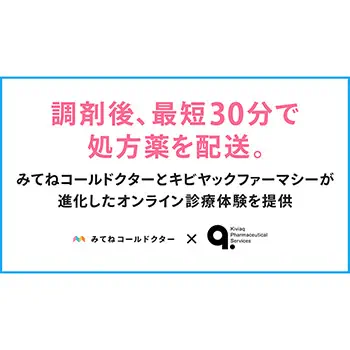
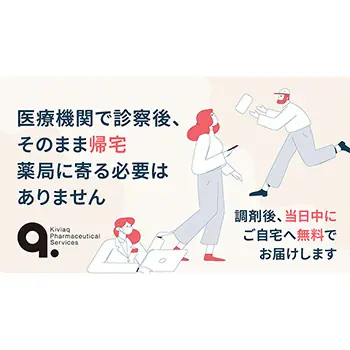
The defining feature of the service is its groundbreaking mechanism: "Prescription medicine delivered to your hand without visiting a pharmacy." Patients simply perform the necessary operations on LINE after their medical consultation. This eliminates burdens such as travel, waiting times, and the risk of secondary infection, allowing medicine to be delivered free of charge in as little as 30 minutes after dispensing.
Leading this "Pharmacy Revolution" is Kiviaq Inc., whose vision is "Overwhelming Quality for All Medical Experiences." By fusing technology and SCM (Supply Chain Management) to create a completely new pharmaceutical distribution and pharmacy experience, they are aiming to make a significant impact on the Japanese medical and pharmacy industry, where inefficiencies have been left unaddressed for many years.
We asked Representative Director and CEO Shun Okada about the background of the founding, the specific details and future developments of this next-generation pharmacy service, and the vision of the future he is depicting.
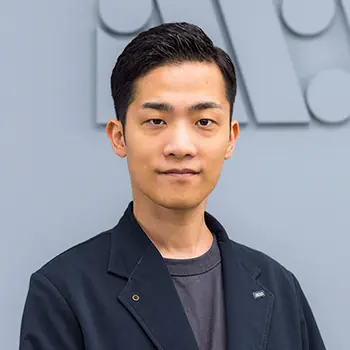
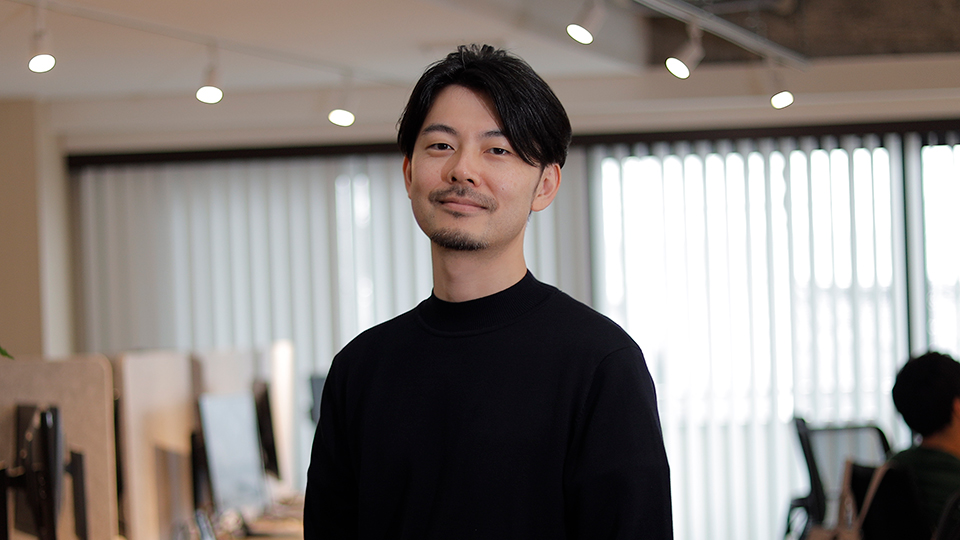 Shun Okada, Representative Director and CEO of Kiviaq Inc.
First, I would like to ask about your career leading up to the founding of Kiviaq.
Okada: After graduating from high school, I moved to the US and obtained a bachelor's degree from the University of South Alabama. I started working as a CPA at the KPMG Los Angeles office, but immediately after, the Lehman Shock hit... Amidst a storm of layoffs and staff shortages right after joining, I became involved in managerial project work rather than the auditing tasks accountants usually do, starting from an early stage in my career.
So, you started running in a direction slightly different from a typical accountant's career.
Okada: Gradually, my desire to create top-line revenue myself and maximize profits at the forefront of global business grew stronger than staying in an accountant's position. In an era before the term "GAFA" was even used, I sent direct job application emails to Apple, Amazon, and Google in both Japan and the US. Among them, Amazon Japan offered me a role to "lead a project to build the largest domestic warehouse, from strategy formulation to launch and management stabilization," which led me to decide to return to Japan.
You returned to Japan, joined Amazon, and were entrusted with a project.
Okada: It was a turning point in my life. At Amazon, I was constantly strategizing for logistics and supply chain operations—how to deliver goods to customers faster, easier, and at lower costs. I was involved in building proprietary delivery networks, mechanisms for delivery by non-major carriers, and the implementation of Japan's first "unattended delivery" (Oki-hai) service.
Later, with a desire to start my own business, I left Amazon. While engaging in entrepreneurial activities, I had a fateful opportunity to join Minacara Inc. in the healthcare industry. Serving as CFO and then Representative Director and President, my mission was corporate turnaround and creating new businesses for the next 10 years. While achieving profitability in the pharmaceutical EC business and promoting new online medical and pharmacy businesses, certain issues became glaringly apparent.
What kind of issues were there?
Okada: Through managing Minacara, I painfully realized that SCM—the smooth operation of processes from raw material procurement to manufacturing, inventory management, delivery, and sales—which is standard in the logistics industry, is a major issue in the medical and pharmacy industry. As a result, the reality of drug shortages for patients and inconvenient medical access became visible.
So, I thought that if I applied the knowledge and experience in supply chain and logistics I had cultivated so far to pharmacies and the medical industry, I could create a better world. That is what led to the founding of Kiviaq.
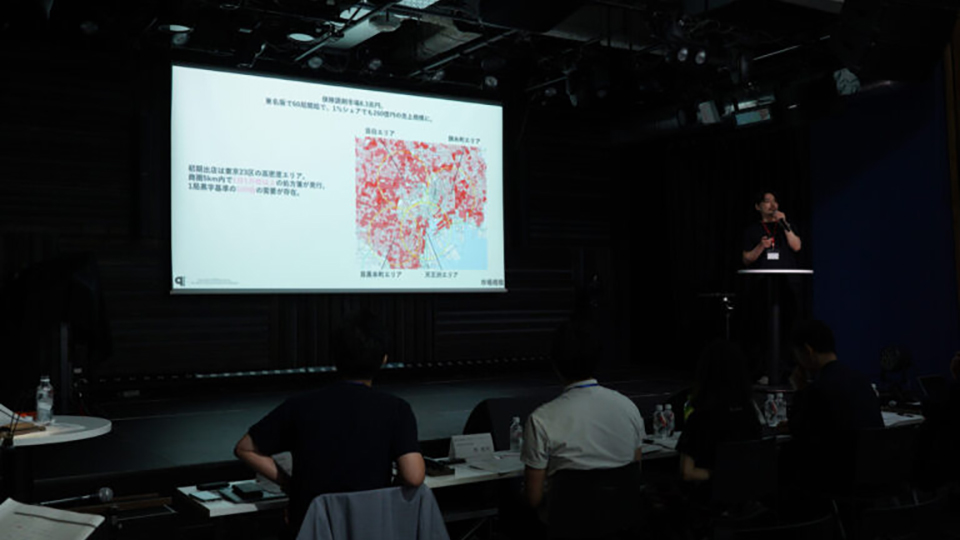 Mr. Okada giving a pitch
From the perspective of patients using medical institutions and pharmacies, please tell us about the issues regarding medical access.
Okada: I often accompany my elderly mother to the hospital, and simply put, the biggest issue is the "overwhelming waiting time." Waiting a long time at the hospital and then being made to wait again at the pharmacy is truly inefficient. Also, it is surprisingly common to go to a pharmacy only to be told, "We don't have stock, so please go to another pharmacy." The "mal-distribution of medicine," where you have to visit several places to finally find what you need, is a major issue.
Another issue I feel is the low added value of pharmacies. Medication guidance by pharmacists is a legal obligation, but many patients feel "as long as I get the medicine, anywhere is fine" and don't feel the necessity, so the branding and expertise of pharmacies are not being demonstrated. I believe the fact that the "family pharmacist" system hasn't progressed much is the flip side of these issues.
So, the pharmacy launched this time is the first step in solving these issues. Specifically, what kind of service does it provide?
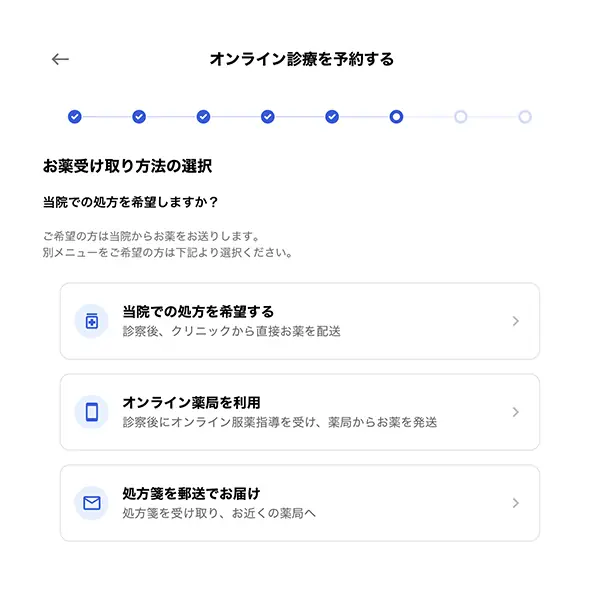
Okada: The pharmacy service provided by Kiviaq completes everything from prescription reception to dispensing and delivery on a LINE basis. After registering Kiviaq's official LINE account, patients input the necessary information according to the notifications received and receive medication guidance via online video call at their desired time. Then, if they select a desired delivery time slot (as fast as 30 minutes after dispensing), we deliver the medicine to a designated location such as their home, workplace, or in the future, delivery lockers.
If visiting a compatible medical institution, the institution will link the patient's prescription to Kiviaq's pharmacy, so the patient does not need to handle the prescription themselves. Of course, the service can also be used with non-compatible medical institutions.
It's revolutionary that there is no exchange of prescriptions and one can choose the time for online medication guidance. Where is the dispensing done?
Okada: Kiviaq operates a dispensing pharmacy, currently consolidated at one store in Shiba-Daimon. A major strength is that we are not a "platformer" but a "player" that owns the dispensing pharmacy and has a delivery division. Because we vertically integrate the pharmacy and logistics division, we can control the quality of service and lower costs through our own efforts. We have achieved free service fees and delivery fees.
In terms of service recognition and expansion, sales to compatible medical institutions seem key. How has the reaction been from medical institutions?
Okada: Thankfully, it has been very good, which we take as a positive surprise. Usually, for things like medical device sales, the closing rate is less than 1%, but for this business model, we receive comments from doctors asking, "Why hasn't a service like this existed until now?" and the rate of agreement to cooperate has reached nearly 30%.
What kind of patients tend to use Kiviaq's pharmacy?
Okada: I think there are largely three motivations for use. The first is the layer that finds it "physically difficult to go to a pharmacy," such as those with a broken leg or gout where walking is painful, those whose children are fussy after a hospital visit, or those who want to avoid secondary infection. The second is the layer that finds it "difficult to go to a pharmacy from a mental or privacy perspective," such as those with mental illnesses for whom going out itself is difficult, or those who do not want to receive medication explanations in a public space. The third is the layer that "values Taipa (Time Performance)." This includes busy business people, but a need unique to pharmacies we realized came from patients in the terminal stage with limited time left. We heard voices saying that while hospital visits may be unavoidable, waiting at a pharmacy afterwards is a "waste of life," and they want to be home doing what they love as soon as possible.
The needs of terminal patients are a perspective that is hard to notice.
Okada: I painfully realize that deeply diverse needs were hidden within what everyone endured, thinking "inconvenience is normal and unavoidable." We are starting to receive voices from users saying, "I'm grateful to get medicine even at night" or "It helped that it arrived in 30 minutes," and we are feeling a positive response.
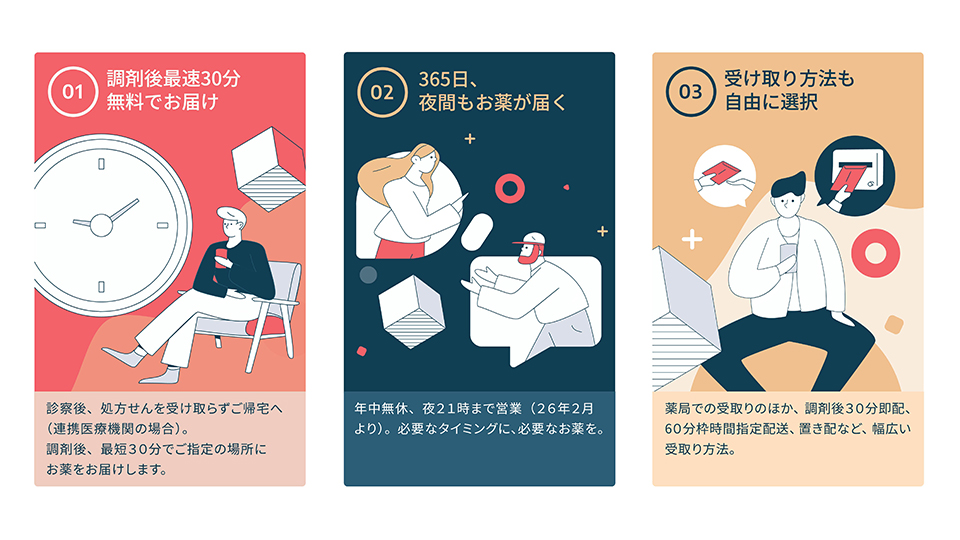 Kiviaq Service Concept Image
I would like to ask about future business expansion. What kind of service expansion are you considering as a medium- to long-term vision?
Okada: In the next 4 to 5 years, we plan to open 60 pharmacies primarily in urban centers like Tokyo, Nagoya, and Osaka. This will enable us to provide a minimum 30-minute delivery service to people living in those areas.
What we want to advance in parallel is the realization of the "Logistics Warehouse Pharmacy (Hub Pharmacy)." This is a completely warehouse-style pharmacy that functions as a hub bundling multiple store-type pharmacies (spokes). Here, physical tasks like medicine picking and packing will be completely mechanized and automated, and a minimum number of pharmacists will manage a wide variety of medicine inventory. We will verify a model where this hub and spokes are connected by a truck transport network to exchange inventory in real time.
It really is an image of bringing Amazon's logistics strategy into the pharmacy industry.
Okada: Exactly. I believe this concept of the Logistics Warehouse Pharmacy will lead to improved medical access in rural areas. With the revision of the Pharmaceuticals and Medical Devices Act in May 2025, it became possible to outsource part of the dispensing work. At present, while many local governments are still in the consideration stage, we will create part of a new regional medical system where Kiviaq's factory-like Logistics Warehouse Pharmacy takes on the physical tasks related to dispensing in rural areas, thereby supporting local medical institutions and dispensing pharmacies.
What are the benefits for rural pharmacies?
Okada: Rural pharmacies are facing tough management conditions due to decreasing patient numbers and other factors. If Kiviaq takes on the dispensing work, that portion of the pharmacists' resources is freed up. We want those freed resources to be invested more actively into interpersonal tasks, such as participating in home healthcare. In other words, we want to create an environment where pharmacists can concentrate on high-value-added work where their specialized knowledge truly shines. By combining the Logistics Warehouse Pharmacy with a delivery network, we will be able to reliably deliver medicine to patients in depopulated areas and other places where medical access is difficult.
 Kiviaq Pharmacy 001 @ Minato-ku
Are there any challenges to clear for business expansion?
Okada: The delay in DX (Digital Transformation) across the Japanese medical industry. In particular, electronic prescriptions have hardly spread at present. If this doesn't spread, information such as a patient's medical history and currently taken medications cannot be smoothly shared between doctors and pharmacists, making it difficult to improve the quality of aftercare and medical interviews.
The fact that paper prescriptions are still mainstream is also inefficient, isn't it?
Okada: The adoption rate of electronic prescriptions is currently only about 20% at medical institutions. Consequently, the visualization of pharmaceuticals has not progressed, and hundreds of billions of yen in taxes are wasted annually on duplicate prescriptions (where the same medicine is prescribed again even though the patient has it on hand). I want to cast a stone at such industry-wide issues, and it is important to continue preparing technology and mechanisms while watching the timing of digitalization progress.
If the mechanism changes, the role of pharmacists seems likely to change as well.
Okada: Precisely. Pharmacists are currently taking up a lot of time with tasks close to light labor, such as medicine delivery, shelving, picking, and accounting. Therefore, the reality is that they cannot devote enough time to interpersonal tasks they should inherently be doing, such as medication advice utilizing specialized knowledge and leftover medication management. If we make the physical tasks of pharmacies efficient with our logistics warehouse concept, pharmacists will be able to concentrate on highly specialized tasks such as medicine consultation from patients and checking drug interactions. By creating "a pharmacy that doesn't just hand over medicine but contributes to community health," we want to change it into a place where pharmacists working there can also do rewarding work.
You want both the medical providers and the patients receiving care to first try Kiviaq's new service and realize its benefits.
Okada: Thank you. I would definitely like many people to actually use the service. And while receiving frank opinions, I want to improve and develop the service with a sense of speed, creating a movement that can gradually change the mindset of the entire industry.
Editor's Note
Issues such as the "double wait" at hospitals and pharmacies and the mal-distribution of medicine have been accepted by us general consumers as "unavoidable" for many years. However, Kiviaq's challenge is proving that this "status quo" can be questioned and solved with the power of technology and logistics.
In the field of Medical DX, where Japan is said to be lagging decades behind overseas, Kiviaq is undoubtedly trying to create the future standard. If the "Logistics Warehouse Pharmacy" concept is realized and spreads nationwide, pharmacies will likely transform into professional groups of interpersonal tasks that truly support people's health. We want to support this movement of creating a new "standard" in healthcare.
■ ICT Startup League
This is a support program that started in FY2023, triggered by the Ministry of Internal Affairs and Communications' "Startup Creation-type Embryonic Research and Development Support Project."
The ICT Startup League supports startups through four pillars.
1. R&D Funding / Hands-on Support
Up to 20 million yen in research and development costs is provided in the form of a subsidy. In addition, for hands-on support, the selection evaluation committee members involved in the selection of league members stay close after selection to promote growth. For companies that the evaluation committee members rated as "absolutely want to adopt," a "push-support" (fan-like support) system is built where the committee members themselves provide continuous support such as advice on business plans and providing growth opportunities.
2. Discovery & Cultivation
We provide opportunities for learning and encounters that promote the business growth of league members.
We also deploy discovery for those aiming to start a business in the future, aiming to expand the base.
3. Competition & Co-creation
It is a place for positive competition like a sports league, where startups learn together and improve themselves through friendly rivalry to win the necessary funds (up to 20 million yen). We also provide a place for co-creation where league members collaborate to expand their businesses through various opportunities such as sessions by selection evaluation committee members.
4. Dissemination
We will disseminate the initiatives of league members in cooperation with the media! By letting many people know about the businesses, we aim to expand new matching and chance opportunities.
■ Related Websites
Kiviaq Inc.
/
Kiviaq Inc. (LEAGUE MEMBER)
/
ICT Startup League
InnoJin Integrates Telemedicine with Pharmacies: Resolving Fragmentation in Ophthalmology

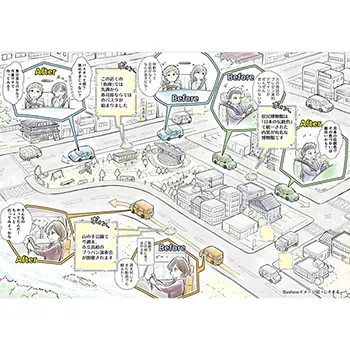
iiba Signs Cooperation Agreement with Komaki City, Aichi to Develop Digital Childcare Map
For more details on STARTUP LEAGUE's startup support, please see here.