- TOP
- About
- Affiliated League
- Information
- Column
- Media Information
- Job Information
- League Report
- League Members
- Partners
-
-
 公式X
公式X
公式X

Career or childcare? In modern Japan, many parents face this binary choice and struggle with the conflict. Prioritizing work often sacrifices time with children, while focusing on childcare compels parents to abandon their careers. As symbolized by terms like the "Barrier of First Grade" (the shortage of after-school care) and the "daycare waiting list problem," the environment surrounding child-rearing remains severe.
However, there is an entrepreneur who powerfully asserts, "It is not impossible to enjoy both 100%." She is Minami Suwa, Representative Director and CEO of Simplee Inc.
She advocates for a new concept called "Childcare as a Service (CaaS)."
It envisions a world where childcare is not completed as an individual responsibility (BtoC), but where society—hotels, commercial facilities, and corporations (BtoBtoC)—possess childcare functions as a standard feature.
Suwa holds an unconventional career history: she founded a company while at Keio University and experienced selling the business to a major corporation; she then ran at the forefront of DX at a foreign consulting firm, and eventually learned programming herself to develop her own system.
Under the conviction that "Time is Life," we approached the core of her future vision and the trajectory of her challenge to update Japan's childcare infrastructure alongside 1 million potential nursery teachers.
 Minami Suwa, CEO of Simplee Inc.
I'd like to start with your roots. Looking at your profile, it seems you experienced entrepreneurship while still a student. What kind of business was it?
Suwa: Yes. While attending Keio University (SFC), I launched a business where female university students proactively tackled social issues. At the time, the term "Influencer Marketing" hadn't taken root yet, but under the banner of "Marketing by women for women," I created a model where female students participated in corporate product development and local government revitalization projects.
It was like a precursor to what we now call Gen Z marketing. I gathered influential students, such as Miss Campus contestants, and provided consulting for new business development to large corporations. I sold this business to a major company upon graduation.
What were your thoughts on entrepreneurship at that time?
Suwa: I considered my student days to be a "Golden Time." Once you become a working adult, you are judged by your title or your company's signboard, such as "So-and-so from Company X." But as a student, people treat you flatly, and sometimes you get the chance to hear the "real talk" or see behind the scenes of corporate decision-making. I decided to use this privilege to just take action.
Of course, I often received harsh feedback from adults. I was sometimes dismissed with, "That won't work as a business." But since I had youth and flexibility on my side, I thought, "If my method is wrong, I just need to fix it," and I honestly absorbed the feedback and iterated improvements. I believe that experience built my foundation as a manager today.
You could have continued as a serial entrepreneur, but you chose to join a foreign consulting firm as a new graduate. Why was that?
Suwa: "Being able to undergo societal training for free" was one of the motives. Although I achieved certain results with student entrepreneurship, I couldn't deny the aspect that it was ultimately a student's imitation of business. I felt there were mountains of things I couldn't learn without placing myself inside an organization, such as the dynamics of large corporations, decision-making processes, global standard evaluation systems (like 360-degree feedback), and the backend of large-scale system construction.
So, I chose a US-based consulting firm that allowed side hustles and where I could acquire cutting-edge business skills. As a result, the roughly six years I spent there working on large-scale projects for financial institutions and others became valuable time for deeply understanding the field of DX and system implementation. This has become the technical foundation for Simplee today.
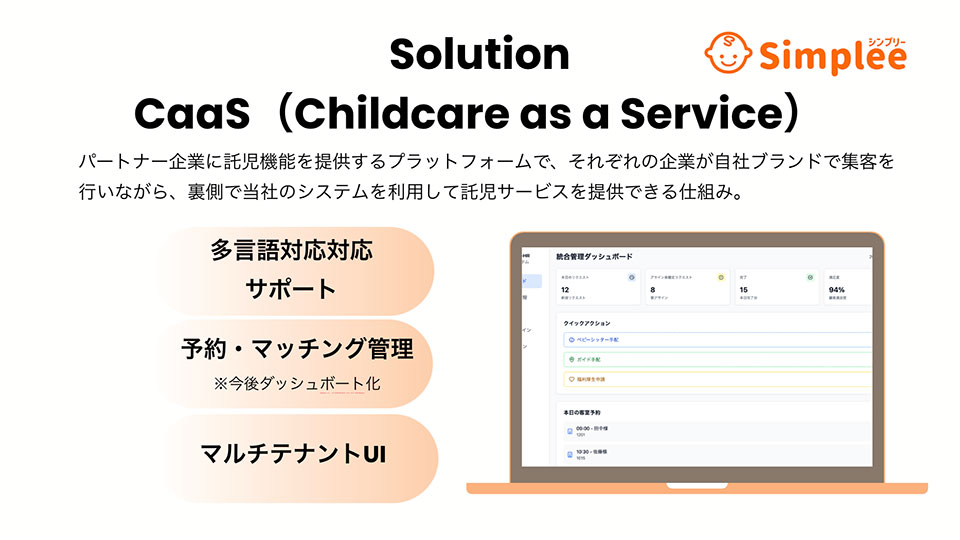 Solution provided by Simplee: "CaaS"
It looks like smooth sailing for your career, but was childbirth the turning point?
Suwa: Without a doubt, that was the biggest turning point.
Originally, I had a "greedy" ideal of wanting to do both work and childcare with equal intensity. I didn't want to suffer from "Empty Nest Syndrome," wondering what was left for me after child-rearing was over. I also predicted that dual-income households would become the norm and that the number of people struggling with the same conflict as me would increase.
However, reality wasn't sweet. When I tried to return to work, I couldn't find a trustworthy sitter, and corporate welfare benefits were difficult to use. Above all, sitter fees were expensive, and I faced the economic contradiction that almost my entire salary would disappear to pay for it. "I want to work, but the cost to work is too high." This intense pain is the origin of my current business.
So you decided, "If it doesn't exist, I'll make it." What surprised me is that you taught yourself programming and built the system. A consultant who can write code is a very powerful weapon.
Suwa: Yes, I started studying furiously during my maternity and childcare leave (laughs). Since I was doing DX consulting in my main job, I had a motive to deepen my IT knowledge, but more than anything, I wanted the "power to give form to my ideas." I learned both front-end and back-end, rented a server, and built a beta version of a web app myself that allowed for childcare reservations even for sudden schedules. I still remember the emotion I felt when the database worked and information was stored.
Why were you so obsessed with "building it yourself"?
Suwa: It is said that entrepreneurship requires "People, Goods, and Money," but it is an impossible feat for an individual with no track record to suddenly gather excellent "People" or ample "Money." However, I thought I could make the "Goods (Product)" with my own hands.
When I entered a pitch contest with a system that actually worked, an investor (Incubate Fund) saw it and asked, "Why don't we turn this into a business?" If I had explained it only with PowerPoint slides back then, I don't think the conversation would have progressed this quickly. Making the "Goods" myself resulted in becoming a magnet that attracted "People" and "Money."
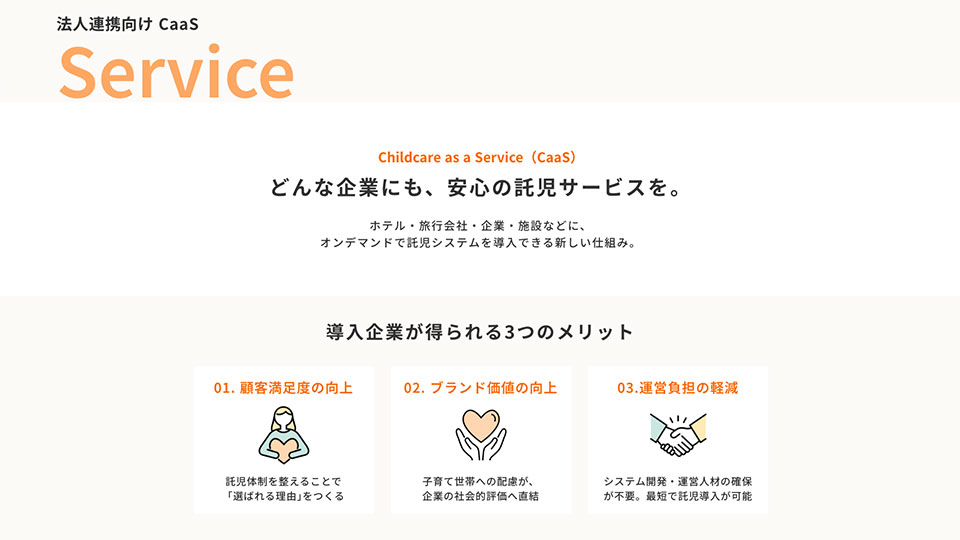 CaaS for Enterprise
That led to the birth of the concept "Childcare as a Service (CaaS)," which is the core of Simplee. How is this different from traditional babysitting services?
Suwa: In a nutshell, it is a shift from a world where "Individuals (C) arrange it" to one where "Society (B) arranges it."
Traditional sitter services are mainly BtoC, where parents have to find, contract, and coordinate with sitters themselves. However, Simplee's CaaS is a BtoBtoC model where "Businesses (B)" such as hotels, wedding venues, and event organizers implement childcare functions.
For example, we have introduced CaaS to Marriott group hotels. When guests think, "I want to leave my child for a bit to go to dinner," they can smoothly book childcare via the concierge. Since Simplee handles all the backend systems and operations, the hotel can become a "hotel with childcare functions" without risk.
This enables experiences (experience consumption) that were previously abandoned because "we have children," such as for inbound tourists or families attending weddings.
I see. It's an image where childcare functions are embedded into the "location." Are there any specific points you focused on regarding the system?
Suwa: I focused on a UI/UX that aligns with on-site operations.
"Micro-changes" to reservation details occur frequently, such as cancellations due to a child's sudden fever or changes in usage time. If you try to handle this via a game of telephone with calls and emails, mistakes inevitably happen, and the burden on the site is heavy.
Our system synchronizes information in real-time between the end-user, the facility, Simplee, and the sitter, so complex coordination costs can be dramatically reduced. This is a function I could only build because I ran the operations on-site myself and felt the pain firsthand.
The spread of this new service seems likely to lead to employment for sitters as well.
Suwa: It is said that there are about 1 million "potential nursery teachers" (licensed but inactive childcare workers) in Japan who have qualifications but are not working in the field. The causes are low wages, long working hours, and difficulty in taking time off.
Since Simplee provides high-value-added services for wealthy individuals and corporations, we can pay sitters higher compensation than the market rate. Also, work that supports "special occasions" often brings direct words of gratitude, offering great job satisfaction. I pride myself on being able to propose a new way of working where they can hold pride as professionals, not as "low margin, high volume" labor.
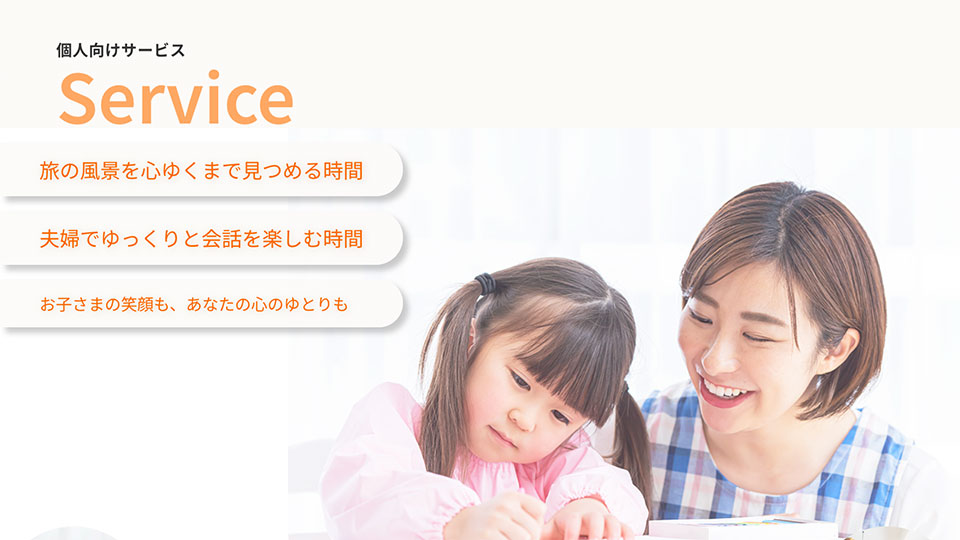 CaaS for Individuals
You were selected for the ICT Startup League this fiscal year. Please tell us about your future outlook.
Suwa: The environment where I can improve myself alongside mentors with high perspectives and fellow entrepreneurs through participation in the League has become a huge asset. Startups succeed or fail based on how well they can keep moving forward with conviction, so the existence of comrades is encouraging. In particular, the fact that we are receiving government support holds great significance in gaining trust for our B2B business.
As for our future vision, we plan to expand CaaS from major domestic cities to the entire country, and eventually look toward global expansion centered on Asia. Culturally similar Asian regions share common issues regarding declining birthrates and dual-income households. Members from Thailand have already joined our team, and we are proceeding with cross-border projects.
Finally, please give a message to those aiming to take on challenges like you.
Suwa: When I first started, I was extremely afraid of "failure." But now, I believe that "nothing is more important than failing." When things don't go as planned, that is exactly the chance to gather data, analyze it, and improve. I want you to think of entrepreneurship as a "game of how many failure experiences you can stack up" and please take on the challenge without fear.
For me, it is not "Time is Money," but "Time is Life." To make the limited time of life shine its brightest for myself and for all our users, Simplee will continue to challenge itself.
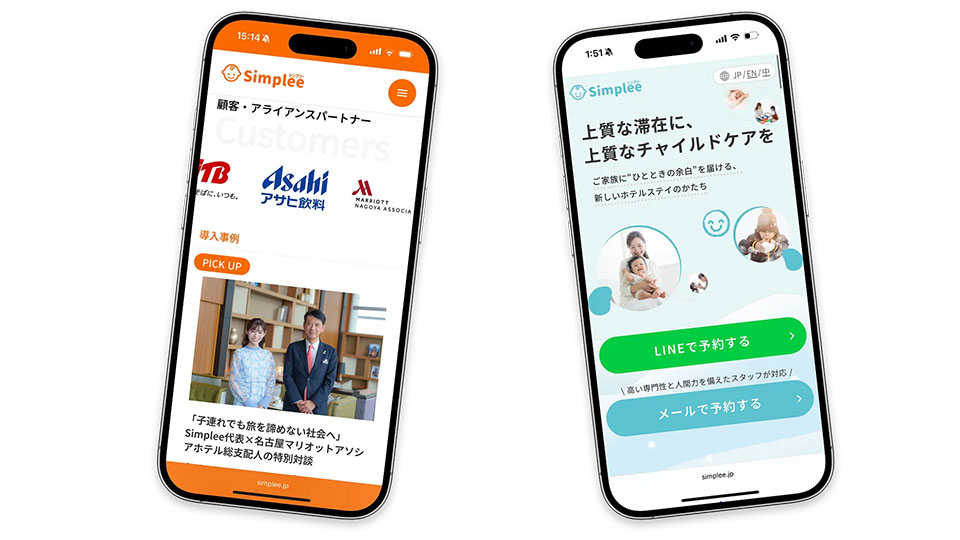 Right: Corporate CaaS Screen, Left: Individual CaaS Screen
Editor's Note
"Time is Life"—This phrase, which Ms. Suwa repeated several times during the interview, is not merely a slogan for efficiency. It is a desperate philosophy born from the experience of having her own disposable time reduced to the absolute limit due to child-rearing.
Although she is such a stoic manager, there was a moment at the end of the interview where she showed her face as a mother.
"Recently, I'm hooked on cooking with my son. Kneading hamburger patties, wrapping gyoza. It's like an extension of arts and crafts, and it becomes a good 'joint operation'."
The time spent kneading hamburger patties side-by-side with her child, for a woman who values time and moves business by the second. I felt that this is exactly the richness of "Life's Time" that she wants to protect. The "options" that Simplee expands will undoubtedly increase such warm moments in families around the world.
■ICT Startup League
A support program started in FY2023, triggered by the Ministry of Internal Affairs and Communications' "Startup Creation-type Budding Research and Development Support Business."
The ICT Startup League supports startups through four pillars.
① R&D Funding / Hands-on Support
Up to 20 million yen in research and development costs is provided in the form of a grant. In addition, through hands-on support, the selection evaluation committee members who were involved in selecting the league members will stay close after selection to promote growth. A support system akin to "fandom activities" is built, where committee members provide advice on business plans and growth opportunities to the companies they evaluated as "absolutely want to select."
② Discovery & Incubation
We provide places for learning and encounters that promote the business growth of league members.
We also deploy discovery initiatives for those aiming to start businesses in the future, aiming to expand the base.
③ Competition & Co-creation
It serves as a place for positive competition like a sports league, where startups learn together and improve themselves to win the necessary funding (up to 20 million yen). We also provide a place for co-creation where league members can collaborate to expand their businesses through various opportunities such as sessions by selection evaluation committee members.
④ Dissemination
We will disseminate the initiatives of league members in cooperation with the media! By letting many people know about the businesses, we aim to expand the field for new matching and chances.
■Related Websites
Simplee Inc.
/
Simplee Inc. (LEAGUE MEMBER)
/
ICT Startup League

a23s's "Cloud Legal" Case Study Wins "SUCCESS STORY AWARD 2025" in Governance DX Category
For more details on STARTUP LEAGUE's startup support, please see here.